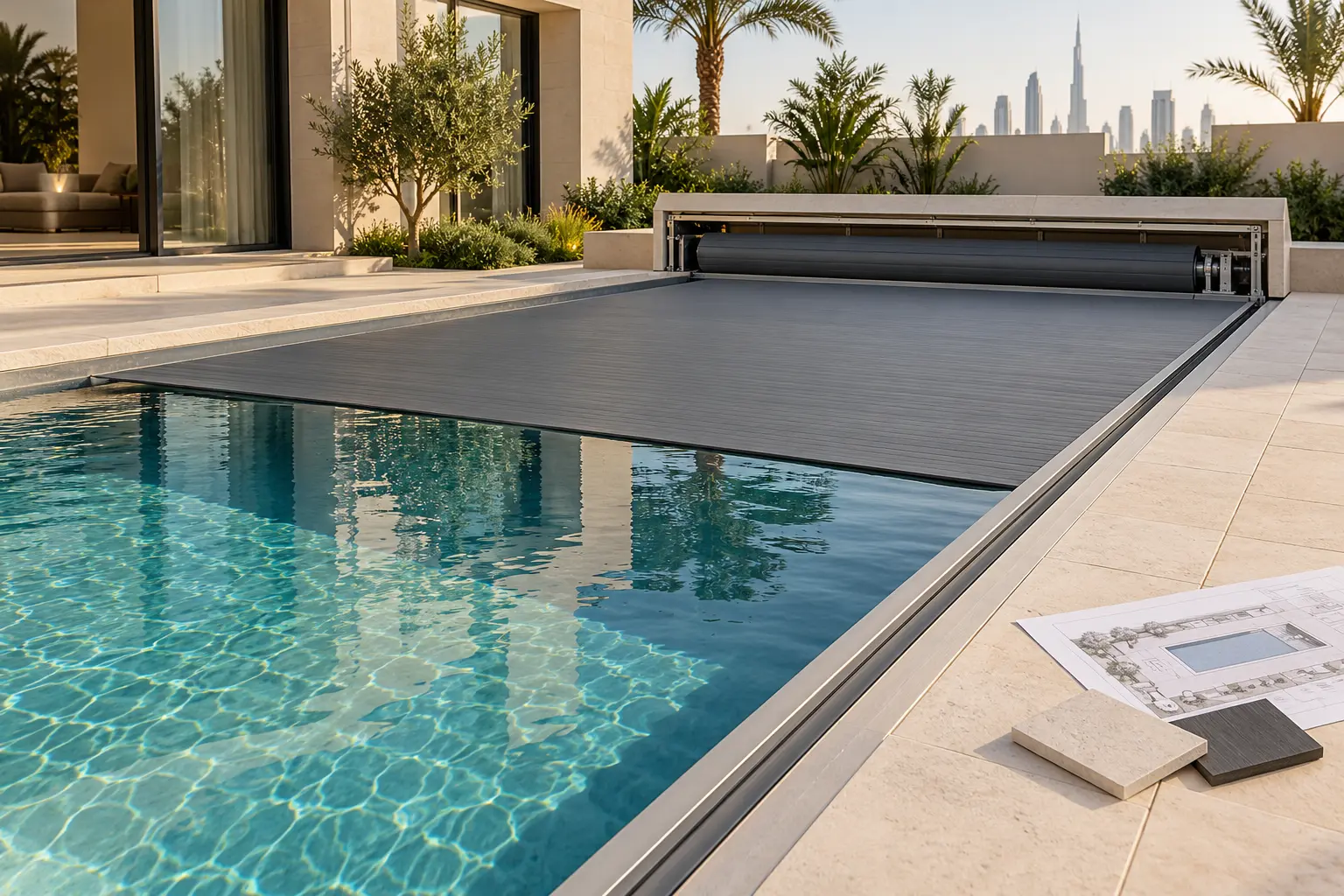
Treat an automatic pool cover as part of the pool architecture, not an accessory to add after the terrace is finished. Choose the operating objective, confirm a cover system that suits the proposed geometry, and coordinate its tracks, housing, lid, drainage, power, control position and service access on the same pool drawings. Then compare quotations against that common design basis and require a complete handover for the exact installed model.
Start with the reason for covering the pool
An automatic cover can support several objectives: convenient everyday closing, reducing debris, limiting evaporation, managing an occasionally unused pool or creating a particular visual result when the pool is closed. Write the priorities in order. A proposal optimised for discreet tracks and a stone lid may differ from one developed mainly for an existing pool or simple access to the mechanism.
A cover does not replace property-specific supervision, barriers, operating rules, water treatment or professional advice. Ask the supplier to identify the standards, certifications and operating conditions that apply to the exact offered system and region.
Fix the cover geometry alongside the pool geometry
Begin with a dimensioned plan showing the waterline, steps, raised walls, spa, sun shelf, overflow channel, infinity edge, ladders, handrails and anything crossing the cover path. Mark the cover rectangle separately from the architectural pool outline.
Coverstar's current planning information says automatic-cover tracks must be arranged in a rectangle around the pool. It also describes under-track, standard top-track and recessed top-track systems for different design conditions. This is manufacturer-specific evidence, not a universal rule for every product. Use it to understand why pool shape and cover selection must be tested together with the chosen supplier before structural drawings are released.
Compare track strategies as design routes
Ask each supplier to draw the track, drive and housing rather than naming a system in a quotation. Under-track systems can be concealed beneath or within the deck or coping construction and are commonly associated with new work. A recessed top track can sit within a prepared deck channel. A standard top track remains visible on the finished surface and may provide a route for certain existing or freeform pools. The exact applicability is decided by the selected manufacturer and installer.
Compare the effect on the pool edge. A track can influence coping width, joints, falls, channel grates, terrace build-up and cleaning access. Request plan and section details that show the actual interfaces.
Swipe or scroll horizontally to compare all columns.
| Planning route | Information to request | Decision to resolve |
|---|---|---|
| Under-track system | Track, encapsulation, coping support, housing and lid sections | Whether the new pool edge can conceal the system without compromising the intended detail |
| Recessed top track | Channel dimensions, finish tolerance, fixing zone and drainage relationship | Whether a flush-looking track remains practical to install, clean and replace |
| Standard top track | Visible track layout, drive position, fixings and deck clearances | Whether the retrofit-friendly route is acceptable visually and operationally |
| Alternative or manual cover | Storage, handling, deployment method and supported use | Whether simpler equipment better matches the actual operating brief |
| No cover provision | Expected debris, evaporation and operating routine | Whether omitting the cover is a conscious decision rather than a late discovery |
Design the housing and lid as part of the terrace
The roller and drive need a defined location at one end of the cover path. Show the internal housing, structural support, access opening, removable or hinged lid, finish above it and the route used to remove serviceable parts. The lid should be reviewed both closed and open: a beautiful stone finish is not successful if technicians cannot reach the equipment without damaging adjacent work.
Coordinate the lid with foot traffic, furniture zones and the terrace pattern. Assign the lid, finish support, lifting hardware and final surface, and record the cover installer's tolerances. Approve a representative sample and edge detail for a stone-faced solution.
Resolve water, debris and drainage around the mechanism
A below-deck housing is not merely an empty box. The team needs to coordinate how rain, wash water and pool splash are managed; how debris is removed; and how the housing can be inspected. Ask the cover supplier to state its drainage and access requirements for the selected system, then have the appointed designer and contractor incorporate them into the property-specific drainage strategy.
Do not route water by assumption or copy a detail from another site. The terrace falls, overflow or skimmer arrangement, landscape irrigation and local drain route all affect the interface. Record who keeps drains and tracks clear after handover. Coverstar's current owner guidance specifically recommends keeping dirt and debris out of the track and autocover housing, which makes access and cleaning space part of the design rather than an afterthought.
Coordinate controls, power and operation without prescribing installation
Choose the control approach with the exact system. Coverstar lists key switch, rocker switch, touchpad and touch-screen options, but availability and suitability must be confirmed for the offered product and region. On the plan, identify a proposed control position with a clear view of the entire pool and cover path. Ask how authorised operation is managed and how controls are protected from weather and unintended use.
The quotation should state the motor, controller and required service inputs, while the appointed qualified specialists assess the villa supply, isolation, routes and local requirements. Avoid turning a manufacturer diagram into a homeowner wiring instruction. Coordinate conduit and access before waterproofing, coping and terrace finishes close the routes, and request the final as-installed information at handover.
Compare complete cover quotations
Normalise the proposals before comparing totals. One quotation may include the cover fabric, tracks, drive, controls, housing, lid and installation; another may stop at the mechanism. Request the exact product family, fabric specification and colour, track type, control, drive location, compatible pool size and shape, included construction items, exclusions, delivery, installation, commissioning, training and warranty provider.
Treat appearance as a physical selection because screen swatches may not represent the final material. Review a fabric sample beside the coping and terrace finish. Ask which components remain visible after retraction.
Use this automatic-cover coordination checklist
Before the pool structure, coping or terrace package is released, confirm the following with the appointed designer, pool contractor and selected cover supplier. This is a coordination checklist, not an installation method.
- The owner priorities and intended operating routine are written in order
- The exact cover travel rectangle is shown against steps, spa, ledges, raised walls and water features
- The selected track strategy is drawn in plan and section with realistic finish tolerances
- Coping, overflow or skimmer details, terrace joints and falls are coordinated with the track
- The roller housing, drive, lid, lifting method and removal route are dimensioned
- Housing drainage, splash, cleaning and debris-removal requirements are assigned
- Motor, controller and service inputs are named for property-specific professional coordination
- The control location provides the operating view and access approach required by the selected system
- Fabric and visible component samples are reviewed with adjacent finishes
- The quotation separates equipment, enabling construction, installation, commissioning and exclusions
- Handover includes model records, operating demonstration, maintenance guidance, warranty and support contacts
Make the cover decision before edge details are frozen
The useful output is a coordinated cover sheet within the pool drawing set: design intent, cover rectangle, track and coping sections, housing and lid, drainage notes, control position, service inputs, finish selections and responsibility schedule. Attach the accepted supplier information and keep revisions under the same document-control process as the pool structure and terrace.
For a Veyrune swimming-pool construction discussion, share the proposed pool plan, edge style, terrace concept and reason for wanting a cover. The practical next step is to test suitable systems against that layout, then let the appointed supplier and project specialists resolve the selected product's exact requirements before construction fixes the pool edge.
Frequently asked questions
01Can an automatic cover be added after a pool is built?
Some systems are intended for existing pools, but the visible track, drive position, usable deck and resulting appearance may differ from an integrated new-build solution. Ask a suitable supplier to assess the exact pool and return a drawn proposal. Do not assume that cutting a channel into a finished terrace will reproduce a system designed into the coping and housing from the start.
02Does an automatic cover work with a freeform or infinity pool?
Compatibility depends on the selected system and the geometry through which the cover travels. Coverstar states that its tracks operate in a rectangular arrangement and describes different track approaches for pool shapes, including top-track and certain pool-in-pool applications. Ask the supplier to show the precise cover rectangle, uncovered water or feature zones and every affected edge before the pool design is accepted.
03Is an automatic pool cover maintenance-free?
No. Manufacturer guidance calls for keeping tracks and the cover housing clear of dirt and debris, and moving components can require service or replacement. The proposal should provide access, a cleaning method, an inspection routine, a local support route and an explanation of which tasks belong to the homeowner and which require the appointed service provider.
Sources and further reading
Coverstar: Automatic pool-cover options, track systems and controls ↗Checked Wednesday, 14 October 2026Coverstar: Owner FAQs for maintenance, debris and fabric condition ↗Checked Wednesday, 14 October 2026Latham Coverstar: Automatic cover installation and owner guidance ↗Checked Wednesday, 14 October 2026Confirm current requirements for your property and selected equipment. Product examples do not imply a supplier relationship or local availability.
This is an editorial planning guide, not a property survey, approved design or installation specification. Project requirements are confirmed by the appointed specialists.
Let’s bring it back to your home.
Explore the complete service and share a first brief for your property.
New swimming pools in Dubai