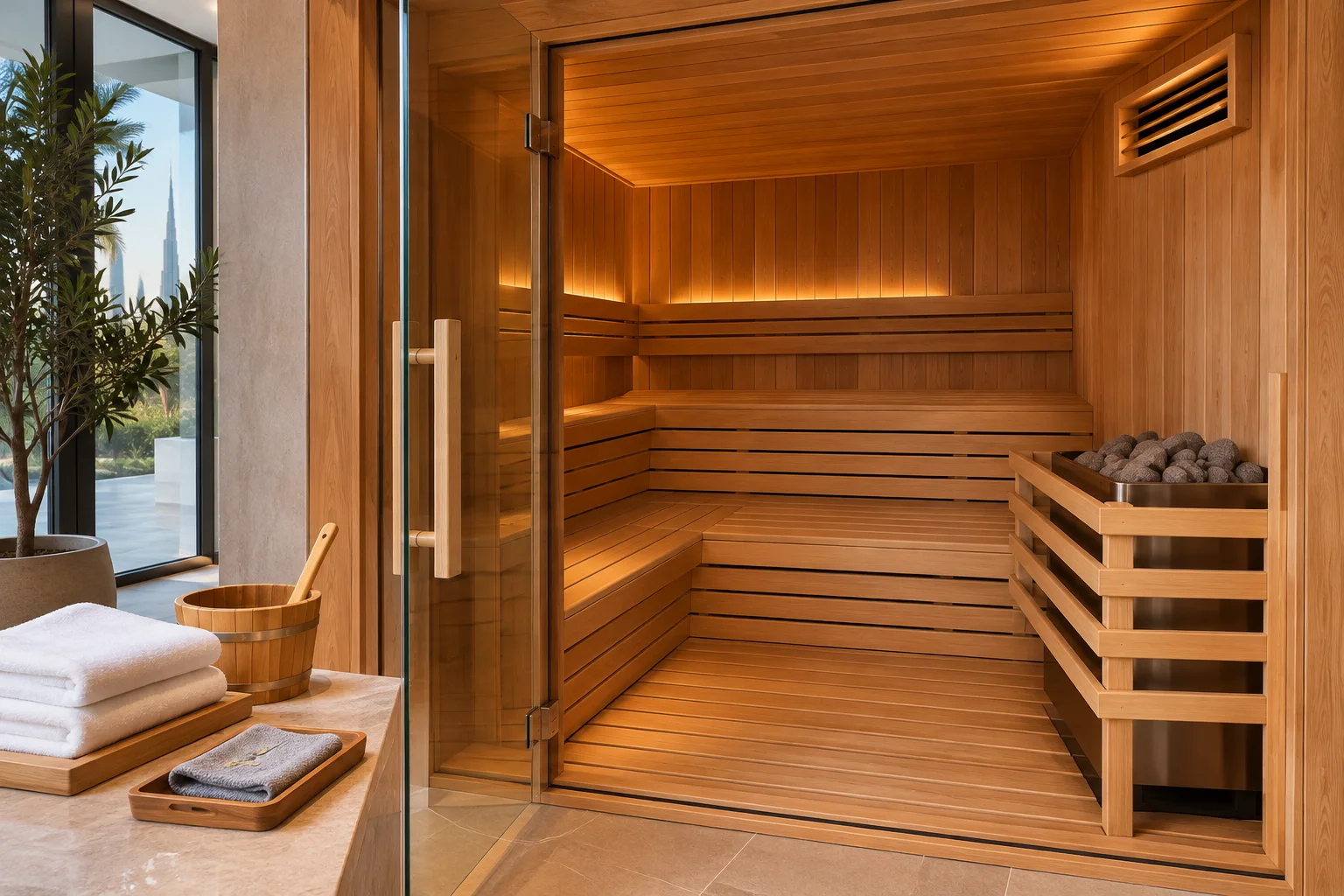
Design a home sauna around the routine after each session, not only heat-up. Ask the supplier how moisture is removed, which vent and door positions support drying, whether the heater has an approved drying cycle, and how timber, glass, floor and equipment are cleaned. Separate after-use tasks from deep cleaning and specialist maintenance. Keep the exact manuals and approved products, and investigate persistent odour, staining or slow drying rather than masking them.
Design the sauna around what happens after bathing
A dry sauna still receives water from bathers, steam created on the stones, cleaning and the adjacent shower or wellness room. Warm timber and glass may appear dry quickly while moisture remains on lower surfaces, beneath removable bench parts or near the floor. The practical design question is therefore not simply whether the room has a vent, but how the complete room is expected to dry after normal use.
Ask the sauna supplier to describe the after-use state: which vents remain open, whether the door is closed, partly open or fully open, which control mode is used and how long the room normally takes to return to a dry condition under the proposed villa environment. This answer should be tied to the selected heater, room construction and ventilation concept rather than copied from another cabin.
Separate the everyday routine from periodic maintenance
The simplest way to make care usable is to divide it into three layers. After every session, remove textiles and loose items, wipe visible water and leave the room in the approved drying configuration. At planned intervals, clean benches, backrests, glass, floor and accessible heater surfaces with the approved method. Specialist maintenance covers electrical equipment, controls, fixings, ventilation performance and any repair or component replacement.
Put the three layers on one handover sheet with the responsible person, product, method and interval. Daily household use, occasional guest use and an outdoor room exposed to dust may need different frequencies. The supplier should set the baseline and explain how use changes it.
Use manufacturer guidance as a model-specific starting point
Harvia's current maintenance guidance is a useful example of the detail a homeowner should expect. It advises removing bench covers and the water bucket, drying visible droplets, using a damp cloth, opening the air vent and leaving the door half open. For its system, it also describes keeping the heater on for approximately ten minutes to help dry wooden parts. That timing is manufacturer guidance, not a universal prescription for every sauna.
Ask the appointed supplier to provide equivalent instructions for the exact heater, controls, timber and finish. Resolve conflicting documents before handover rather than choosing the easier instruction.
Compare the handover plan through one care table
A care plan is easiest to follow when each surface and component has a defined method. Ask each bidder to complete the same table before the room is ordered.
Swipe or scroll horizontally to compare all columns.
| Area | Evidence to request | Decision to close |
|---|---|---|
| Benches and backrests | Timber, finish, approved cleaner and protective treatment | What is done after use and during deep cleaning? |
| Door and glazing | Cleaning method, seals and hardware inspection | Which product avoids residue in the heated room? |
| Floor and threshold | Cleaning route, water management and removable parts | How is dirt removed without saturating timber? |
| Ventilation | Vent positions, fan operation and drying sequence | How will the owner recognise slow or incomplete drying? |
| Heater and stones | Exact manual, visual checks and specialist service tasks | What may the owner handle only when fully cool? |
| Controls and lighting | Shutdown, drying mode and fault guidance | Which warning requires use to stop and service to be called? |
| Records | Product list, intervals and warranty contacts | Where will the current instructions be kept? |
Protect the timber without sealing in the wrong product
Sauna timber is chosen for a hot environment, but different species, profiles and factory treatments still need their own care. Bench towels can reduce direct soiling, and prompt removal helps the surfaces dry. Products such as fragrances, honey or plant material can stain timber if residue is left behind. Harvia specifically warns against lacquer on interior surfaces and recommends purpose-made substances for protection.
Ask whether the timber is untreated, heat treated, factory coated or intended for oil treatment. Test any protective product on a concealed sample because colour may deepen. Do not mix systems without written compatibility; follow the supplier's repair and warranty instructions.
Keep ventilation, door position and adjacent air coordinated
The ventilation brief should explain both bathing and drying modes. A vent that provides suitable air movement during use may need a different position after shutdown. Mechanical extract in the adjacent wellness room can also influence the direction of air through an open sauna door. The complete arrangement should be commissioned in the actual villa, not judged only from a drawing.
Dubai's climate does not remove the need for a defined drying path. Humidity, air-conditioning, dust and room location affect the surrounding conditions. Ask the specialists which air dries the room and where moisture leaves. Do not block vents or add a portable fan unless the system permits it.
Treat the heater and stones as equipment, not furniture
The heater needs the exact operating, shutdown and maintenance instructions supplied with its model. Harvia's safety guidance tells owners to keep the manual available, maintain clearances and use qualified professionals where specialist knowledge is required. It also notes that stones can break down over time and obstruct airflow through a heater. These points demonstrate why visible cleanliness is only one part of care.
At handover, define what the owner may inspect, when the heater must be cool and which work belongs to a technician. Never store towels, buckets or cleaning products on the heater or inside its clearances. Do not dry clothes in the sauna.
Investigate changes instead of masking them
A new damp smell, dark staining, persistent condensation, loose bench component, rattling fan, discoloured electrical fitting or change in heater performance deserves a recorded inspection. Note when the change occurs, which controls were active and how the room was left after use. Photographs can help the supplier understand the condition without claiming a diagnosis.
Do not mask odour with fragrance or stronger chemicals. The cause may involve ventilation, hidden moisture, cleaning or a component fault. The appointed specialist decides whether the room should remain out of use and which checks are appropriate.
Use this home-sauna drying and cleaning checklist
Ask the supplier to adapt this checklist to the selected room and demonstrate it at handover. It is not a replacement for the manuals.
- Remove bench towels, buckets and loose accessories after use
- Wipe visible water with the approved cloth or method
- Set vents, door and controls to the demonstrated drying positions
- Use a heater drying period only when the exact manual permits it
- Keep the heater safety zone free from stored items
- Allow the heater and stones to cool before permitted visual checks
- Use only cleaners approved for the timber, glass, floor and heater
- Avoid excessive water on timber and concealed construction
- Record the periodic cleaning and protective-treatment schedule
- Check removable bench parts and the floor cleaning route
- Keep ventilation openings clear and observe drying performance
- Investigate persistent odour, staining or condensation
- Retain the heater, control, lighting and ventilation manuals
- Record warranty and specialist maintenance contacts
- Demonstrate the routine to household members and guests
Make care part of the sauna proposal
A complete proposal should identify the timber and surface treatments, ventilation concept, heater and controls, cleaning products, drying sequence, removable components, maintenance intervals and handover demonstration. It should distinguish tasks the owner can perform from work reserved for qualified technicians. That makes care a design requirement instead of an afterthought.
For a Veyrune planning conversation, bring the location, expected use, preferred timber, adjacent wet-area plans and care concerns. The next step is a room-specific handover brief tied to the selected manuals before fabrication.
Frequently asked questions
01Should the sauna door be left open after every use?
Many manufacturers recommend using ventilation and leaving the door partly open as part of drying, but the exact sequence should follow the selected sauna and heater manuals. Ask the supplier to demonstrate the correct vent, door and control positions at handover. Do not assume the same routine applies to every indoor or garden sauna.
02Can ordinary household cleaner be used on sauna timber?
Use only products and concentrations approved for the selected timber and sauna system. Strong chemicals, coatings or excessive water can damage surfaces or leave residues in a heated room. Harvia, for example, specifies a mild slightly alkaline cleaner for its family-sauna guidance and warns against lacquer on interior surfaces; another supplier may give different instructions.
03What if a home sauna still smells damp after drying?
Persistent damp odour is a reason to inspect the cause, not mask it with fragrance. Record when it occurs and ask the appointed specialist to check ventilation operation, hidden moisture, drainage or floor cleaning, timber condition and the selected drying routine. Stop using the room if the supplier's manual or an observed electrical or structural condition indicates a safety concern.
Sources and further reading
Harvia Support: Maintaining Your Sauna ↗Checked Friday, 13 November 2026Harvia: Five Sauna Maintenance Tips ↗Checked Friday, 13 November 2026Harvia: Sustainable Sauna Experiences and Safety ↗Checked Friday, 13 November 2026Confirm current requirements for your property and selected equipment. Product examples do not imply a supplier relationship or local availability.
This is an editorial planning guide, not a property survey, approved design or installation specification. Project requirements are confirmed by the appointed specialists.
Let’s bring it back to your home.
Explore the complete service and share a first brief for your property.
Custom home saunas in Dubai