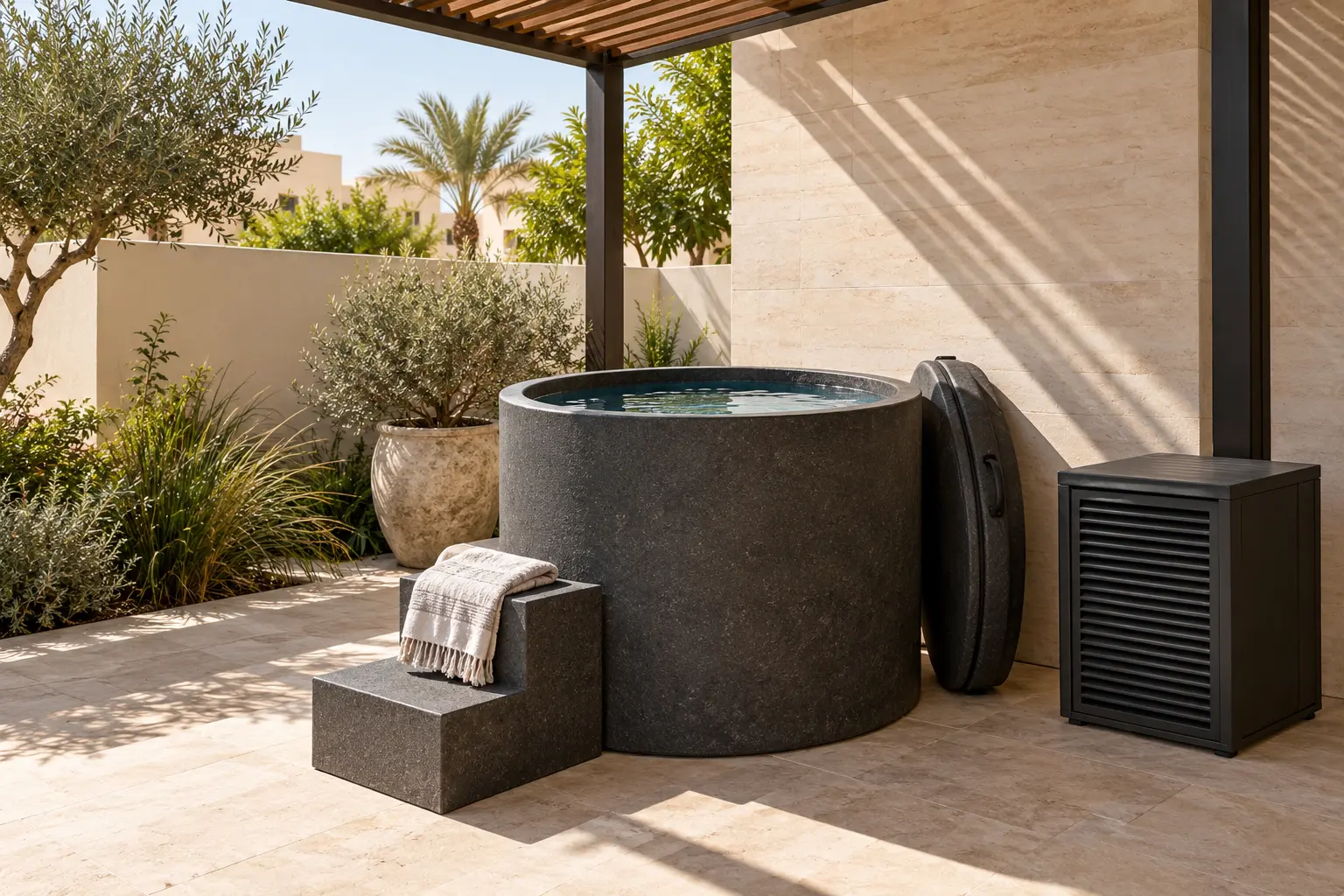
Do not select an outdoor cold plunge from its lowest advertised water temperature alone. Give the supplier a site-exposure brief, then request written evidence for the exact vessel and cooling system under the proposed shade, ambient conditions, airflow clearances, usage pattern and service arrangement.
Translate the product claim into a site question
A product page may show a minimum water setting, an outdoor-use label or a cooling-capacity figure. Those details are useful, but none proves how the complete installation will behave on a particular Dubai terrace. The supplier needs to know the vessel, water volume, starting temperature, target setting, solar exposure, surrounding air temperature, ventilation and intended use before its claim becomes relevant to the project.
Start with a one-page exposure brief. Mark the proposed tub and equipment positions on a plan, add photographs at morning and afternoon, identify existing shade and note any proposed screen or cabinet. State whether the plunge is expected to remain ready continuously or cool before planned use. The goal is not to design the refrigeration system yourself; it is to give the responsible supplier enough information to stand behind a selection.
Confirm that outdoor use means your outdoor use
Outdoor-rated is not a complete installation instruction. Ask which components may be exposed, which must remain covered, the allowed ambient range, the required weather protection and whether direct sun changes performance or warranty conditions. Confirm whether the manual supplied with the quoted unit is the current manual for that exact model and region.
Manufacturer guidance can vary substantially. Sun Home's current setup guide says outdoor use is supported, recommends a cover, requires airflow around chiller vents and notes that initial cooling depends on ambient temperature, starting water temperature and sun exposure. That is evidence for those models, not a universal rule. Your quotation should identify the product-specific limits that apply to the equipment being supplied.
Ask for a written performance basis
Request a short selection statement rather than a promise that the unit is powerful. It should identify the vessel volume, insulation and lid; the selected cooling unit; the assumed ambient condition; the target water setting; the starting condition; whether the calculation assumes shade; and the expected pull-down or steady-state behaviour. If the supplier cannot give a guaranteed cooling time, it can still disclose the assumptions and known limits.
Separate temperature setting from achieved temperature. A control panel may accept a low number even when the system cannot maintain it under every exposure. Ask what evidence supports performance at the proposed site: a published operating envelope, manual, test condition, technical selection or written manufacturer confirmation. Record any caveat about extreme conditions or recovery after several users.
Swipe or scroll horizontally to compare all columns.
| Supplier statement | What it does not prove | Better request |
|---|---|---|
| Cools to a low set point | That the set point is maintained at your site | Performance basis using stated ambient, vessel and shade assumptions |
| Suitable outdoors | That full sun or an enclosure is acceptable | Outdoor rating, exposure limits and required protection |
| High-capacity chiller | Compatibility with the quoted tub and plumbing | Complete matched-system schedule and model references |
| Quiet operation | Noise at the villa boundary or bedroom | Published test basis and proposed equipment location |
| Easy maintenance | Safe access to filters, drains and major parts | Clearance drawing and task-by-task access plan |
Design shade without trapping rejected heat
Shade can reduce direct solar gain on the vessel and equipment, but a tight decorative enclosure can create a different problem. Air-cooled equipment needs to take in and discharge air according to the manufacturer's instructions. If hot discharge air is drawn back into the intake, the equipment may operate under harsher conditions even though the cabinet looks protected.
Ice Barrel's official support guidance for high ambient air temperature tells owners to keep the air filter clean, maintain space for circulation and, where possible, shade the area from direct sunlight. Its separate chiller guidance also warns against sealed spaces with poor airflow. These are product-specific examples of the questions to ask: where are the intake and discharge, what are the minimum clearances, and has the supplier reviewed the proposed screen or cabinet?
Coordinate the filled load and base
A compact plunge occupies little floor area but becomes much heavier when filled and occupied. Ask the supplier for the dry weight, water capacity and maximum operating weight of the exact configuration, including steps, cover and service cabinet. Give that information to the appointed structural or building professional when the location is an elevated terrace, altered slab or other condition that needs review.
The base should also match the manufacturer's levelling and drainage instructions. Record finished dimensions, support points, permissible tolerances and the route for emptying the vessel without sending water toward doors, neighbouring property or equipment. A generic drawing of a tub outline is not enough to coordinate these interfaces.
Define power, water and drainage responsibilities
Ask the selected supplier to state electrical requirements, protection, connection type and allowable cable arrangement for the actual regional model. The appointed electrical professional should then assess the property connection and outdoor location. Do not infer a Dubai installation from a manual written for another voltage or plug standard, and do not hide extension leads inside a landscape detail.
Decide how the plunge is filled, topped up, drained and cleaned. Show hose routes, drain points and any overflow or condensation management on the site plan. Identify who supplies each connection and who performs final commissioning. This prevents an equipment delivery from being treated as a complete fitted installation when the surrounding services remain undefined.
Test the proposed layout against daily ownership
Walk through arrival, entry, immersion, exit, covering and cleaning. The tub needs safe access and a stable step or hand-support strategy appropriate to the selected product. The cover needs somewhere to go without blocking the chiller or becoming a trip hazard. Wet feet need a clear route to a shower, towel storage or the villa without crossing electrical equipment or a narrow coping edge.
Then review service tasks: cleaning an air filter, changing a water filter, reaching a drain, isolating power, removing a panel and replacing a large component. This guide focuses on exposure evidence, while the separate equipment-access guide develops those maintenance clearances in detail. Both should be resolved before a stone surround, screen or pergola fixes the available space.
Use this supplier-evidence checklist
Send the completed exposure brief with the quotation request and ask the supplier to answer against the exact model. Keep the response with the accepted equipment schedule.
- Exact vessel, chiller, filtration, controls and regional electrical model identified by reference
- Outdoor rating and allowable sun, weather and ambient exposure confirmed in writing
- Performance assumptions stated for vessel volume, insulation, lid, shade, use and target setting
- Air intake, discharge direction, minimum clearances and enclosure conditions shown on a drawing
- Dry weight, water capacity, filled operating weight and base requirements supplied
- Fill, drain, overflow, condensation and cleaning-water routes coordinated with the terrace
- Noise information and equipment location reviewed against nearby rooms and neighbours
- Consumables, cleaning frequency, service access and major-component removal route documented
- Commissioning checks, operating demonstration, warranty provider and support route included
Compare proposals as installed systems
Create one comparison row for every checklist item and mark each response as documented, assumed or excluded. A more expensive proposal may include the cover, filtration, commissioning and outdoor preparation that another leaves to the homeowner. Conversely, added features do not compensate for missing evidence about the site's actual conditions.
For a Veyrune cold-plunge conversation, share photographs of the proposed location, approximate dimensions, shade pattern, access route and whether a sauna or shower is part of the same project. The useful next step is a complete installed brief that the appointed supplier can verify before the vessel, services and surrounding architecture are committed.
Frequently asked questions
01Can a cold plunge be installed outdoors in Dubai?
An outdoor installation can be assessed, but suitability is product- and site-specific. Ask the supplier to confirm outdoor rating, ambient operating limits, sun and weather exposure, airflow clearances, electrical and drainage requirements, and the expected performance of the exact vessel and chiller at the proposed location.
02Does a larger chiller automatically solve high ambient heat?
Not by itself. Performance also depends on the vessel volume and insulation, lid use, starting water temperature, target setting, solar gain, ventilation, hot-air recirculation and frequency of use. Request a written selection basis for the complete system rather than relying on horsepower or another headline figure.
03Should an outdoor cold plunge be placed in a closed cabinet?
Only if the selected manufacturer permits that arrangement and its required airflow and service clearances are achieved. Cooling equipment rejects heat; a visually neat but poorly ventilated enclosure can recirculate hot air. Show the supplier the proposed cabinet and ask for written acceptance of vent areas, clearances and access.
Sources and further reading
Sun Home Saunas: Cold Plunge Setup Guide covering site support, airflow, sun exposure and outdoor use ↗Checked Tuesday, 6 October 2026Ice Barrel Support: High Ambient Air Temperature guidance for ventilation, filters and shade ↗Checked Tuesday, 6 October 2026Ice Barrel: Chiller indoor/outdoor placement and ventilation FAQ ↗Checked Tuesday, 6 October 2026Confirm current requirements for your property and selected equipment. Product examples do not imply a supplier relationship or local availability.
This is an editorial planning guide, not a property survey, approved design or installation specification. Project requirements are confirmed by the appointed specialists.
Let’s bring it back to your home.
Explore the complete service and share a first brief for your property.
Fitted cold plunges in Dubai