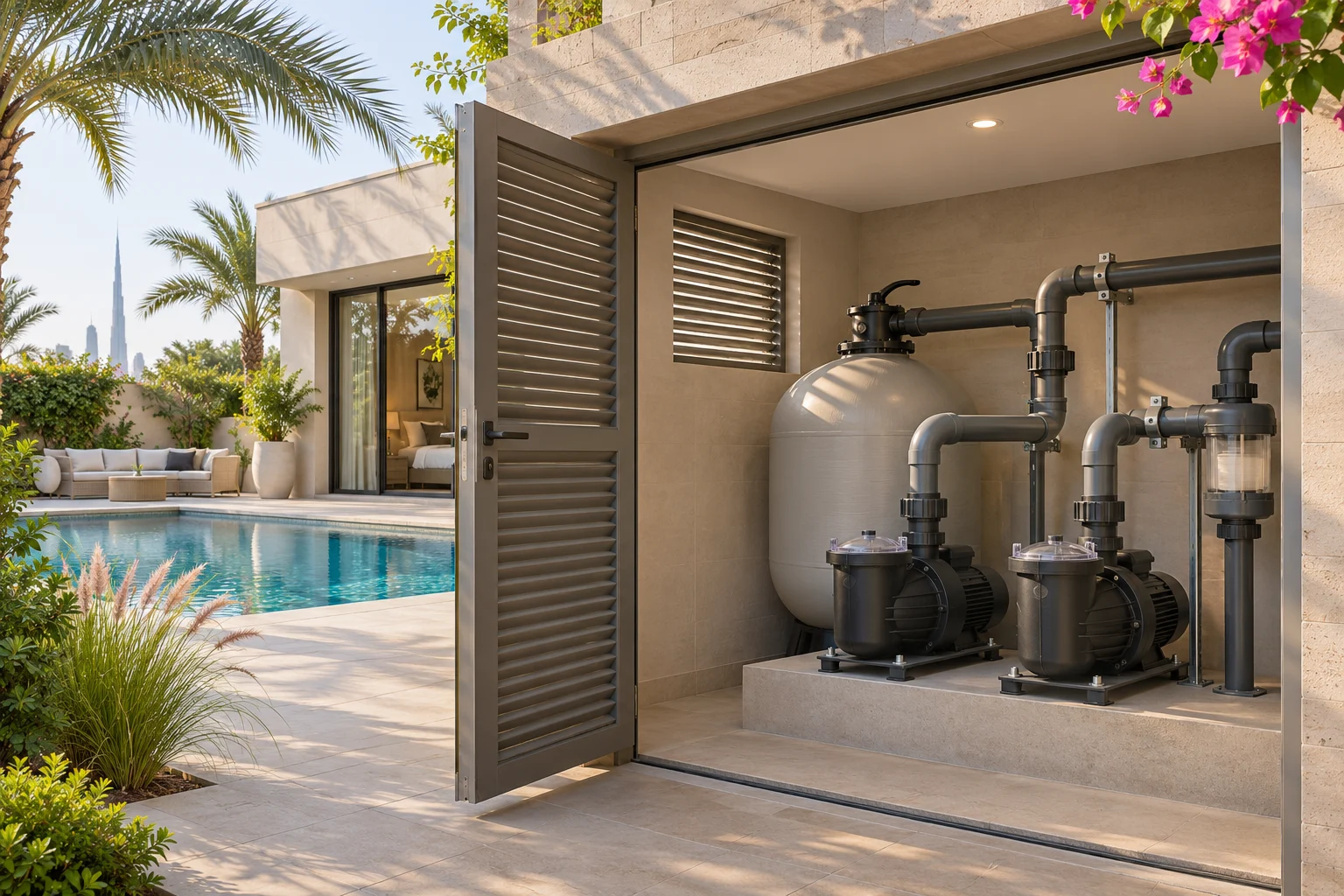
A quiet pool installation is not created by choosing one product described as silent. Start with the actual equipment schedule and operating modes, map bedrooms, seating areas and neighbouring boundaries, then coordinate plant-room location, solid equipment support, supported pipework, ventilation and service access. Ask suppliers for model-specific sound information and the conditions behind it. Commission the complete installation under realistic filtration, heating, spa and water-feature modes, record unusual vibration or tonal noise, and correct causes rather than hiding them inside an unventilated enclosure.
Plan noise before the equipment room is fixed
Pool equipment may run while people sleep, work, dine outdoors or use the garden. The useful starting point is therefore a site plan, not a pump brochure. Mark bedrooms, study areas, terraces, neighbouring plots, reflective walls and the likely plant-room position. Note which activities happen during the day, evening and night, and which pool modes must operate at those times.
Dubai Municipality's current swimming-pool plan guidance requires drawings to show the pump-room layout, equipment, pipework and electrical information. It does not turn one generic distance into a noise solution. The property, community requirements and complete selected equipment determine the review. Resolve location while a route, wall construction or landscape screen can still change without major rework.
List every sound-producing component and operating mode
The circulation pump is only one source. Heating or cooling equipment, booster pumps, water-feature pumps, air blowers, dosing systems, transformers, actuated valves and ventilation fans may all contribute. A system that is quiet in normal filtration can sound different during high-flow cleaning, spa jets, backwashing or a waterfall sequence.
Create an equipment schedule with manufacturer, model, duty, proposed speed or flow range, operating hours and location. Ask for sound data with the measurement condition, distance and operating point where available. A single headline decibel value is not a property prediction. It may describe one product in a controlled condition and omit other equipment, reflections, ventilation openings or pipe-borne vibration.
Compare proposals through one noise-control table
Give each bidder the same receivers, equipment schedule and operating scenarios. The comparison should show how noise and vibration are managed without compromising heat rejection, water safety, drainage or service access.
Swipe or scroll horizontally to compare all columns.
| Planning item | Evidence to request | Decision to close |
|---|---|---|
| Sensitive locations | Plan showing bedrooms, terraces, boundaries and plant-room openings | Which receivers and operating periods control the design? |
| Equipment | Exact models, duties, modes and model-specific sound information | Is the evidence relevant to the proposed operating point? |
| Mounting | Base, fixing and any manufacturer-approved isolation arrangement | How are equipment weight and vibration transferred to the structure? |
| Pipework | Route, supports, flexible connections where specified and hydraulic assumptions | Could strained or poorly supported pipework transmit noise? |
| Enclosure | Wall, door, louvre, ventilation, drainage and access concept | Can noise treatment coexist with cooling and safe maintenance? |
| Commissioning | Agreed operating scenarios, observations and corrective responsibility | How will the installed system be checked before handover? |
Choose equipment from duty evidence, not the quietest claim
Variable-speed pumps can match different circulation requirements without operating at one fixed speed. Pentair's current product information promotes quieter performance at lower average operating speeds, while its installation manuals also connect mechanical noise with mounting, pipe support and suction conditions. That combination illustrates why the product and system must be assessed together.
Ask the hydraulic designer to state the required operating points for filtration and each feature. The selected pump should be compared at those duties, not only at its quietest setting. Oversizing a pump and throttling it, or forcing high speed through restrictive pipework, is not a documented noise strategy. The appointed specialists determine pipe sizes, velocities, fittings and equipment selection for the actual design.
Coordinate the base, supports and pipe routes
The equipment base should be stable, level and compatible with the selected products. Pentair installation guidance for several pumps calls for a secure concrete platform for quiet performance and warns that inadequately supported suction or discharge pipework can strain the pump. Treat that as manufacturer guidance for those products, not a universal detail to copy without review.
Show where pipes attach to walls, floors and equipment, and avoid using the pump casing to carry pipe loads. Structural transmission can make a modest source more noticeable inside the villa. Any isolation mounts or flexible connectors must be selected for the actual equipment, load, movement, water service and manufacturer's instructions; a generic rubber pad is not an engineered specification.
Keep ventilation and acoustic treatment compatible
A plant room needs the environmental conditions required by the equipment. Heat pumps, pump motors, drives and chemical systems may need airflow and clearances. Dubai Municipality guidance also expects pump-room layout and ventilation to be addressed. Closing every opening can raise temperature, shorten equipment life or make the room unsafe to service.
Ask the responsible specialists to coordinate doors, louvres, fans, weather protection, drainage and acoustic performance as one enclosure. Place openings thoughtfully relative to sensitive areas, but do not obstruct the manufacturer's airflow path. Materials inside a humid plant space must be appropriate for the environment and must not conceal leaks, controls or required access.
Use controls and schedules without compromising water care
Operating schedules can move some higher-load activities away from quiet periods, but water quality and equipment requirements come first. Identify normal filtration, heating or cooling recovery, spa use, water features, cleaning and backwash separately. Agree which modes can be scheduled and which must respond automatically to system needs.
A control proposal should name the programmed modes, time windows, overrides and handover demonstration. Do not simply switch equipment off to solve a complaint if doing so conflicts with circulation, treatment or manufacturer requirements.
Commission the sound of the complete system
Commissioning should operate the actual equipment through the scenarios agreed in the brief. Listen at the plant room, nearby terrace and relevant indoor or boundary positions. Record which pumps, fans, valves, heaters and features were active, their settings, doors and louvres, and any unusual vibration, rattle, cavitation or tonal sound.
If a formal acoustic assessment is required, the appointed acoustic specialist defines the method, instruments and acceptance basis. A phone application is not a substitute for calibrated evidence. Close obvious defects before handover, then retain the final equipment schedule, control settings and maintenance instructions so a future change in sound can be compared with the commissioned condition.
Use this quieter plant-room briefing checklist
Complete the checklist before approving the plant-room layout and revisit it when equipment changes. It is a coordination tool, not an acoustic or hydraulic design.
- Mark bedrooms, terraces, boundaries and reflective walls on the site plan
- List every pump, fan, heater, cooler, blower and dosing component
- Define normal, cleaning, spa, water-feature and backwash modes
- Request exact models and relevant sound information with test conditions
- Confirm hydraulic duties rather than comparing headline pump size
- Show a stable equipment base and manufacturer-compatible fixing
- Coordinate pipe supports so equipment does not carry pipe loads
- Identify any proposed vibration isolation and responsible designer
- Coordinate doors, walls, louvres and fans with ventilation needs
- Keep drains, controls, filters and service panels accessible
- Agree operating schedules without compromising water care
- Define realistic commissioning scenarios and observation points
- Record final settings, manuals and corrective responsibilities
- Escalate formal noise assessment to a qualified acoustic specialist
Turn the brief into a comparable pool proposal
A complete proposal should name the equipment basis, plant-room location, ventilation concept, mounting and pipe-support responsibilities, controls, commissioning and exclusions. It should separate product marketing from project evidence and identify any property or community review that remains. Ask every bidder to address the same scenarios so omissions are visible.
For a Veyrune new-pool planning conversation, bring the villa and garden plan, preferred pool features, likely plant-room positions and rooms or terraces that need particular protection from equipment noise. The next step is a coordinated layout and equipment review with the appointed specialists before structure, walls and service routes are fixed.
Frequently asked questions
01Is a variable-speed pool pump always quiet?
Not in every installation or operating mode. Variable-speed equipment can operate more quietly at lower speeds, but noise also depends on the selected duty, hydraulic resistance, mounting, pipe support, ventilation, equipment condition and the listener's position. Compare model-specific evidence and commission the complete installed system rather than relying on a product label.
02Should a noisy pool pump be enclosed in a sealed box?
Do not assume a sealed box is safe or effective. Pool pumps, controls, chlorination equipment and heating or cooling equipment can require ventilation, drainage, clearances and service access. An enclosure that traps heat or blocks maintenance may create a new problem. The appointed equipment, mechanical and acoustic specialists should coordinate any treatment with the exact products and plant-room conditions.
03What should be checked if pool equipment suddenly becomes louder?
Treat a change in sound as an operating symptom. Record which equipment and mode were active, then stop use if the manufacturer guidance identifies a fault or unsafe condition. A qualified pool specialist can check issues such as debris, air entry, cavitation, loose or strained pipework, bearings, mounting and blocked ventilation. Do not dismantle powered equipment or bypass protective controls.
Sources and further reading
Dubai Municipality: Technical Guidelines for Approval of Swimming Pool Plans ↗Checked Thursday, 12 November 2026Pentair: IntelliFlo Variable Speed Pump Installation and User's Guide ↗Checked Thursday, 12 November 2026Pentair: IntelliFlo3 Variable Speed and Flow Pool Pump ↗Checked Thursday, 12 November 2026Pentair: WhisperFlo VST Installation and User's Guide ↗Checked Thursday, 12 November 2026Confirm current requirements for your property and selected equipment. Product examples do not imply a supplier relationship or local availability.
This is an editorial planning guide, not a property survey, approved design or installation specification. Project requirements are confirmed by the appointed specialists.
Let’s bring it back to your home.
Explore the complete service and share a first brief for your property.
New swimming pools in Dubai