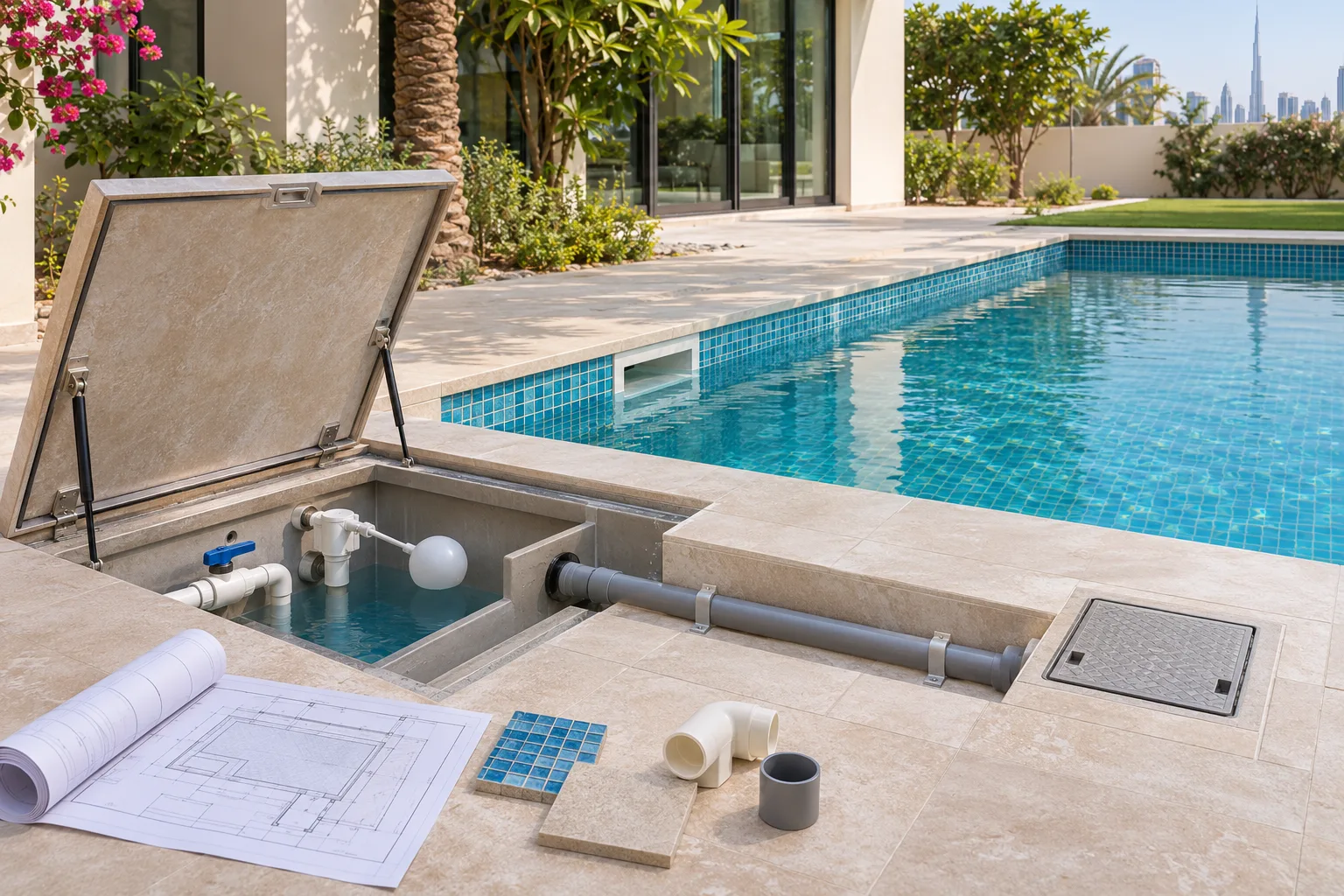
A complete pool water-level proposal identifies the normal operating level, low-level response and high-level overflow point; separates make-up water from overflow and backwash routes; names the control method and its failure safeguards; and preserves access for isolation, testing and maintenance. Automatic filling is a convenience, not proof that a pool is leak-free. Ask the appointed pool, plumbing and drainage specialists to coordinate the actual water source, protection, overflow destination and approvals for the property before construction.
Define three water levels before selecting hardware
Start with a section through the pool that marks the intended normal operating level, the point at which make-up water is requested and the highest level at which overflow is relieved. Relate those marks to the skimmer opening, tile line, coping, overflow channel or balance tank that actually governs the chosen pool. A list of valves and sensors without these references cannot show whether the components will control the intended water surface.
Also state what level is acceptable when the circulation system is off and what changes when bathers enter, rainfall occurs or water moves between a pool and balance tank. These are design questions for the appointed specialist, not fixed universal dimensions. The useful owner deliverable is a coordinated drawing that lets the pool builder, plumber, drainage designer and controls supplier work from the same level references.
Separate make-up water from unexplained water loss
A pool loses some water through splash-out, cleaning and environmental conditions, but an automatic filler cannot determine the cause by itself. It only reacts to a lower sensed level. If it runs frequently, the extra water can hide a leaking pipe, shell, fitting or valve while increasing treatment demand. A good proposal therefore includes a visible isolation point and a method of reviewing abnormal fill behaviour.
Ask whether the controller can limit a single fill period, lock out after an abnormal condition, record activity or issue an alert. Fluidra's UNIK regulator manual describes a safety function intended to stop the fill valve remaining open when a pool or component has a permanent leak. That is a product-specific example, not a requirement satisfied by every controller. The proposal should name the actual safeguard supplied and how it will be tested at handover.
Choose a control method that can be maintained
A mechanical float valve can be simple and directly visible in a leveler chamber. An electronic system can separate the sensor from the fill valve and may offer high-level or timed protection. A perimeter-overflow pool may instead control water through a balance tank with multiple level functions. Each approach can be appropriate when it matches the hydraulic design, installation environment and maintenance plan.
Pentair's T40-F instructions show an adjustable float in a dedicated leveler bucket, a fresh-water connection and a separate overflow connection. Jandy's K2000 product information describes an electronic leveler with a high-level switch for perimeter-overflow and vanishing-edge applications. Use these as examples of the decisions that must be explicit. Do not treat an illustration from one product as permission to mix components from unrelated systems.
Compare proposals through one evidence table
Issue the same pool section and hydraulic concept to each bidder. The comparison should expose missing interfaces before pipes disappear below a deck.
Swipe or scroll horizontally to compare all columns.
| Proposal item | Evidence to request | Decision to close |
|---|---|---|
| Level references | Section marking normal, fill-start and overflow levels | Which component controls each level? |
| Make-up source | Named supply, isolation and required protection review | Who approves the connection for this property? |
| Control method | Float, sensor, controller and valve schedule | How can the system be tested and serviced? |
| Failure safeguards | Timeout, lockout, alarm or monitoring description | What happens after abnormal filling or sensor failure? |
| Overflow route | Pipe reference, capacity basis and intended destination | Who confirms the route and any approval? |
| Backwash separation | Distinct equipment-waste route on the drawings | Are overflow and maintenance flows clearly differentiated? |
| Handover | Commissioning record, settings, photos and instructions | What evidence will help detect later change? |
Coordinate the incoming water connection
The drawing should name the proposed make-up-water source, pipe responsibility, isolation valve and point of discharge into the level-control arrangement. It should also identify who confirms any required backflow or contamination protection, pressure control and local plumbing requirements. These are not details for a homeowner or pool finisher to improvise from a generic online diagram.
Keep the supply connection inspectable. If the valve, strainer or protection device is concealed behind fixed paving, future testing can require destructive work. Where a deck-level chamber is proposed, coordinate its lid, drainage, structural support and surrounding finish. The chamber should not become a stagnant, inaccessible pocket or an unmarked trip point.
Draw overflow and backwash as different systems
Overflow is a response to water above the intended high level, which may result from rainfall, displacement or a control fault. Backwash and equipment waste are deliberate maintenance flows. Combining labels such as 'waste/overflow' on one dashed line obscures which condition the route was sized and approved to receive. Ask for separate references, even if an appointed drainage specialist later coordinates a permitted common destination.
The proposal should show the overflow inlet level, continuous fall or other designed conveyance, inspection points and intended destination. It must not assume that a landscape bed, road gully, sanitary connection or storm system is acceptable merely because it is nearby. Confirm capacity, routing and permissions for the actual property before closing the deck.
Keep level-control equipment accessible
A float can foul, a sensor can need cleaning and an isolation valve can require operation. Show how the lid opens, where a technician stands and which components can be removed without disturbing coping or a glass barrier. Avoid placing the access point beneath heavy furniture, fixed planters or a cover-storage path. For a balance tank, coordinate the level devices with safe inspection and the wider plant-room access plan.
The accompanying image is a construction process illustration. It deliberately makes the skimmer waterline, level-control chamber and separate pipe route visible for discussion; it is not an approved hydraulic detail or evidence of completed Veyrune work. The installed layout must follow the selected equipment, property structure and appointed designers' documents.
Commission normal, low and high-level responses
Handover should demonstrate more than water appearing at the correct tile. Record the final level marks and verify the fill-start and fill-stop responses under the equipment supplier's procedure. Confirm that isolation works, the overflow path is unobstructed and any timeout, lockout, alarm or high-level switch produces the documented result. Do not create a flood or run equipment outside its instructions simply to prove a point.
Retain the controller settings, float adjustment reference, valve model, photographs and as-built pipe labels. Explain what the owner should observe rather than encouraging enclosure opening or valve adjustment. Repeated filling, a changing waterline, an alarm or water appearing at an unintended outlet should trigger review by the appropriate pool or plumbing specialist.
Use this make-up-water and overflow checklist
Close these items before the pool deck and service chambers are completed. This is a project-briefing and proposal-comparison checklist, not a do-it-yourself plumbing method.
- Mark normal, fill-start and overflow levels on one coordinated section
- Relate those levels to the selected skimmer, edge or balance-tank concept
- Name the make-up source, isolation point and responsible plumbing designer
- Identify required connection protection without assuming a generic detail
- Select and document the float, sensor, controller and fill valve
- State the abnormal-fill timeout, lockout, alarm or review method
- Draw overflow separately from filter backwash and equipment waste
- Confirm the intended drainage destination and property-specific approvals
- Preserve safe access to sensors, floats, valves and inspection points
- Handover settings, test records, pipe labels, photographs and owner guidance
Frequently asked questions
01Does an automatic pool filler prove that the pool is not leaking?
No. It replaces water when the sensed level falls, regardless of whether the loss came from normal operation or an unresolved defect. A proposal should include a practical way to isolate the make-up supply, review unexpected demand and investigate unexplained level change. Automatic filling should not be allowed to conceal continuing water loss.
02Is a pool overflow pipe the same as the filter backwash waste line?
No. Overflow manages water above the intended high level, while backwash or equipment-waste flow comes from maintenance and may have different flow, routing and approval requirements. Draw and label the routes separately, identify their intended destinations and have the appointed specialists confirm the property-specific arrangement.
03Should skimmer and perimeter-overflow pools use the same level-control arrangement?
Not automatically. A skimmer pool usually controls level in relation to the skimmer opening, while a perimeter-overflow or vanishing-edge pool typically coordinates the pool edge, collection channel, balance tank and tank controls. Compare the proposal with the selected hydraulic concept and equipment instructions rather than copying one generic detail.
Sources and further reading
Pentair: Automatic Pool Filler T40-F Installation and User Guide ↗Checked Thursday, 19 November 2026AstralPool / Fluidra: UNIK Level Regulator Installation and Maintenance Manual ↗Checked Thursday, 19 November 2026Jandy: Levolor K2000 Water Leveling System ↗Checked Thursday, 19 November 2026Confirm current requirements for your property and selected equipment. Product examples do not imply a supplier relationship or local availability.
This is an editorial planning guide, not a property survey, approved design or installation specification. Project requirements are confirmed by the appointed specialists.
Let’s bring it back to your home.
Explore the complete service and share a first brief for your property.
New swimming pools in Dubai