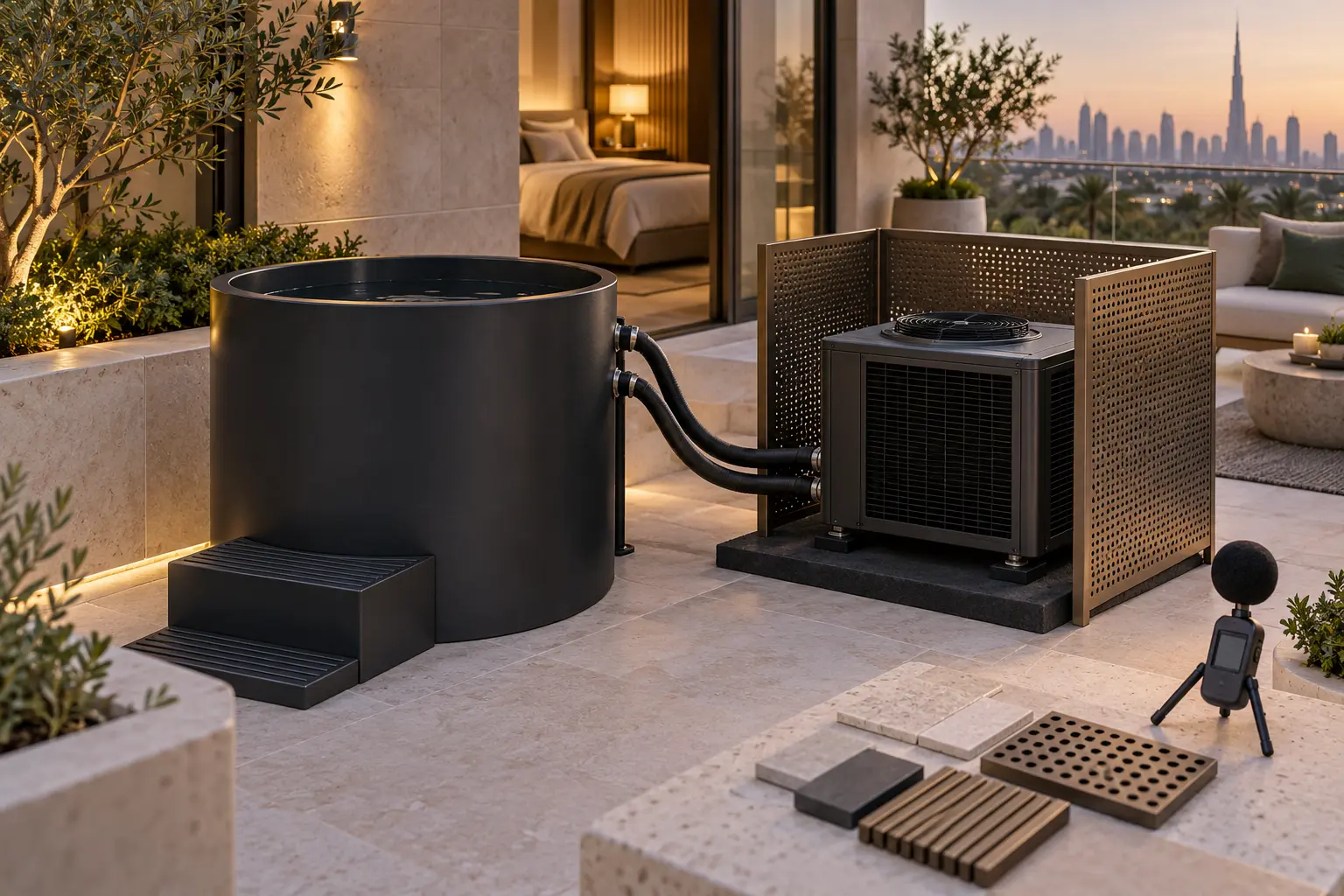
Plan the cold-plunge tub, chiller, pipe route, airflow, vibration control and nearby sound-sensitive rooms as one system before finishes are fixed. Request model-specific sound data and operating conditions, then compare an integrated unit, an adjacent screened chiller and a remote service-zone arrangement. Do not seal a heat-rejecting chiller inside decorative joinery: follow its installation manual, protect required airflow and retain safe service access.
Plan sound before selecting the equipment corner
A refrigerated cold plunge is not silent. Depending on the system, users may hear a compressor, condenser fan, circulation pump, moving water and occasional changes in operating state. The same unit can be acceptable in a daytime garden zone yet intrusive beside a bedroom at night. The right question is not whether chillers make noise, but how the selected model, location, enclosure and operating pattern will affect this property.
Mark the plunge and plausible equipment locations on a plan, then add bedroom windows, quiet rooms, outdoor seating, neighbour-facing boundaries and reflective walls. Record intended use periods and any verified community constraints. This receiver map is more useful than choosing the shortest pipe route alone.
Request sound evidence that can be compared
Ask for the selected model's published sound data and conditions: sound pressure or sound power, measurement distance, test environment, operating state and whether circulation equipment is included. Ask about start-up, temperature pull-down and steady maintenance. A number without conditions cannot be compared fairly.
Sun Home publishes a model-specific example of 55–60 dB for its Standard Chiller and explains that compressors and fans make sound. That figure is evidence for that product in the context stated by its manufacturer; it is not a universal cold-plunge value, a Dubai limit or a prediction at a property boundary. The useful lesson is to question a proposal when no acoustic information is supplied.
Compare locations as complete systems
Each location trades visual simplicity, pipe length, airflow, access and acoustic separation differently. Use the table to structure design questions, then check every option against the selected equipment manual and property conditions.
Swipe or scroll horizontally to compare all columns.
| Arrangement | Potential advantage | Questions to resolve |
|---|---|---|
| Integrated chiller and tub | Compact package and fewer exposed connections | Published sound, heat-discharge direction, access to internal components, vibration path through the tub and replacement route |
| Adjacent chiller behind a ventilated screen | Short pipe route and deliberate visual control | Clear intake and exhaust, screen reflections, isolation, drainage, weather protection and panel removal for service |
| Remote outdoor service zone | Greater separation from the plunge and seating | Approved pipe length and lift, heat gain, insulation, pump duty, controls, leak visibility and access to the full route |
| Indoor plant cupboard | Weather protection and concealed equipment | Manufacturer permission, engineered ventilation and heat rejection, condensate or drainage, acoustic lining, fire and electrical requirements, and service clearance |
Keep airflow separate from visual concealment
A chiller removes heat from the water and rejects it to the surrounding air. Restricting the intake or letting hot exhaust recirculate can undermine operation. Sun Home's current Cold Plunge Pro setup instructions publish specific vent clearances and service access for that exact model. Ice Barrel likewise tells owners to keep its chiller vents unobstructed, provide the specified clearance, place it on a level surface and consider shade. Always use the requirements for the equipment actually proposed.
A screen can be useful, but draw airflow through it rather than labeling a solid box as ventilated. Show intake and discharge, free area, wall distance, removable panels, filter access and the service zone. Confirm any louvres, perforations or acoustic treatment with the equipment supplier and relevant specialist.
Separate airborne sound from vibration
Airborne sound travels from fans, compressors, pumps and water through openings and around screens. Structure-borne vibration travels through feet, brackets, pipework, slabs and rigid panels before another surface radiates sound. A screen that blocks a direct line of sight may change some airborne sound, but it will not fix a rigid vibration bridge. Conversely, soft feet alone do not stop fan noise.
Ask the supplier or acoustic adviser to review equipment mass, support and proposed mounting before choosing isolators. Keep flexible connections and pipe supports within the manufacturer's requirements. Avoid unsupported hoses or improvised soft materials. The plinth should remain level, stable, drainable and accessible.
Use Dubai heat as an operating-case question
Hot ambient conditions, solar gain, warm make-up water, exposed pipework and frequent lid opening can increase the cooling demand or running time. Longer operation can make otherwise modest equipment more noticeable. Ice Barrel's high-ambient guidance directs users to maintain airflow, clean the filter, remove obstructions and add shade where appropriate for its product. It is a practical reminder to test the proposal against the intended outdoor environment.
Ask for the permitted ambient range, cooling capacity at relevant conditions, pull-down assumptions, insulation, cover requirements and pipe limits. Do not infer Dubai summer performance from an unspecified headline capacity. A larger machine is not automatically quieter; compare sound, airflow and duty with thermal selection.
Coordinate the tub and water circuit
The plunge should be a compact, deep immersion vessel with safe access, not a miniature swimming pool. Confirm user position, entry support, water depth, displacement behavior and surrounding drainage. Locate suction and returns according to the selected system or specialist design, with guards and user safety addressed by appointed professionals.
A remote chiller introduces a pipe route that must be sized and insulated for the proposed system. Draw valves, unions, filter access, drains, leak-visible joints, low points and winterisation or long-idle procedures if applicable. Do not bury all connections behind fixed stone. The installer should be able to isolate and remove equipment without demolishing the terrace or emptying water into an uncontrolled area.
Agree an operational brief without promising silence
Record likely use times and when nearby rooms need quiet. Some equipment offers scheduling or operating modes, but their effect on temperature maintenance is model-specific. Confirm them from the proposed controls rather than assuming a generic night mode.
For a sensitive property, appoint an acoustic specialist to establish appropriate project criteria and prediction methods. Community or authority requirements should be checked by the responsible consultant. This guide does not invent a decibel limit. A credible proposal identifies the receivers, equipment evidence, control assumptions and verification plan instead of guaranteeing that a chiller will be inaudible.
Use this chiller-noise planning checklist
Send the same checklist to each bidder so the decision is based on an installed system, not a product photograph.
- Identify bedrooms, quiet rooms, seating areas and neighbour-facing boundaries
- Record intended plunge use times and temperature strategy
- Name the exact tub, chiller, pump and filtration models
- Provide sound data with distance, operating state and test conditions
- State the permitted ambient range and relevant cooling performance
- Draw intake and exhaust directions with model-specific clearances
- Show the full pipe route, insulation, valves, unions and leak-visible joints
- Define the equipment support and vibration-isolation basis
- Detail any screen, free area, removable panels and acoustic treatment
- Retain filter, drain, electrical and service access
- Confirm weather, sun, rain and wash-water protection
- Agree commissioning observations at the actual receivers
Verify the installed result before closing the work
Commission the plunge in realistic operating states: initial pull-down where practical, steady cooling, circulation and any normal control transitions. Listen at the plunge, nearby seating, bedroom openings and relevant boundary positions. Check for rattles, rigid pipe contact, screen resonance, recirculating hot air and blocked filters. If formal acoustic criteria apply, use the agreed specialist measurement method rather than a phone application as acceptance evidence.
For a Veyrune cold-plunge discussion, share the proposed location, nearby-room plan, photographs, usage times, desired temperature range and any shortlisted equipment. The next useful output is a comparison of viable chiller locations with model-specific airflow, sound, pipe and access evidence, followed by coordinated installation details and a property-specific commissioning record.
Frequently asked questions
01How loud is a cold-plunge chiller?
There is no reliable single figure for every chiller. Ask for the selected model's sound-pressure or sound-power data, measurement distance, operating mode, ambient conditions and whether pumps and fans are included. One manufacturer's published example is not a specification for another product or a prediction at your bedroom or boundary.
02Can the chiller be hidden inside a cabinet?
Only if the selected manufacturer permits that installation and the designed enclosure maintains all required intake, exhaust, clearance, drainage and service provisions. A visually closed cabinet can recirculate hot discharge air, restrict maintenance and amplify noise. Use a coordinated ventilated screen or purpose-designed plant space instead of assuming decorative joinery is harmless.
03Will rubber feet make a cold plunge silent?
No. Suitable isolation can reduce some structure-borne vibration when it is selected for the equipment and support, but airborne compressor, fan, pump and water noise remain. Pipe connections, rigid screen panels and the supporting slab can also create transmission paths. Review the complete installed system and verify it in operation.
Sources and further reading
Sun Home: Cold Plunge Pro Setup and Installation ↗Checked Monday, 2 November 2026Sun Home: Cold Plunge Tubs with Built-In Chillers — Buyer Guide ↗Checked Monday, 2 November 2026Ice Barrel: Optimal Placement for Your Ice Barrel Chiller ↗Checked Monday, 2 November 2026Ice Barrel: High Ambient Air Temperature ↗Checked Monday, 2 November 2026Confirm current requirements for your property and selected equipment. Product examples do not imply a supplier relationship or local availability.
This is an editorial planning guide, not a property survey, approved design or installation specification. Project requirements are confirmed by the appointed specialists.
Let’s bring it back to your home.
Explore the complete service and share a first brief for your property.
Fitted cold plunges in Dubai