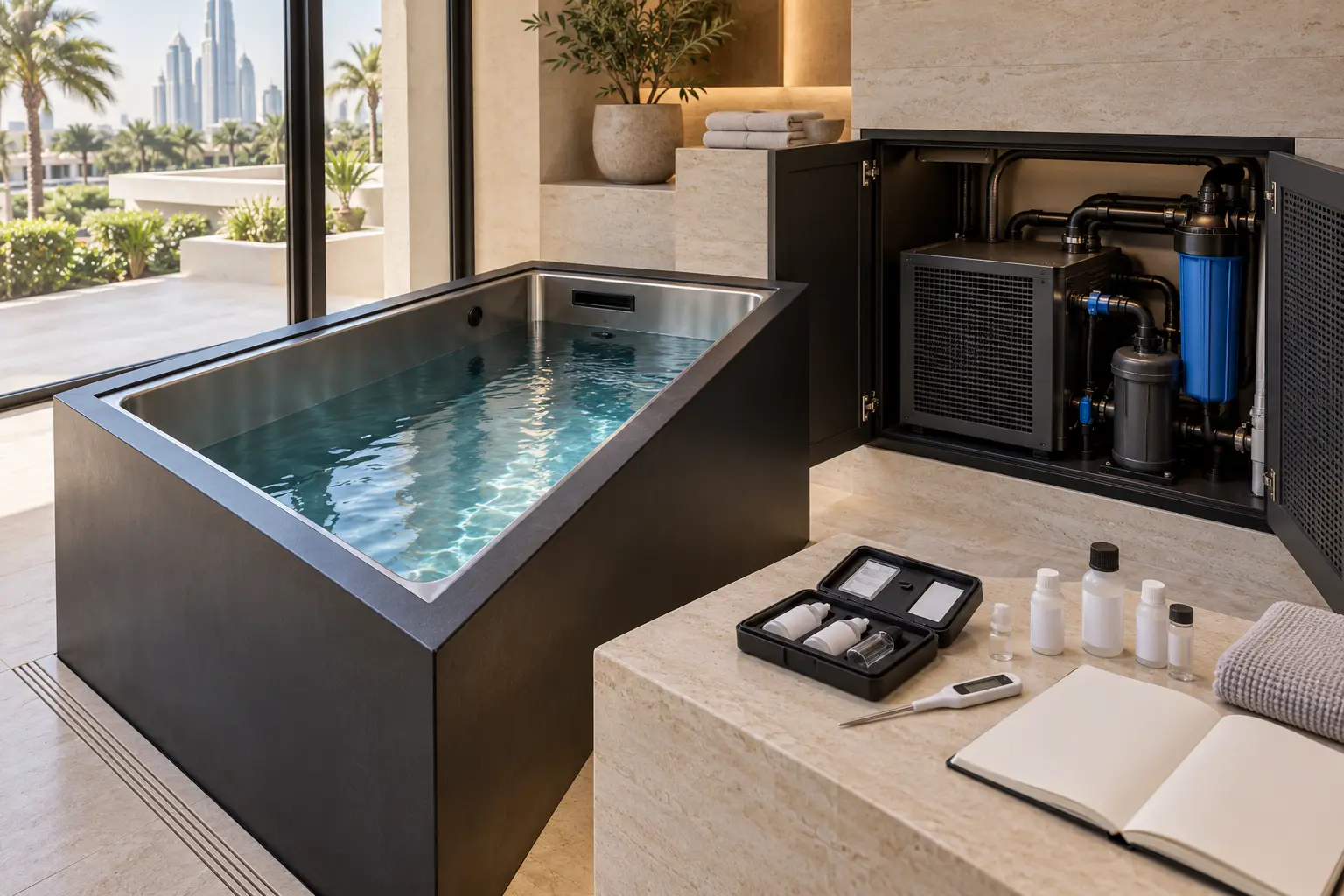
Commission the fitted cold plunge as one installed system, not as a tub and chiller that merely switch on. Record the exact vessel and equipment, confirm the site and connections against their current manuals, observe circulation and leaks, establish a temperature and water-care baseline, demonstrate routine tasks and hand over model-specific support and warranty information. The selected supplier and appointed specialists must define the actual acceptance criteria.
Commission the complete installed system
A cold plunge is ready for handover only when the vessel, circulation, cooling, filtration or treatment components, controls, site services and surrounding construction work together as intended. A chiller display lighting up does not prove correct flow, leak-free connections, suitable equipment access, stable operation or an understandable water-care routine.
Agree the commissioning plan before the installation is boxed in. It should name the responsible installer or supplier, the exact manuals used, the site conditions to record, the checks to witness and the documents to issue. Keep technical acceptance with the appointed specialists. The homeowner's role is to receive clear evidence, a practical demonstration and a route to support.
Freeze the equipment schedule before testing
Start with an installed-equipment schedule: vessel, chiller, pump, filter, treatment components, controls, cover and any sensors or accessories. Record manufacturer, model, serial number, supply date, warranty provider and manual revision where available. Photograph identification plates without publishing private account codes or Wi-Fi credentials.
Match the actual hoses, fittings, valves, filters and power requirements to the selected model's documentation. Manufacturer instructions differ. Plunge's current Gen 1 cold-only setup guide, for example, specifies its own location clearances, fill sequence, flow observation and model-specific electrical information. Ice Barrel publishes a separate setup sequence for its chiller, valves, quick connections and water flow. These examples demonstrate why a mixed generic checklist cannot replace the exact manual.
Record pre-start conditions and visual checks
Before energising equipment, ask the installer to confirm that the support surface, vessel level, water level, chiller position, ventilation space, drainage arrangement, hoses, isolation valves, filter and electrical provision match the selected system and approved installation design. Check that service panels open without removing permanent finishes and that routine filter or drain work has a controlled route for water.
Record the date, ambient condition, starting water temperature and whether the installation is indoors, shaded or exposed. Note the cover position and any doors or grilles that affect airflow. These facts make the test interpretable. A cooling result without a starting point or environmental context cannot fairly confirm the supplier's property-specific performance basis.
Prove circulation before judging cooling
Ask the installer to demonstrate the intended flow path and point out each inlet, outlet, valve, filter and drain. Observe the system starting, running and stopping. Look for stable circulation, unexpected noise, trapped-air symptoms, alarms and moisture at every accessible connection. Check the vessel, equipment cabinet and adjacent floor again after the system has operated, because a slow seep may not appear at first fill.
Do not run a pump dry or bypass a filter to force a test. Plunge's current setup guide tells users not to proceed when water is not flowing from its jets, while the Ice Barrel setup guide requires its water valves to be open before operation. The responsible supplier must state the correct sequence for the installed product and resolve a no-flow condition before cooling performance is assessed.
Create a useful temperature-performance record
Agree what the commissioning observation is intended to prove: control operation, temperature-sensor agreement, cooling progress, stability at a chosen setpoint or recovery after a defined interruption. Use an identified reference thermometer if the supplier calls for one, and record the chiller display and reference reading at consistent intervals. Note water volume, ambient condition, cover position and whether anyone uses the vessel during the observation.
Avoid converting one commissioning run into a universal promise. A supplier may specify different operating limits or test assumptions for shade, outdoor heat, airflow and starting temperature. If the result differs from the documented property-specific basis, record the evidence and ask the supplier for a written assessment. Do not simply lower the setpoint, obstruct ventilation or alter treatment settings to create a better-looking screenshot.
Handover water care as a model-specific routine
Water care belongs in commissioning because the pump, filter, treatment method, source water and bather load interact. Ask for the current residential instructions approved for the installed system: what to test, which products are compatible, the routine frequency, how filters are cleaned or replaced, when water is changed, what readings or symptoms require action and who to contact when the result is uncertain.
Plunge's current water-maintenance page explicitly says its guidance works alongside regular maintenance protocols and notes that water chemistry can vary with source-water quality. That is a useful warning against copying a chemical dose from another product or property. Keep all treatment products in their original labelled containers, follow the selected supplier's instructions and use qualified local advice where the installation or water source requires it.
Swipe or scroll horizontally to compare all columns.
| Handover area | Evidence to receive | Weak substitute |
|---|---|---|
| Installed equipment | Model and serial schedule linked to current manuals | A quotation with generic product names |
| Circulation | Demonstrated flow path, valve positions and leak check | A chiller display that powers on |
| Temperature | Dated readings with starting and ambient conditions | A single low-temperature photograph |
| Water care | Approved products, tests, frequencies and corrective route | Water that looks clear on handover day |
| Ownership | Routine tasks, consumables, warranty contacts and access demonstration | A box of spare parts without explanation |
Witness the controls, alarms and routine service tasks
The demonstration should cover normal start and stop, setpoint adjustment, any schedule or app feature, filter access, safe isolation described by the supplier, routine cleaning and the correct response to common warnings. If connectivity is included, confirm who owns the account and how access will be transferred; never place passwords or QR credentials in a shared handover report.
Ask the supplier to distinguish a homeowner task from technician-only work. The installer should show how to recognise loss of flow, leakage, blocked airflow, abnormal noise or an error code, and when to stop using the equipment and request support. Record support contacts, model-specific troubleshooting links and the information the provider will need, such as serial number and an error-code photograph.
Use this cold-plunge commissioning checklist
Complete the checklist with the selected supplier and appointed specialists. It is a handover-control framework, not a substitute for their installation or electrical instructions.
- Installed vessel, chiller, pump, filter, controls and treatment components match the accepted schedule
- Model and serial numbers, current manuals, warranty provider and support route are recorded
- Support, level, water level, airflow, drainage, access and site services are checked for the selected system
- Valves, hoses, fittings and flow direction are identified and accessible connections remain dry during operation
- Circulation is demonstrated before cooling performance is assessed, with no unresolved alarms or abnormal noise
- Starting water temperature, ambient condition, cover position, setpoint and timed readings are saved
- Water-care products, test method, filter routine and corrective steps are specific to the installed equipment
- The homeowner receives a demonstration of controls, routine tasks, warning signs and safe support escalation
- Final photographs show the equipment zone, valve positions and service access without exposing credentials
- Open items, limitations and any repeat seasonal or post-finish check have a named owner and due date
Turn commissioning evidence into an ownership pack
The final pack should contain the accepted equipment schedule, manuals, commissioning sheet, dated temperature record, leak and flow observations, water-care plan, consumables list, warranty documents, support contacts and final access photographs. Add a simple maintenance calendar based on the manufacturer's current guidance, but do not invent a generic interval where the manual or supplier sets a different condition.
For a Veyrune cold-plunge installation discussion, share the intended vessel, location, proposed cooling equipment and any available supplier documents. The practical next step is to write the commissioning deliverables into the quotation before surrounding finishes restrict access, then let the selected supplier define product-specific acceptance and care requirements for the Dubai property.
Frequently asked questions
01How long should a cold plunge take to reach its set temperature?
There is no safe universal promise. The result depends on the exact system, starting water temperature, vessel volume, insulation, cover, ambient conditions, airflow and use. Ask the supplier to state the performance basis for your installation, then record actual starting conditions, elapsed time and stable temperature during commissioning without treating one test as a guarantee for every season.
02Is clear cold-plunge water proof that the water care is correct?
No. Appearance alone does not establish water quality or compatibility with the equipment. Use the selected manufacturer's current water-care instructions and any project-specific professional guidance. Handover should identify the approved products, test method, target information supplied for that model, routine frequency, corrective steps and when the water must not be used.
03Should the cold plunge be commissioned before the surrounding joinery or stone is finished?
Plan staged checks. Connections, valves, flow and leaks are easier to inspect before access is restricted, while final operation should be demonstrated after the surrounding work, drainage, ventilation and access panels are complete. Protect accepted equipment during finishing and repeat relevant checks if it is moved, disconnected or exposed to construction debris.
Sources and further reading
Plunge Support: Manual and Setup Guide for the Plunge Gen 1 Cold-Only, updated August 2026 ↗Checked Monday, 12 October 2026Plunge Support: Water Maintenance Manuals, updated July 2025 ↗Checked Monday, 12 October 2026Ice Barrel Support: Setting Up Your Chiller ↗Checked Monday, 12 October 2026Confirm current requirements for your property and selected equipment. Product examples do not imply a supplier relationship or local availability.
This is an editorial planning guide, not a property survey, approved design or installation specification. Project requirements are confirmed by the appointed specialists.
Let’s bring it back to your home.
Explore the complete service and share a first brief for your property.
Fitted cold plunges in Dubai