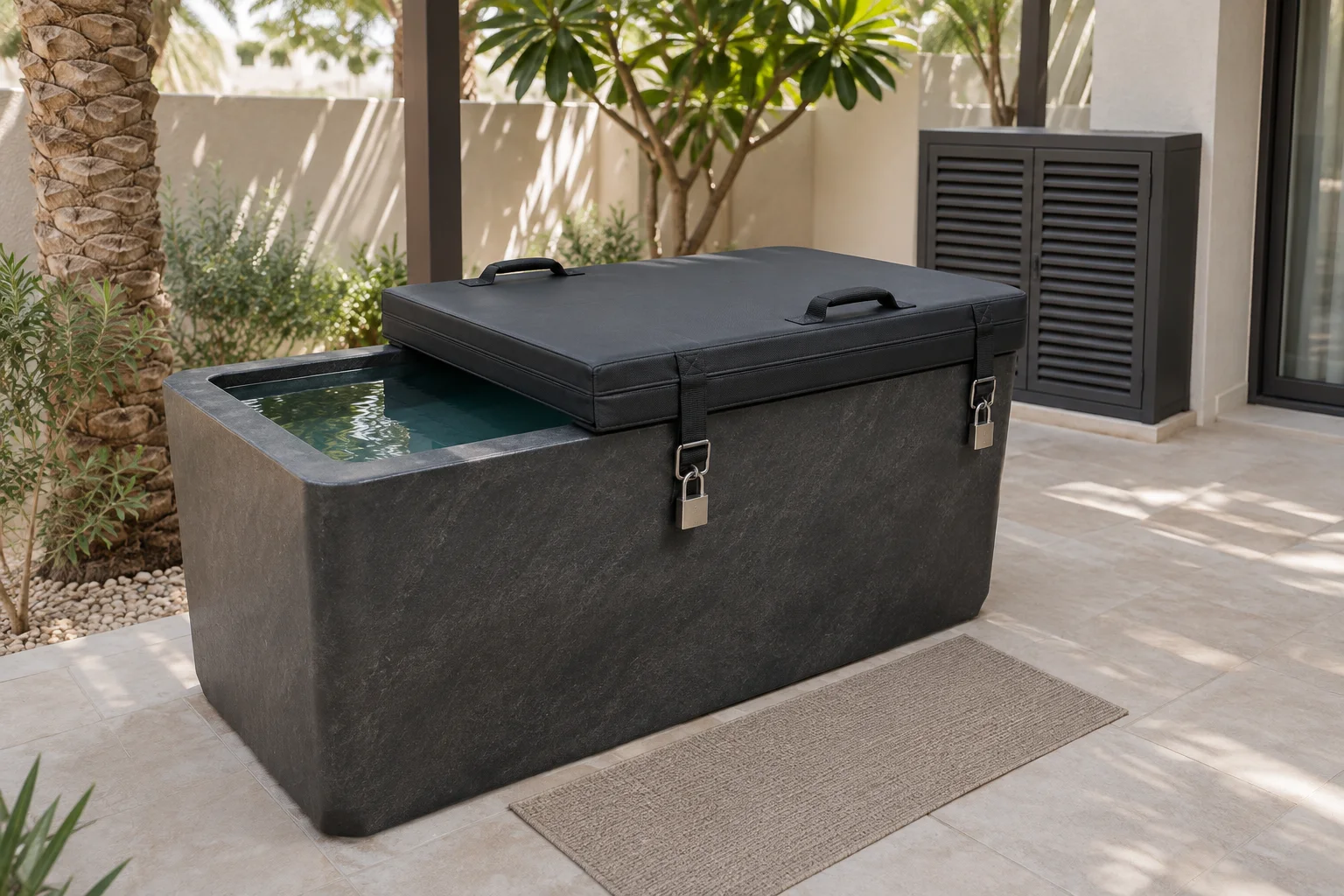
A cold-plunge cover should be specified as part of the installed system, not treated as a decorative accessory. The proposal needs to identify its functions, vessel compatibility, secure closed condition, handling space, insulation, weather assumptions, water-shedding behaviour and maintenance route. A cover is one layer of risk control and does not replace supervision, property-specific access measures or the selected manufacturer's instructions. Ask to see it closed, secured and demonstrated at handover.
Define what the cover is expected to do
Begin with functions, because one product may not perform every role. A cover might reduce debris, limit heat gain or loss, protect an empty vessel from exposure, reduce evaporation, discourage casual access or support an operating sequence between uses. Ask the supplier to separate stated product functions from assumptions made by the installer or homeowner.
Write the intended idle condition: who uses the area, whether children or guests can reach it, whether the plunge is indoors or outdoors, and whether it remains filled. This brief helps compare a dust lid, insulated cover, strapped or lockable design and additional property access measures without calling them equivalent.
Select the cover with the exact vessel
The cover should match the vessel's external dimensions, rim profile, controls, plumbing projections and surrounding finishes. A built-in plunge needs a coordinated recess and removal route; a freestanding product may rely on proprietary attachment points. Record the manufacturer, model, dimensions, material, fastening method and replacement reference in the proposal.
Do not approve a generic cover based only on plan dimensions. Check how it sits over steps, handholds, raised controls or an irregular rim, whether gaps remain, and whether straps align with suitable attachment positions. If the cover is fabricated separately, require the vessel supplier to confirm compatibility and clarify which party warrants the completed arrangement.
Separate insulation from access control
An insulated cover can help the equipment manage the selected water temperature, but thickness alone does not establish performance. Ask for the cover build-up, fit and supplier-stated thermal information, then ensure the chiller proposal uses compatible operating assumptions. The complete installation still depends on vessel and pipe insulation, exposure, set point, opening frequency and equipment heat rejection.
A heavy or insulated lid is not automatically a safety cover. Access-related claims need their own evidence: how the cover secures, whether the closures can be locked, what the manufacturer says about use, and whether any stated load or standard applies to that exact product. Never invite standing, sitting or storage on a cover unless the manufacturer explicitly permits it.
Compare cover types by evidence, not appearance
Use this comparison to organize supplier questions. It does not certify any product or replace the selected manufacturer's instructions.
Swipe or scroll horizontally to compare all columns.
| Cover approach | Potential strength | Evidence to request |
|---|---|---|
| Light fitted lid | Quick debris protection for frequent use | Exact fit, wind response, storage position and whether it secures |
| Insulated soft cover | Thermal and weather protection with manageable weight | Build-up, hinge or fold direction, straps, locking hardware and care |
| Rigid cover | Defined shape and robust closed appearance | Weight, lift method, drainage, attachment, supported loads and replacement route |
| Integrated sliding or lifting cover | Cover handling incorporated into the surrounding design | Mechanism access, pinch points, power/manual operation, drainage and service plan |
Plan a secure idle state for the property
The proposal should show the plunge in its normal closed condition and explain who can release the cover. Confirm the number and positions of closures, how keys or release devices are controlled, and whether the cover remains secure in wind or when the vessel is empty. Any lock should be demonstrated without presenting it as a substitute for supervision or the wider access plan.
Dubai Municipality's May 2024 pool-plan guideline includes private villa pools and states that a pool area should be secured when not in use with a fence and self-closing gate. Whether and how that document applies to a particular fitted cold plunge must be confirmed by the appointed consultant and relevant authority; the plunge should not simply be assumed to fall inside or outside a pool rule because of its marketing name.
Use external guidance carefully
The US Consumer Product Safety Commission's home-pool guidance discusses fences, gates, door alarms and power safety covers as ways to reduce unsupervised access to pools, spas and hot tubs. It is not Dubai law and it does not certify a cold-plunge cover, but it reinforces a useful planning principle: access measures work as layers, and a product claim should be matched to the exact product and household condition.
Ask the consultant or supplier to identify the local requirement and any product standard or test behind the proposed cover. Avoid broad phrases such as childproof or safety approved unless the proposal names the applicable evidence, scope and limitations. The owner still needs clear rules for supervision, keys, guests and periods when the cover is open.
Design cover handling into the layout
A cover that is awkward to lift, fold or store is less likely to be used consistently. Record its weight, dimensions and normal opening movement. Check who is expected to operate it, whether two people are required, and where it rests without blocking the entry step, dry landing, chiller ventilation, drainage or service access.
For a hinged, sliding or assisted system, review the mechanism, attachment structure, pinch and trip zones, manual release and maintenance access. For a removable cover, provide a clean storage position protected from damage and wind. Handles and straps should be used only as the manufacturer directs; do not improvise lifting points from fastening hardware.
Coordinate rain, condensation and cleaning water
An outdoor cover should shed rain without directing water toward electrical equipment, into the vessel through dirty edges or across the dry landing. Ask where water runs when the cover is closed, where it drips during opening and how the surrounding surface drains. A recessed cover pocket or box also needs its own cleaning and drainage plan.
The underside can collect condensation and needs a stated cleaning method. Confirm permitted cleaners, drying position, handling of straps and locks, and inspection for tears, saturated insulation, damaged stitching or distorted panels. Do not assume that a cover intended for one climate, product or water-treatment system has the same care requirements on another installation.
Record the manufacturer's idle-state instructions
The 2025 Vigor Cold Plunge owner's manual instructs users to use and lock its cover whenever the unit is not in use, whether empty or full. It also warns against leaving that product exposed to direct sun without water or its cover and says to carry the cover by its handles rather than its lock straps. These directions are useful examples of why the exact manual matters; they must not be transferred automatically to a different model.
At handover, place the selected manual, cover specification, closure information and replacement reference with the operating records. Mark any instructions that change between filled, drained, operating, serviced or long-idle conditions. The owner should not have to reconstruct the correct state from a generic sales brochure.
Use this cold-plunge cover checklist
Close these items before ordering the vessel or surrounding finishes. The accompanying image is a design concept showing a compact deep plunge with an insulated cover, handles and lockable straps partly closed. It is not a certified product detail or evidence of completed Veyrune work.
- Define debris, insulation, exposure and access-control functions separately
- Name the exact vessel and compatible cover model or fabrication responsibility
- Record dimensions, rim fit, gaps, attachment points and closure positions
- Request evidence for thermal, load, locking or safety-related claims
- Confirm the property's wider supervision, barrier and guest-access plan
- Check lifting weight, opening direction, storage position and operating space
- Keep the cover clear of entry routes, drainage and equipment ventilation
- Plan rainwater, condensation and cleaning-water paths
- Document inspection, cleaning, repair and replacement requirements
- Demonstrate the cover closed, secured, opened and stored at handover
Frequently asked questions
01Is every cold-plunge cover a safety cover?
No. A cover may be designed mainly for insulation, cleanliness or weather protection and may not be intended to resist access or loads. Ask the supplier to identify the exact product, its stated functions, how it secures and the evidence behind any safety-related claim. Do not infer load capacity or access prevention from appearance, thickness or the word cover.
02Should the cover stay on when the plunge is empty?
Follow the exact manufacturer's instructions. One current Vigor cold-plunge manual directs owners to use and lock its cover when the unit is not in use whether empty or full, and it also warns about uncovered sun exposure. That is model-specific guidance, not a universal rule. The handover should state the selected vessel's empty-state, weather and storage requirements.
03Can a cover replace a barrier or supervised access plan?
Do not assume so. The property's risk assessment and applicable authority or community requirements should determine access controls. CPSC guidance treats barriers, covers, alarms and supervision as layers rather than interchangeable guarantees; it is US guidance, not Dubai law. Ask the appointed professionals which measures apply to the actual villa and plunge installation.
Sources and further reading
Dubai Municipality: Technical Guidelines for Approval of Swimming Pool Plans, version 4.0 ↗Checked Thursday, 26 November 2026US Consumer Product Safety Commission: Safety Barrier Guidelines for Home Pools ↗Checked Thursday, 26 November 2026Watkins Wellness: 2025 Vigor Cold Plunge Owner's Manual ↗Checked Thursday, 26 November 2026Confirm current requirements for your property and selected equipment. Product examples do not imply a supplier relationship or local availability.
This is an editorial planning guide, not a property survey, approved design or installation specification. Project requirements are confirmed by the appointed specialists.
Let’s bring it back to your home.
Explore the complete service and share a first brief for your property.
Fitted cold plunges in Dubai