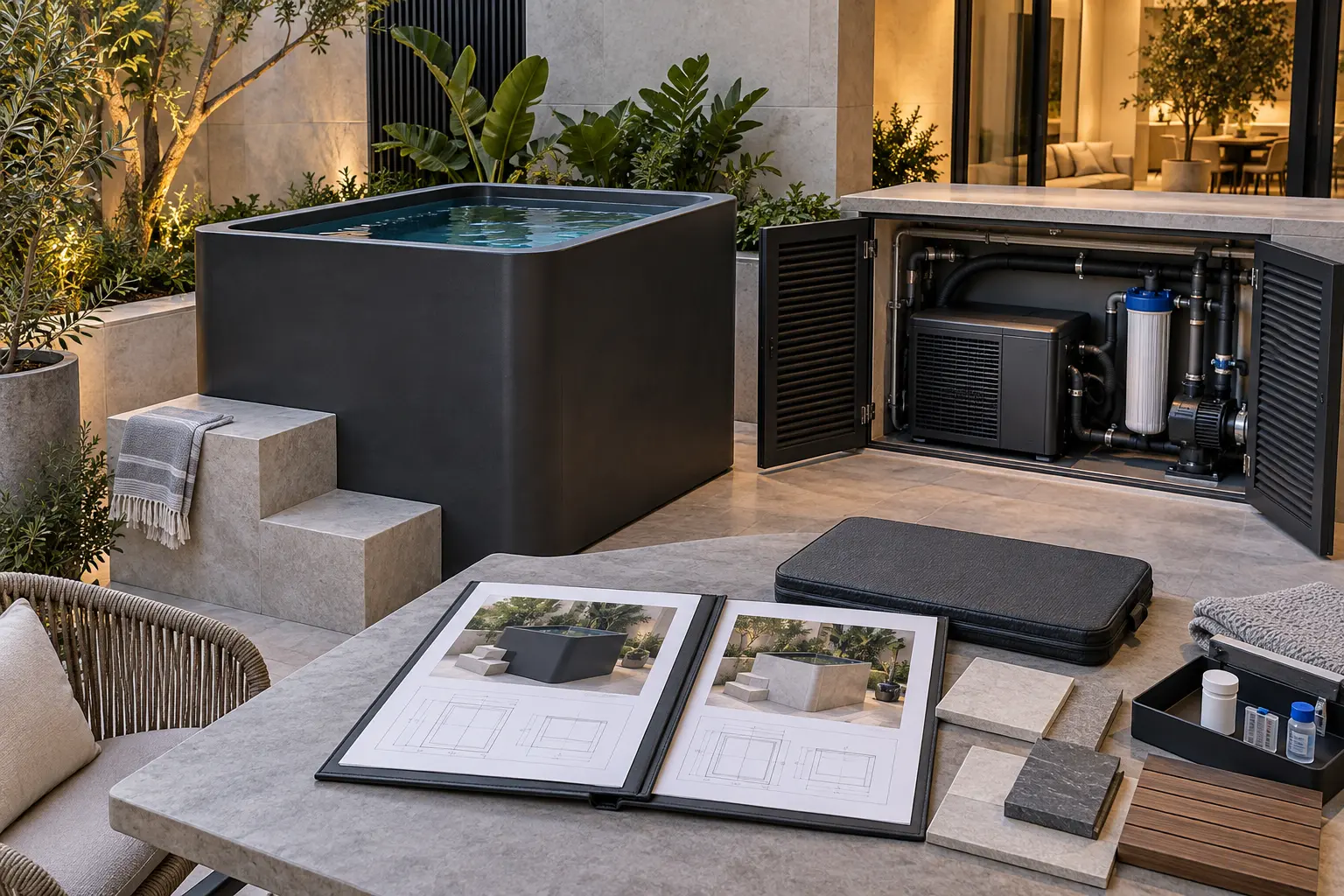
Compare a complete installed system against one property brief. A tub price is not a fitted-project price, and two similar-looking plunges may include different cooling, sanitation, construction, commissioning and ownership responsibilities.
Give every bidder the same cold-plunge brief
Start with the location, intended users, immersion posture, exposure, access route, equipment zone and operating routine. State whether the project is a freestanding unit, recessed product with a surround or bespoke integrated vessel. Include any sauna, shower, landscape or room renovation that must be coordinated.
Ask each bidder to mark assumptions and exclusions against that brief. A delivered freestanding tub is not comparable with a proposal including demolition, a structural base, concealed services, stone cladding and a plant cabinet. Resolve the purchasing route before comparing totals.
Compare the installed scope in layers
Break every proposal into the visible vessel, cooling and circulation, water-care system, controls, cover, access aid, site preparation, connections, drainage, surrounding finishes, delivery, installation, commissioning and post-installation support. Identify the supplier and responsible installer for each layer. If one company coordinates several specialists, the quotation should still show the boundaries.
Current products demonstrate why the schedule matters. Sun Home lists an integrated chiller, ozone and ultraviolet sanitation, dual-pump filtration, cover and steps for its Cold Plunge Pro configuration. Plunge describes ozone and physical filters in its systems and gives model-specific filter guidance. These examples are not endorsements or universal specifications; they show that ‘cold plunge included’ can conceal meaningful differences.
Swipe or scroll horizontally to compare all columns.
| Scope layer | Proposal evidence to request | Common comparison trap |
|---|---|---|
| Vessel and access | Exact model or drawn vessel, dimensions, water capacity, immersion depth, steps and cover | Comparing external dimensions without checking usable posture or entry |
| Cooling and circulation | Chiller, pumps, stated performance basis, controls, routes and service clearances | Comparing only the lowest advertised temperature |
| Water care | Filtration, sanitation method, consumables, testing and cleaning responsibilities | Treating ozone, UV or filtration as a complete maintenance plan by itself |
| Property preparation | Base, access, power, filling, drainage, ventilation, weather protection and finish interfaces | Assuming a delivered product price includes building work |
| Commissioning and ownership | Functional checks, water-care setup, training, manuals, warranties and support contacts | Accepting delivery as proof that the installed system is ready to use |
Check the vessel before comparing the equipment
Record external size, internal opening, usable depth, water capacity, posture, entry route and cover operation. An upright plunge and a longer reclined vessel can serve different users even when both are single-person products. Confirm the selected model can pass through the actual gate, corridor or room opening.
For a built-in or recessed proposal, request sections through the surround. Show the vessel, insulation, movement or separation detail specified by the supplier, removable panels, drainage and the route used to replace serviceable equipment. The visible stone or timber finish should not trap a product that was designed to remain accessible.
Make cooling performance assumptions visible
Ask for the exact chiller and pump configuration, operating range, supported ambient range, water volume, cover, ventilation and operating mode. A minimum temperature published for one integrated vessel does not establish performance for another tub, larger volume or hot enclosed courtyard.
Request evidence from the selected supplier for the proposed conditions and region. Separate first cool-down from maintaining temperature between uses. Ask what happens during peak ambient conditions, how heat is rejected, what clear space the equipment needs and whether a shaded or ventilated service zone is part of the quotation. Do not turn a brochure number into a performance guarantee for the property.
Compare filtration, sanitation and the owner’s routine
Name the filter type, sanitation equipment, circulation schedule, water-testing approach, required chemicals or consumables and cleaning tasks. Ask how frequently each item is inspected or replaced under the proposed usage, where replacements come from and who performs the work. A technology label does not remove the need for a manufacturer-supported water-care plan.
Plunge’s current guidance describes ozone alongside micron filtration and recommends checking and replacing the main filter according to condition and use. Its residential All-In setup guide says the app provides filter instructions and that the unit’s maintenance protocol is based on cold water. Sun Home publishes its own model-specific care schedule. Use the manual for the exact offered system; do not combine isolated instructions from different products.
Price the property interfaces explicitly
The quotation should locate a level supporting area, delivery path, filling point, emptying route, splash management, nearby drainage, power connection, equipment airflow and future service access. For indoor work, coordinate room finishes and environmental conditions with the appointed design and building-services specialists. For outdoor work, record exposure, shade and weather assumptions.
Sun Home’s current product information for its Cold Plunge Pro asks for a level, structurally sound surface, drainage nearby and airflow around the chiller, and it states product-specific electrical requirements. Another model may differ. Ask qualified local specialists to assess the villa and selected equipment; do not use a manufacturer web page as a generic construction or electrical instruction.
Normalise delivery, installation and exclusions
Confirm whether the price includes transport to Dubai, customs or taxes where applicable, off-loading, route protection, lifting, final positioning, packaging removal and damage inspection. Measure the access route before ordering. For a heavy integrated unit, a delivery to the property boundary is not the same as placement in a garden or upper-level wellness area.
List building work separately: removal, base, drainage, electrical work, plumbing, cabinet, cladding, steps, floor repair and landscape reinstatement. State who coordinates the work and provides drawings. A clear exclusions list prevents a product quotation from appearing complete while villa work remains unpriced.
Require commissioning and a usable handover
Commissioning should verify the installed system under the supplier’s procedure: filling and drainage, circulation, cooling, controls, leaks, filter access, sanitation equipment, alarms or app functions where included, and the normal operating state. Ask the supplier to record model and serial information, settings and relevant observations. Commissioning is not a medical exposure recommendation.
The handover pack should include the selected manual, safety information, water-care plan, filter and consumable references, cleaning and draining instructions, warranty provider, support route and responsibilities for surrounding construction. The homeowner should see how to open the cover, enter and exit safely, use normal controls, recognise a problem and isolate or stop the unit only as the manufacturer directs.
Use this cold-plunge quotation checklist
Before comparing totals, make sure each supplier has answered the same questions. This is a purchasing and coordination checklist, not an installation or health protocol.
- The quotation identifies freestanding, recessed-product or bespoke-vessel purchasing route
- The exact vessel, usable depth, water capacity, entry aid and cover are shown
- The chiller, pumps, controls, filtration and sanitation components are named
- Performance claims state the vessel, ambient, location, cover and operating assumptions
- Delivery route, off-loading, positioning, protection and packaging removal are assigned
- Base, power, filling, drainage, splash, airflow and service-access responsibilities are drawn
- Indoor room or outdoor exposure interfaces are reviewed with the relevant specialists
- Filters, chemicals or other consumables and their expected care routine are listed
- Building work, finish work, taxes, optional upgrades and exclusions are separated
- Commissioning covers circulation, cooling, controls, leaks, water care and access
- Handover includes manuals, models, serials, care instructions, warranties and support contacts
- No medical outcome, operating cost or site performance is assumed without appropriate evidence
Compare complete systems, then choose the finish
A useful comparison sheet has one row for every scope layer and one column for each proposal. Mark included, optional, excluded and unresolved items. Add property work that must be obtained separately so the homeowner can see the likely complete route without inventing a total before specialists quote it.
For a Veyrune cold-plunge installation discussion, share the proposed location, access dimensions, indoor or outdoor conditions, preferred vessel style, intended operating routine and any adjoining sauna or shower. The practical next step is one property brief and responsibility matrix that suitable suppliers can answer with current product evidence.
Frequently asked questions
01Why are two cold-plunge quotations so different?
They may describe different purchasing routes. One might be a delivered freestanding product; another may include property assessment, base or surround, drainage, service connections, equipment cabinet, access, commissioning and handover. They may also use different vessel capacity, insulation, cooling, filtration and sanitation. Rebuild both proposals around one scope matrix before comparing totals.
02Should I compare cold plunges by minimum advertised temperature?
Not by that figure alone. Ask the supplier to state the conditions behind its claim, including the exact vessel and equipment, water volume, ambient range, location, cover, ventilation, duty cycle and power. The useful question is whether the offered system is supported for your proposed Dubai installation and operating routine, with the assumptions and warranty position documented.
03Does a fitted cold plunge need a drain nearby?
The selected product and project design determine the arrangement, but every proposal should explain filling, emptying, splash, cleaning water and accidental overflow. Sun Home’s current planning information for one model calls for a level sound surface with nearby drainage and room for airflow. Treat that as product-specific evidence and ask each bidder to draw the actual route and responsibility for your property.
Sources and further reading
Sun Home: Cold Plunge Pro product, site-preparation, equipment and care information ↗Checked Friday, 16 October 2026Sun Home: Official cold-plunge manuals and support directory ↗Checked Friday, 16 October 2026Plunge: How cold-tub filtration and filter care work ↗Checked Friday, 16 October 2026Plunge Support: Residential All-In setup, drainage and maintenance guidance ↗Checked Friday, 16 October 2026Confirm current requirements for your property and selected equipment. Product examples do not imply a supplier relationship or local availability.
This is an editorial planning guide, not a property survey, approved design or installation specification. Project requirements are confirmed by the appointed specialists.
Let’s bring it back to your home.
Explore the complete service and share a first brief for your property.
Fitted cold plunges in Dubai