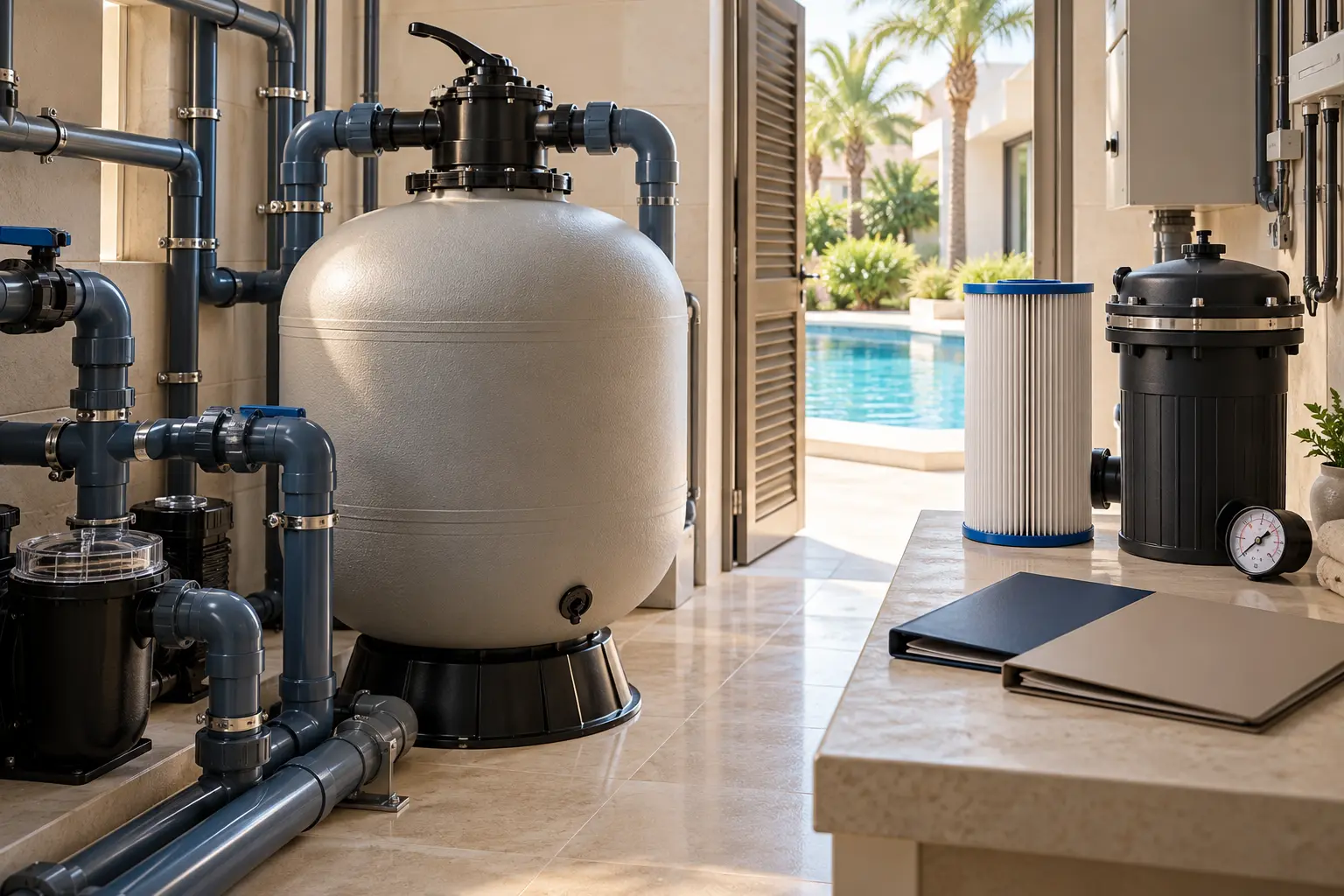
Do not choose a villa pool filter from a media label or a claimed micron figure alone. Compare the exact model within the complete circulation design, then make the cleaning routine, backwash or rinse-water route, plant-room access, replacement parts and handover responsibilities visible before accepting a proposal.
Start with the pool, not the filter label
A filter removes suspended material as water circulates through the pool system, but it does not work alone. The proposal also depends on the pump, pipework, suction and return layout, treatment equipment, operating schedule and the way the filter will be cleaned. Pentair's current filter catalogue groups residential choices into sand, cartridge and diatomaceous-earth, or D.E., products. That is a useful taxonomy, not a selection result for your property.
Issue every proposer the same pool brief: calculated water volume, edge type, integrated spa or water features, expected use, heating or cooling, treatment approach, plant-room location, access constraints and whether any existing equipment will remain. Ask the appointed designer to state the intended design flow and assumptions. Without that common basis, two model numbers are not comparable.
Understand the three proposal families without choosing by slogan
A sand-filter proposal normally includes a pressure vessel, specified filter media and a multiport or valve arrangement that supports filtration and backwashing. A cartridge proposal uses removable pleated elements that are taken out and cleaned or replaced according to the exact manual. A D.E. proposal uses diatomaceous-earth media with a model-specific internal element and cleaning process. Some products combine cartridge-style elements with D.E., so even the family name may not describe the ownership routine precisely.
Manufacturer pages make those differences visible. Pentair says its range includes all three categories and tells owners to follow proper maintenance and safety measures before cleaning. Its cartridge page describes rinsable elements, while its D.E. information describes regular backwashing for its D.E. designs. Treat those statements as prompts to request the current manual for the exact offered model, not as instructions that can be transferred across brands.
Swipe or scroll horizontally to compare all columns.
| Proposal family | Scope evidence to request | Ownership question |
|---|---|---|
| Sand | Exact vessel, media, valve arrangement, pressure basis and backwash route | Where does backwash water go, and who inspects or renews the media? |
| Cartridge | Exact housing, number and part references of elements, removal clearance and rinse arrangement | Where can elements be removed and cleaned without obstructing the plant room? |
| D.E. | Exact model, internal grid or element, media requirement, cleaning process and waste route | Who supplies and handles the specified media and records maintenance? |
| Any proposal | Design flow, pressure information, hydraulic schematic, access and model-specific manual | How does this filter operate with the pump, treatment equipment and maintenance plan? |
Ask how the exact model was selected
The proposal should identify the full model, size and regional documentation, then explain the selection basis in plain language. Record the pool volume and intended system flow, but also ask about allowable pressure, clean-filter pressure loss, expected loading, service intervals and how other equipment affects operation. Avoid a proposal that simply selects the largest catalogue rating or repeats a generic turnover claim without showing its assumptions.
Jandy's current residential pages illustrate why model-level review matters. Its CC cartridge page refers to high residential flow rates, head-loss information and a clean/dirty indicator, while its SFSM sand page lists several vessel sizes and calls out doorway access for one model. Those details may be useful if those products are actually offered, but they do not establish compatibility, UAE availability or suitability for your pool. Ask the proposer to supply the equivalent current evidence for the exact system in the quotation.
Compare the whole hydraulic scope
Request a simple plant schematic that places the filter between the relevant pump, valves and treatment equipment. It should show which pipework and valves are included, how normal and cleaning modes are controlled, and where gauges, air relief and drains sit. For a renovation, distinguish retained pipework from new work and state who verifies its condition and compatibility.
Ask the appointed specialist to review the pump and filter together. A larger pump is not automatically a better match, and a filter should not be assessed only at one ideal catalogue condition. The homeowner's role is to request the documented design basis and commissioning evidence; hydraulic calculations, pressure testing and installation belong to qualified project specialists using the selected manufacturers' instructions.
Make cleaning water and waste routes explicit
The cleaning method affects the property. A backwashing filter needs an intentional route for the resulting water and an operating arrangement that the appointed team has coordinated with the property. A cartridge needs a practical place to remove, carry and rinse its elements, plus a plan for the resulting dirty water. A D.E. system adds product-specific media handling and disposal questions.
Do not accept phrases such as drains nearby or hose to garden as a complete answer. Ask who confirms the permitted discharge destination, how the route is isolated from inappropriate connections, how splash or leakage is contained, and whether the route remains usable after the landscape and plant room are finished. Property-specific authority, community and utility requirements take precedence over a generic brochure.
Draw the service envelope before closing the plant room
A filter may fit on plan yet be impossible to service comfortably. Draw the vessel footprint, valve movement, lid or clamp access, cartridge or grid removal height, gauge visibility, drain access and a route for replacement components. Include doors, shelves, electrical panels and other equipment at their open or service positions. Jandy's sand-filter page specifically discusses doorway width for one model; that is a reminder to verify delivery and future removal, not merely the installed footprint.
Preserve lighting and a stable working area around the equipment. Chemical storage should not be assumed to share every equipment zone. Ask the appointed specialists to define safe access and isolation, and keep high-pressure vessel opening or technical servicing out of a homeowner DIY brief.
Use this pool-filter proposal checklist
Before selection, check that every proposal answers the same questions. Resolve gaps in writing and retain the final comparison with the pool equipment schedule.
- The pool volume, use, edge system, features and retained equipment are stated
- The proposed design flow and hydraulic assumptions are documented
- The exact regional filter model, size, media or elements and current manual are supplied
- The schematic shows the filter, pump, valves, gauges, drains and treatment interfaces
- Clean-filter and expected operating information can be recorded at commissioning
- The cleaning method is explained for the exact model without mixing instructions from other products
- Backwash, rinse water and vessel drains have a property-specific route
- Lid, clamp, valve and element-removal clearances remain usable after fit-out
- Delivery and future replacement routes are checked through doors and access points
- Initial media, spare parts, replacement elements and consumables are identified
- Local warranty and service contacts are confirmed by the actual supplier
- Pipework changes, controls, supports, drainage, commissioning and exclusions are priced visibly
- The handover assigns routine owner, maintenance-provider and specialist tasks
Commission the installed proposal, not the brochure
At completion, record the installed model and serial details, initial pressure in the agreed operating condition, valve labels, pump relationship, visible leaks, gauge operation and any open actions. The appointed specialist should demonstrate the normal operating and cleaning process safely, provide the current manual and explain when professional service is required. Do not copy a pressure threshold or cleaning interval from another filter family.
For a Veyrune pool-planning discussion, share the pool brief, plant-room dimensions, access route, intended treatment and any retained equipment. The practical next step is a model-level comparison that the pool specialist can verify against the hydraulic design and the property.
Frequently asked questions
01Is a cartridge filter always better than a sand filter for a villa pool?
No. They create different ownership and plant-room requirements, and the correct selection depends on the whole pool brief and hydraulic design. A cartridge model is normally opened and its elements removed for cleaning; a sand model uses a valve arrangement and backwash route. Compare the exact regional models, cleaning access, water-disposal plan, replacement media or elements, pressure loss and local support with the appointed pool specialist.
02Can pool filters be compared by flow rate alone?
Flow is important, but one headline number is not a complete selection. Ask for the design flow used in the proposal, the clean and expected operating pressure conditions, the relationship to the pump and pipework, the chosen filter area or vessel size, and the manufacturer's limits for the exact model. The proposed arrangement should be reviewed as a system rather than as independent catalogue items.
03What should a pool-filter handover include?
Ask for the installed model and serial details, current manual, start-up and pressure record, normal operating explanation, cleaning or backwash method, safe isolation procedure delivered by the appointed specialist, replacement media or cartridge references, waste-route explanation, warranty provider and service contacts. The homeowner should receive a clear schedule of responsibilities, not be expected to reconstruct it from product brochures.
Sources and further reading
Pentair: pool filter categories and product resources ↗Checked Wednesday, 21 October 2026Pentair: cartridge-filter overview and maintenance context ↗Checked Wednesday, 21 October 2026Jandy: CC Series cartridge-filter information and manual link ↗Checked Wednesday, 21 October 2026Jandy: SFSM side-mount sand-filter information and manual link ↗Checked Wednesday, 21 October 2026Confirm current requirements for your property and selected equipment. Product examples do not imply a supplier relationship or local availability.
This is an editorial planning guide, not a property survey, approved design or installation specification. Project requirements are confirmed by the appointed specialists.
Let’s bring it back to your home.
Explore the complete service and share a first brief for your property.
New swimming pools in Dubai