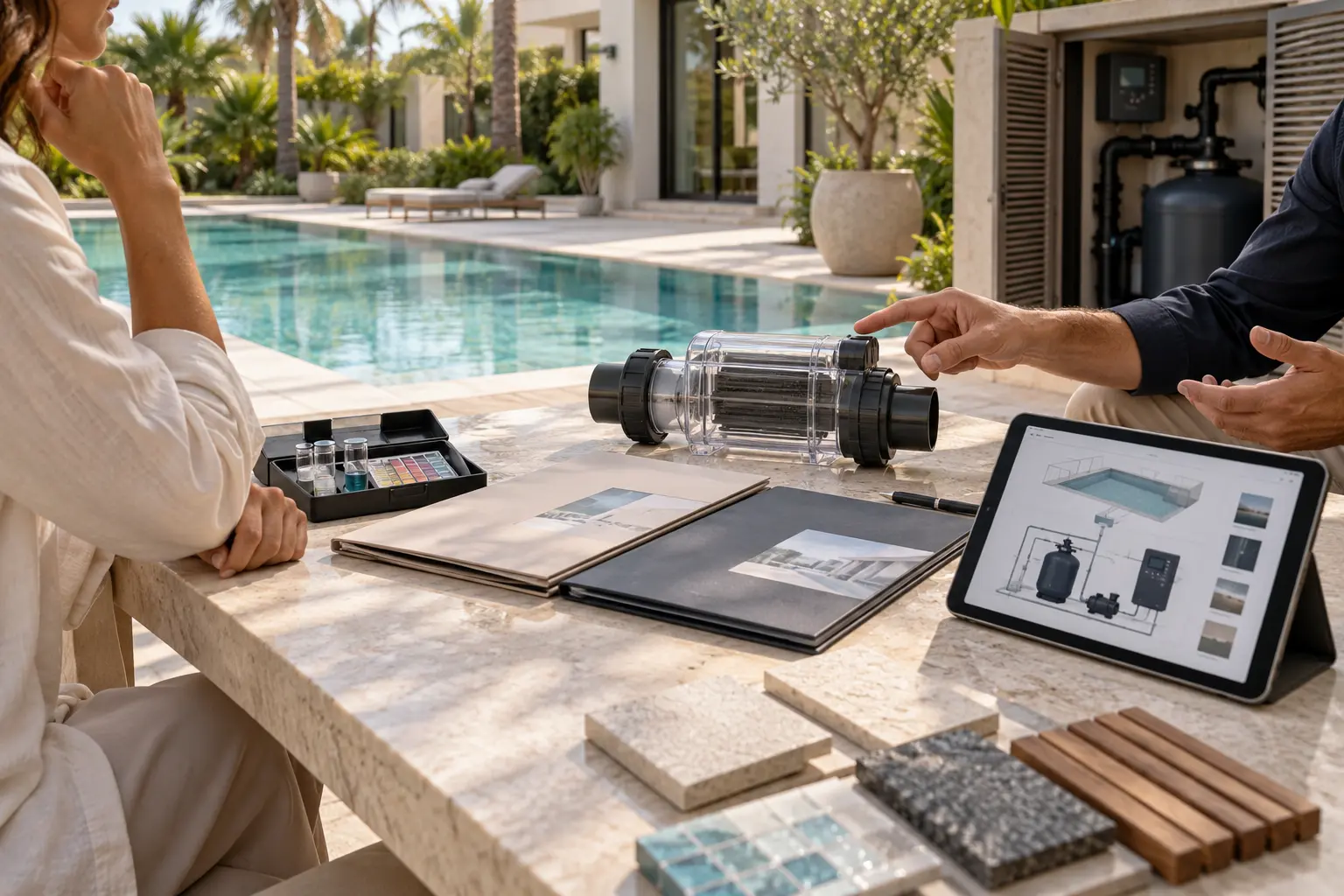
A salt-water pool is still a chlorinated pool: the installed system generates chlorine from dissolved salt. Compare the complete treatment proposal, its assumptions and its ownership requirements rather than choosing from a lifestyle label or one equipment headline.
Start with what the system actually does
A salt chlorinator is part of the pool-water treatment system. Pentair's current IntelliChlor explanation describes water and dissolved salt passing through a generator cell, where electrolysis produces chlorine before the treated water returns to the pool. Jandy likewise describes AquaPure as a salt-water chlorine sanitising system. Those manufacturer descriptions are useful because they remove a common comparison error: salt water and chlorinated water are not opposing categories.
That does not make every salt system equivalent. The pool still needs an agreed testing plan, circulation, equipment coordination and ongoing care. Ask what the proposal solves, which responsibilities remain with the owner or maintenance provider, and how the system fits the pool brief.
Issue one pool brief to every proposer
Record the proposed pool dimensions and calculated water volume, edge type, integrated spa or water features, anticipated use, heating or cooling, plant location and intended automation. State whether this is a new pool, a renovation with retained equipment or a replacement treatment system. A cell added to a known plant arrangement is a different coordination exercise from a complete new plant room.
Ask each proposer to identify assumptions rather than silently filling the gaps. If the water volume, circulation design or retained equipment has not been confirmed, the response should say so. A model name without a documented basis is not enough evidence for a homeowner to compare two proposals.
Normalise the scope before comparing prices
Put each proposal into the same matrix. This exposes the difference between equipment supply, installation into a prepared plant room and a complete coordinated treatment package. It also prevents automation, electrical work or commissioning from appearing included simply because they are shown in a brochure image.
Swipe or scroll horizontally to compare all columns.
| Comparison layer | Evidence to request | Question to resolve |
|---|---|---|
| Selection basis | Pool volume, use assumptions, exact regional model and documented rationale | What information determined the proposed cell and power arrangement? |
| Hydraulic scope | Cell, sensors, valves, pipework changes and relation to pump operation | Who confirms the proposed arrangement within the complete circulation system? |
| Controls | Local interface, automation compatibility, available functions and offline operation | Which functions are actually supported by the offered model combination? |
| Water care | Testing plan, target information from the exact manual, consumables and maintenance responsibility | What work continues after automatic generation begins? |
| Handover | Commissioning record, settings, manuals, serials, warranty and support contacts | What evidence shows that the installed system has been set up and explained? |
Ask for the exact model and current documentation
Request the cell, power or control centre, sensors and any integration components by exact model. Confirm that the documentation supplied with the proposal covers that model and intended market. Pentair's current product pages list several IntelliChlor families and replacement paths, while Jandy's AquaPure page links a product manual, brochure and sensor documentation. A family name alone can hide different capacities, controls and service parts.
Ask what is included in the quoted package and what must be obtained separately. The cell, power supply, sensor assembly, controller interface and connection accessories should not be inferred from a photograph. Availability, warranty route and local support also need written confirmation from the actual supplier; a global manufacturer page does not establish UAE stock or service coverage.
Make the selection assumptions visible
The proposal should explain how the selected system relates to the pool it will serve. Record the water volume, usage and relevant operating assumptions, then ask the appointed specialist to show the product evidence used. Avoid choosing from the largest headline rating or treating deliberate oversizing as automatically better. The selection needs to work within the complete hydraulic, electrical and control design without implying that one automated device replaces professional assessment or testing.
Coordinate flow, power and automation as one system
Salt generation depends on the wider plant operating correctly. Jandy's current AquaPure manual, for example, links chlorinator operation to pump operation and describes its flow sensor as a backup rather than the only flow safeguard. This is product-specific evidence, not a universal wiring instruction. It shows why the quotation must define the interface between circulation, sensing, power and controls.
Ask for those interfaces on the plant schematic and equipment schedule. Identify who designs and checks them, who supplies each component and who commissions the combined result. If automation is included, request a model-level list of supported functions. A generic promise of app control does not establish output control, alerts, history, account transfer or what remains available locally when connectivity fails.
Keep water testing and maintenance in the comparison
Automatic chlorine generation is not automatic ownership. Ask for the testing approach, the maintenance provider's responsibilities, the owner's routine and the product-specific response to readings or alerts. The selected manual should govern care of the cell and sensors. Do not combine cleaning instructions, salinity information or chemical targets from unrelated brands or models.
The Jandy manual advises testing before use, keeping the manual and checking salinity before adding salt; those instructions belong to that system and its documented operating context. Your proposal should provide the equivalent current guidance for the exact equipment offered. It should also explain how the pool's other water-balance requirements are managed and who adjusts the treatment plan over time.
Plan plant-room access and future replacement
Show the cell, sensors and control equipment in the plant-room layout. Preserve the selected manufacturer's clearances and access for inspection, service and eventual replacement. For a renovation, identify retained components and model-level compatibility, plus any pipework, electrical, control or enclosure work. A simple upgrade becomes a coordination gap when the quotation covers only a box delivered to site.
Require commissioning evidence and a usable handover
Commissioning should follow the selected manufacturer's process and the appointed specialist's complete pool plan. Ask for a record of the exact equipment, relevant initial readings, configured output or schedules, sensor checks, control functions and any outstanding action. This guide does not prescribe settings; it helps the homeowner request evidence that the offered system has been commissioned within the pool installation.
The handover pack should include current manuals, model and serial details, warranty provider, normal operating explanation, maintenance responsibilities, consumable or replacement references, support contacts and any automation-account transfer. Keep the salt-chlorination record with the broader pool equipment schedule so future service providers can understand the installed system.
Use this salt-chlorination proposal checklist
Before deciding, check that every proposal answers the same homeowner questions. Resolve unclear items in writing rather than assigning value to an unspecified premium system.
- The calculated pool volume, use and retained-equipment assumptions are stated
- The exact regional cell, power equipment, sensors and controls are named
- The supplier provides current model-specific documentation and warranty contacts
- The hydraulic schematic shows the chlorinator within the complete circulation system
- Pump, flow-sensing, electrical and control responsibilities are assigned
- Automation functions and offline operation are confirmed at model level
- Plant-room access supports inspection, cleaning, service and replacement
- The proposal defines testing, routine care, consumables and maintenance responsibility
- Building work, electrical work, pipework changes, taxes and exclusions are separated
- Commissioning records the installed models, checks, settings and open items
- Handover includes manuals, serials, warranties, support routes and account transfer
- No regional availability, operating cost or performance result is assumed without evidence
Choose the complete treatment proposal
A useful decision compares complete systems against the same pool brief. One proposal may be stronger because it explains interfaces, service access and ownership clearly, not because it uses a more luxurious label. Keep optional automation or equipment upgrades separate so their value remains visible.
For a Veyrune pool discussion, share the layout, intended use, plant location and related heating, cooling or automation plans. The next step is a coordinated equipment brief that qualified specialists can answer with current product evidence.
Frequently asked questions
01Is a salt-water pool chlorine-free?
No. A salt-chlorination system uses dissolved salt and an electrolytic cell to generate chlorine for sanitation. The useful comparison is how the exact proposed system is selected, controlled, tested and maintained for your pool. Do not treat the phrase salt water as proof that routine water testing, professional care or other treatment responsibilities disappear.
02Can I compare salt chlorinators by pool-volume rating alone?
Treat the rating as one input, not a complete design. Ask the proposer to record the pool volume, intended use, hydraulic arrangement, selected cell and controls, local installation conditions and the evidence used for selection. The final system and operating plan should come from the appointed pool and equipment specialists using current documentation for the exact regional model.
03Should salt chlorination be included in the pool-automation proposal?
It should at least be coordinated with it. Some equipment combinations support integrated monitoring or output control, while others use separate controls. Ask for a model-level compatibility statement, the functions available locally and the fallback method if an app or network is unavailable. Do not assume that two products from one brand automatically communicate.
Sources and further reading
Pentair: IntelliChlor salt chlorine generator overview and resources ↗Checked Monday, 19 October 2026Pentair: IntelliChlor Plus and LT product information ↗Checked Monday, 19 October 2026Jandy: AquaPure salt chlorinator product page and downloads ↗Checked Monday, 19 October 2026Jandy: AquaPure and PureLink installation and operation manual ↗Checked Monday, 19 October 2026Confirm current requirements for your property and selected equipment. Product examples do not imply a supplier relationship or local availability.
This is an editorial planning guide, not a property survey, approved design or installation specification. Project requirements are confirmed by the appointed specialists.
Let’s bring it back to your home.
Explore the complete service and share a first brief for your property.
New swimming pools in Dubai