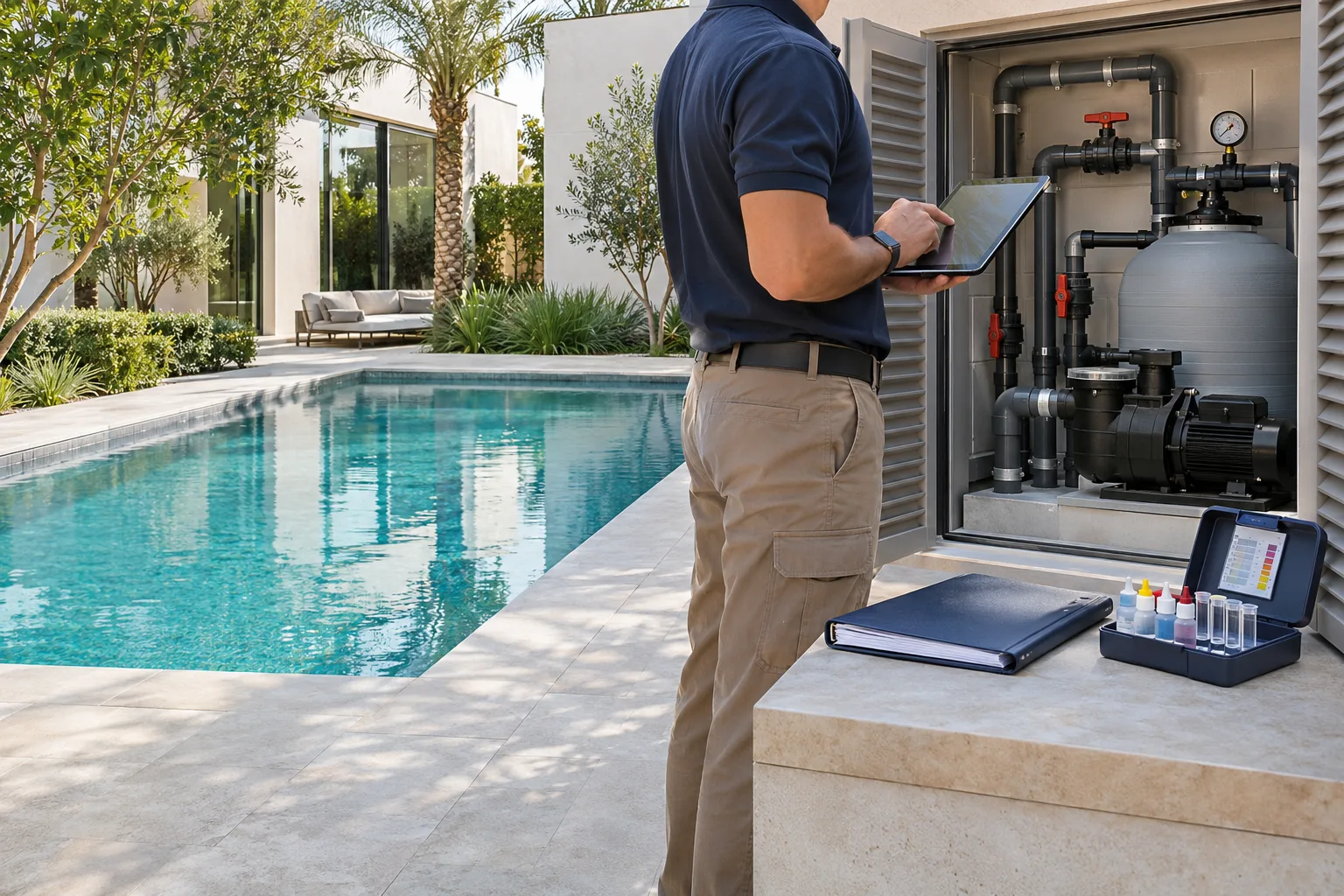
A new pool is not ready for ownership simply because it is full and looks finished. Commissioning should connect the approved design, completed construction, selected equipment, operating settings, water-care baseline and owner demonstration. Ask for witnessed checks and a property-specific handover pack before final acceptance, while keeping specialist testing and safety decisions with the appointed professionals.
Treat handover as a controlled transition
Commissioning is the point at which separate construction packages must work as one pool. The shell, finishes, circulation, disinfection, temperature control, lighting, covers, water features, drainage and controls may have been delivered by different specialists. Handover should show how the finished installation matches the agreed documents and how the owner can operate it without guessing.
Set the acceptance process before the final week. Name who leads commissioning, which specialists attend, what evidence is required and how defects or incomplete items are recorded. Separate practical completion from a ceremonial reveal: a beautiful pool can still have unresolved labels, settings, access panels, manuals or test records.
Compare three layers of completion
Use a layered review so visible finishes do not distract from system readiness or owner information. Each layer has a different question and evidence.
Swipe or scroll horizontally to compare all columns.
| Completion layer | Main question | Useful evidence |
|---|---|---|
| Construction readiness | Is the physical pool complete, accessible and safe to commission? | Approved drawings, inspection records, completed finishes, clean pipework, labelled plant, clear drains and closed outstanding works |
| System commissioning | Do the installed systems start, circulate, treat and respond as designed? | Model-specific start-up sheets, readings, operating-mode tests, control schedules and recorded specialist sign-off |
| Owner handover | Can the household understand operation, care, support and responsibilities? | Demonstration, final manuals, as-built information, maintenance schedule, warranty contacts, consumables and defect list |
Freeze the approved baseline before testing
Start with the latest approved plan, hydraulic schematic, equipment schedule and control description. Dubai Municipality's current pool-plan guideline expects coordinated pool details, pipe-fitting and pump-room layouts, electrical diagrams, filtration and disinfection information. Commissioning should work from the property-specific approved documents and any properly recorded changes, not an early tender drawing.
Walk through the installed equipment against the schedule. Record make, model and serial number where relevant; identify every pump, filter, treatment unit, heater or chiller, valve group, controller, light transformer and feature circuit. Photograph labels and access positions. If an approved substitution occurred, the handover record should show who accepted it and which manual now governs operation.
Witness model-specific start-up rather than a generic switch-on
Pool equipment is not commissioned by applying one internet checklist. Pentair's IntelliFlo guide, for example, includes model-specific priming, maximum-speed, clock and schedule settings. Jandy's variable-speed pump manual includes its own start-up sequence, warnings against dry running and checks around valves and filter pressure release. These examples show why the installed manuals must be used; they do not prescribe the settings for another product or property.
Ask the qualified specialist to identify the start-up procedure used and record the relevant initial values. The homeowner does not need to perform hazardous work or stand over pressurised equipment. The useful evidence is that the correct professional followed the selected equipment instructions, the system was free of construction debris, air was removed as required, leaks were checked and normal operation was observed.
Test every operating mode and control path
A pool may have normal filtration, cleaning, heating or cooling, overflow transfer, water-feature, lighting and cover modes. List the actual modes before commissioning and test each one through the controls the owner will use. Confirm what happens when a feature is off, when the schedule changes and after a normal power interruption.
Record plain-language scene names and the final schedule. Verify that physical labels agree with the digital interface, that manual isolation remains intelligible and that essential circulation does not depend on an unexplained phone account. If remote access is included, identify account ownership, permissions, connectivity assumptions and the route for future transfer or support.
Review the pool, terrace and plant room together
Commissioning is not confined to the plant room. Check the water level and edge behaviour, return flow, skimming or overflow action, steps, ladders, depth markers, covers, lights, drains and water features in their normal conditions. Review the deck for completed drainage, unobstructed routes and finished access covers. Property-specific safety and approval requirements remain with the appointed specialists.
In the equipment area, confirm lighting, ventilation, drainage, clear service access and permanent labels. Valves should have an understandable normal position and equipment should be reachable without removing unrelated finishes. A clean room on handover day is not enough; ask how filters, baskets, chemical containers and replaceable components will be removed and serviced later.
Create a usable water-care baseline
The final water condition should be recorded with the date, test method, responsible party and operating context. Include the values relevant to the selected treatment system and pool finish, along with the initial dosing or start-up record. Do not turn one set of readings into a permanent target without the specialist's operating plan and current local requirements.
Explain routine testing, cleaning, backwashing or cartridge care, topping up and seasonal adjustments for the actual equipment. The owner should know which tasks are safe household maintenance and which require a pool professional. Record consumables, replacement references and the first planned service rather than relying on unlabeled bottles left in the plant room.
Use this new-pool commissioning checklist
Issue the checklist before the commissioning date and assign responsibility for every item. Add project-specific checks for any cover, spa, feature or temperature-control system.
- Confirm the latest approved and as-built drawing set
- Match installed equipment, models and serial numbers to the schedule
- Close or clearly record outstanding construction and finish items
- Verify labels, service lighting, drainage, ventilation and access
- Witness model-specific start-up by the responsible specialist
- Record initial readings, settings and normal valve positions
- Test filtration, treatment, temperature, lighting and feature modes
- Check owner controls, schedules, manual operation and power recovery
- Review water level, edge action, fittings, covers and terrace drainage
- Record the water-care baseline and routine maintenance plan
- Demonstrate cleaning, safe shutdown and support escalation
- Receive manuals, warranties, contacts, test records and defect log
Require a handover pack that stays useful
A practical pack contains the final drawings, equipment schedule, selected manuals, commissioning sheets, control schedule, water-care plan, warranties, finish information, maintenance contacts and a dated list of outstanding items. File names should describe the content and revision. A shared folder is useful only if the owner can open it and knows which document is current.
For a Veyrune new-pool discussion, include commissioning deliverables in the project brief before quotations are compared. Ask each proposal to name the commissioning lead, attendance, tests, owner training and document pack. The result is not a promise that nothing will ever need adjustment; it is a traceable starting point for operating, maintaining and supporting the pool after construction.
Frequently asked questions
01How long should a new swimming pool be tested before handover?
There is no responsible universal duration for every pool. The appointed team should define the checks, operating conditions and observation period for the selected structure, waterproofing system, finishes and equipment. Ask what must be stable before acceptance, which readings are recorded and how any outstanding issue extends or changes the handover process.
02Should the homeowner receive the final pool settings?
Yes. The handover pack should record the final control names, schedules, pump programs, treatment settings and other owner-adjustable values that were demonstrated. These are a baseline for the specific installed system, not permanent settings for all conditions. The operating specialist should explain which adjustments are routine and which require service support.
03Is a verbal pool demonstration enough?
A demonstration is useful, but it should be supported by the final drawings, equipment schedule, manuals, commissioning records, warranty contacts and maintenance plan. Video clips can supplement the pack, but they should not replace the selected manufacturers' instructions or the traceable record of what was installed and tested.
Sources and further reading
Dubai Municipality: Technical Guidelines for Approval of Swimming Pool Plans, Version 4 ↗Checked Wednesday, 4 November 2026Pentair: IntelliFlo Variable Speed Pump Installation and User's Guide ↗Checked Wednesday, 4 November 2026Jandy: Variable-Speed Pumps Installation and Operation Manual ↗Checked Wednesday, 4 November 2026Jandy: VS FloPro Variable-Speed Pumps Installation and Operation Manual ↗Checked Wednesday, 4 November 2026Confirm current requirements for your property and selected equipment. Product examples do not imply a supplier relationship or local availability.
This is an editorial planning guide, not a property survey, approved design or installation specification. Project requirements are confirmed by the appointed specialists.
Let’s bring it back to your home.
Explore the complete service and share a first brief for your property.
New swimming pools in Dubai