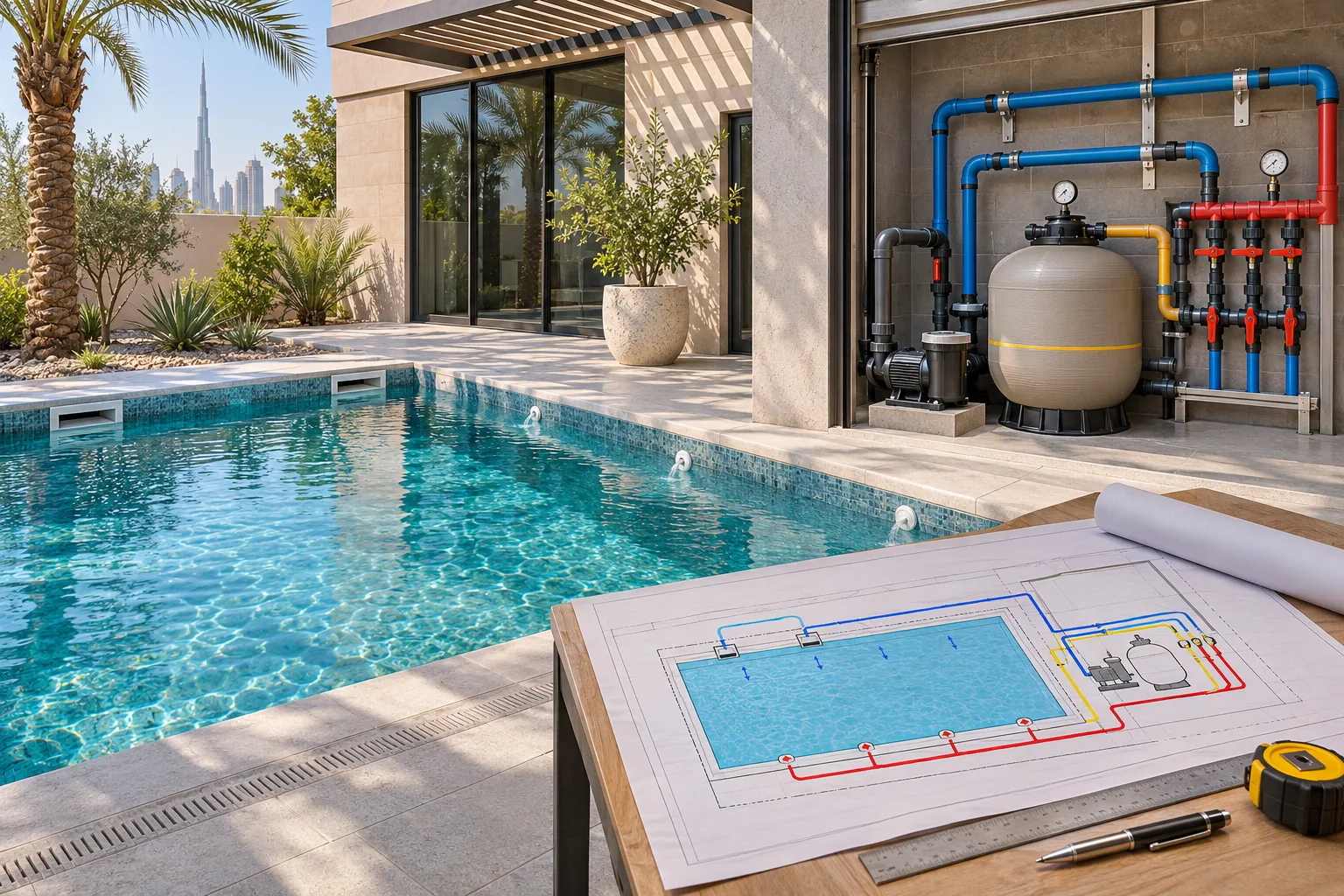
A complete villa pool circulation proposal connects the pool geometry and use to one coordinated hydraulic basis. It shows the collection points, return inlets, suction and return routes, valves, equipment sequence, design flow and operating modes; checks the pump, filter and optional treatment or temperature-control equipment as one system; and defines commissioning and as-built evidence. A turnover figure or equipment list alone cannot show how water is collected and redistributed across the actual pool. Ask the appointed pool designer and qualified specialists to confirm the final calculations, safety provisions and approval requirements for the property.
Begin with one hydraulic basis for the whole pool
Start with the pool plan, dimensions, water depth profile, calculated volume, edge system and intended use. Add connected features, cleaning equipment, temperature control and any secondary treatment that changes the required flow path. Record which inputs are confirmed and which still depend on design development.
Then ask for one hydraulic basis that links those inputs to design flow, system resistance and operating modes. It should identify the calculation author, drawing revision and selected equipment. A collection of brochures cannot replace this coordination because each component influences the duty expected from the others.
Map surface collection and treated-water returns
A plan should show where floating material is collected and where treated water re-enters the pool. For a skimmer pool, mark skimmer locations, operating water level and return inlets. For an overflow design, coordinate the channel, balance tank and level-control arrangement under its separate design. Do not mix the assumptions of the two systems.
Return placement should be reviewed with the pool shape, steps, benches, shelves and prevailing debris conditions. Pentair's professional guidance notes that surface movement from return jets affects how debris reaches skimmers and that return arrangement should be checked when circulation remains poor. That product guidance is a useful diagnostic principle, not a universal inlet layout.
Require a readable pipe and valve schematic
The schematic should distinguish every suction, return, make-up, overflow, backwash or waste route that belongs to the scope. Show flow direction, line identifiers, isolation valves, check valves, unions, strainers, gauges, sample points and equipment sequence. The plan and schematic should use the same names so a technician can trace each route.
Dubai Municipality's May 2024 technical guideline asks pool-plan submissions to include a pool and pump-room pipe-fitting layout, a pool schematic, pump-room layout, turnover calculations and details of equipment, inlets and outlets. It also calls for valve, gauge, sight-glass and sampling details in the filtration drawings. Treat that as a documentation benchmark while the appointed consultant confirms the current route for the actual property.
Check equipment at the same design condition
Ask each bidder to state the pump flow and head, filter flow basis and expected pressure loss through heaters, chillers, secondary treatment and other equipment. The values should refer to the same operating condition. A pump curve at one flow and a filter brochure at another do not demonstrate compatibility.
PWTAG's current technical note says circulation pumps should achieve the required flow and head as filters become dirty and should account for processes such as ultraviolet treatment, ozone and heating. PWTAG primarily addresses managed pools, so use its system principle carefully: the villa design still needs its own calculations, selected-product data and local professional review.
Compare proposals through one evidence table
Issue the same pool plan and operating brief to every bidder. The table helps expose whether a proposal explains the hydraulic system or simply names equipment.
Swipe or scroll horizontally to compare all columns.
| Proposal item | Evidence to request | Decision to close |
|---|---|---|
| Design inputs | Volume, use, edge system and connected-feature schedule | Are all bidders designing the same pool? |
| Collection and returns | Dimensioned plan with flow direction | How is water collected and redistributed? |
| Pipework | Line schedule and pressure-loss calculation | What pipe basis and route support the duty point? |
| Equipment | Pump curve, filter data and treatment pressure losses | Do components work together across the stated condition? |
| Operating modes | Speed, valve and interlock schedule | What changes for normal use, cleaning and optional features? |
| Service access | Plant-room layout with removable components | Can valves, baskets and equipment be reached safely? |
| Commissioning | Measured flow, pressure references and as-built records | What proves the installed system matches the approved basis? |
Define operating modes before controls are programmed
A variable-speed pump is useful only when its modes are coordinated with the rest of the installation. Ask for the intended normal filtration, surface-cleaning, heating or cooling, water-feature and maintenance modes. Where a filter needs a particular cleaning flow, that requirement should be stated separately and matched to the selected valve arrangement.
PWTAG notes that lower flow can affect treatment processes and that abrupt changes can disturb a filter bed. The proposal should therefore state minimum permitted flows, ramping or sequencing, and any interlocks required by the selected equipment. Avoid accepting a list of pump speeds without the resulting flow, valve position and active equipment.
Coordinate suction safety and maintenance access
Suction outlets, covers, grilles and associated pipework are safety-critical and belong in specialist design. The owner should request the selected fitting details, design responsibility, inspection access and completion records without attempting to size or alter them. Any cleaning connection should be clearly differentiated from normal circulation routes.
In the plant room, preserve working space around pump baskets, filter closures, multiport or isolation valves, sensors and removable equipment. Label routes durably and keep a valve from becoming inaccessible behind a tank or fixed joinery. Hydraulic performance and maintainability should be reviewed together.
Commission distribution, not only equipment start-up
Commissioning should record the approved valve positions, pump settings, measured or verified flow method, gauge references and operation of the selected treatment and temperature-control equipment. Observe skimmer draw, waterline behaviour and return distribution under the agreed modes. A running motor alone does not prove that the pool is circulating as designed.
Retain the final schematic, equipment schedule, calculations, settings, photographs and test records. The accompanying image is a construction process illustration showing a pool, plant and circulation plan together for discussion. It is not an approved hydraulic detail or evidence of completed Veyrune work.
Use this pool circulation proposal checklist
Close these items before equipment orders, concealed pipework and control programming. This is a proposal-comparison checklist, not a do-it-yourself hydraulic design.
- Record pool dimensions, volume, use, edge system and connected features
- Show every collection point and treated-water return on the coordinated plan
- Issue a matching schematic with line identifiers, flow arrows and valves
- State the pressure-loss and design-flow basis for the complete system
- Check pump, filter, treatment and temperature equipment at the same condition
- Define normal, cleaning, temperature-control and feature operating modes
- Coordinate suction safety details through the appointed specialists
- Preserve access to valves, baskets, gauges, sensors and removable equipment
- Record commissioning observations, settings and reference measurements
- Handover an accurate as-built schematic, schedule and maintenance brief
Frequently asked questions
01Is the pool turnover period enough to approve a circulation design?
No. Turnover is one calculation input. The proposal should also show how water reaches the collection points, how returns distribute treated water, what flow and pressure each operating mode needs, and whether the selected pump, filter and other equipment remain compatible. The appointed designer should document the property-specific basis rather than treating one number as proof of circulation quality.
02Can the pump, filter and pool fittings be compared as separate quotations?
They can be priced separately, but they should be approved as one coordinated hydraulic system. A pump duty point depends on system resistance; filter pressure loss changes with condition; and inlet, outlet and valve arrangements influence distribution and service. Require one schedule and schematic that identifies who accepts the combined design.
03Do Dubai Municipality pool-plan guidelines apply to a private villa pool?
The current Dubai Municipality guideline states that its scope includes public and private pools within Dubai and identifies private-villa pools as a category. The appointed consultant should still confirm the current submission route, development-area authority and property-specific requirements. This guide uses the official document as a planning reference, not as an approval or a substitute for professional design.
Sources and further reading
Dubai Municipality: Technical Guidelines for Approval of Swimming Pool Plans, version 4.0 ↗Checked Monday, 23 November 2026PWTAG: Swimming pool circulation pumps and variable speed drives (TN49) ↗Checked Monday, 23 November 2026Pentair: Seven servicing tips for variable-speed pumps ↗Checked Monday, 23 November 2026Confirm current requirements for your property and selected equipment. Product examples do not imply a supplier relationship or local availability.
This is an editorial planning guide, not a property survey, approved design or installation specification. Project requirements are confirmed by the appointed specialists.
Let’s bring it back to your home.
Explore the complete service and share a first brief for your property.
New swimming pools in Dubai