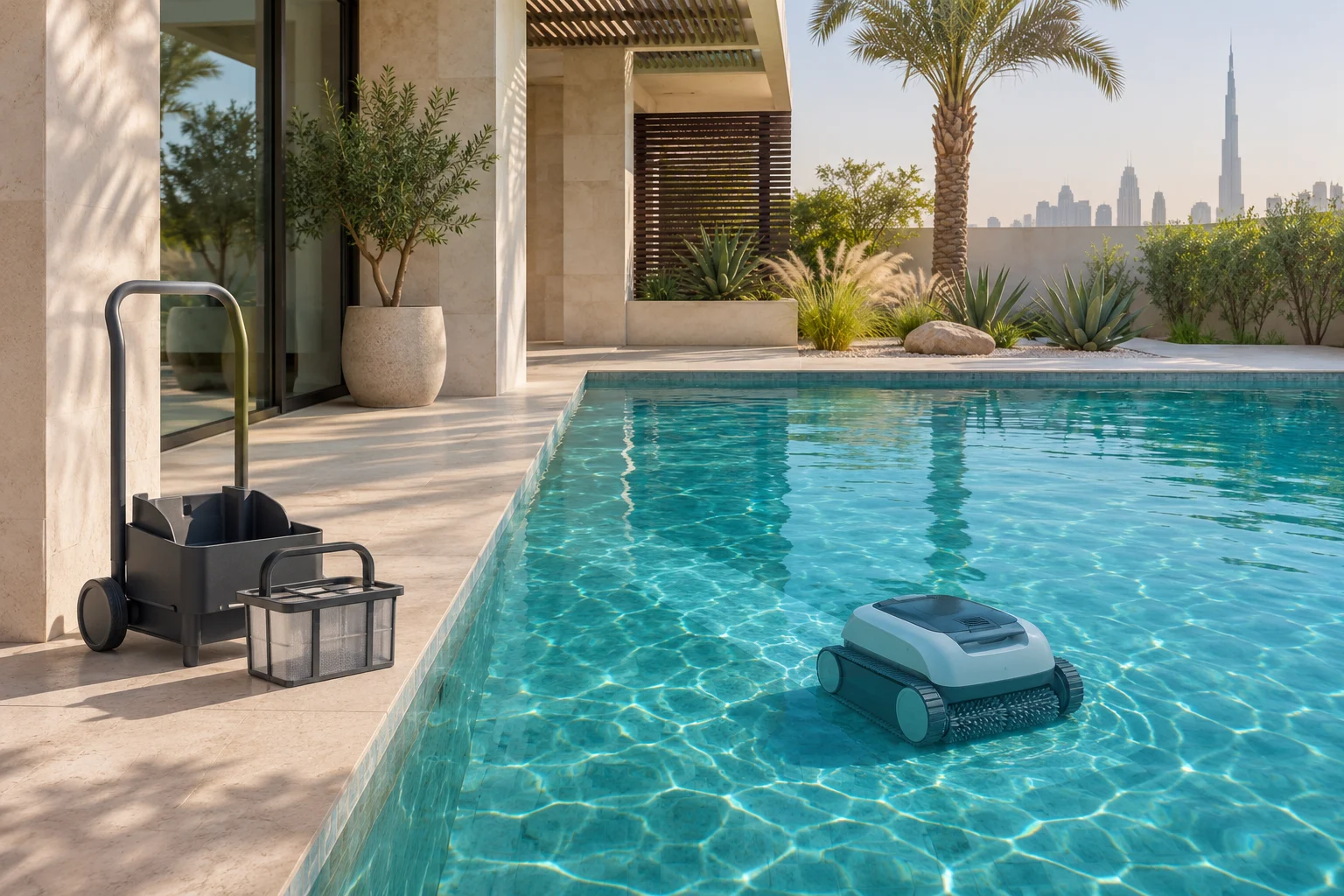
There is no universal cleaning machine for every new villa pool. Select the routine around the actual pool shape, finish, debris, circulation system, storage and person who will maintain it. Robotic cleaners carry their own debris filter; suction-side units use the pool's suction system; pressure-side units collect debris while operating from return pressure or a dedicated arrangement. Whichever option is proposed, retain manual tools, define safe storage and require a model-specific demonstration at handover.
Design the ownership routine, not just the water shape
A new pool can be visually complete yet frustrating to own if cleaning was left until the final equipment order. The intended cleaner has to move across the real floor, approach walls and steps, tolerate the selected finish, handle the property's typical debris and be easy enough to clean and store that the routine actually happens.
Start with an operating description. Record the pool dimensions and depths, beach entries, benches, overflow channels, covers, water features and any tight transitions. Note likely sand, fine dust, leaves and landscape material rather than assuming one generic debris load. Identify who removes the cleaner, empties its basket or services the suction line, where wet equipment drains, and whether a maintenance company or resident performs the task.
Understand what each cleaner type asks from the pool
Pentair's current cleaner overview separates robotic, suction-side and pressure-side approaches. Its guidance describes suction-side cleaners as suited to smaller debris such as sand and silt, pressure-side cleaners as useful for larger debris, and robotic cleaners as operating with their own low-voltage power and debris filtration rather than relying on the main pool pump. Those are useful category distinctions, not a property-specific selection or performance guarantee.
The exact proposed model matters more than the category label. Obtain its compatible pool size, surface guidance, cable or hose length, cleaning modes, filtration grade, power or flow requirement and excluded features. Ask the supplier to mark any areas that will still need brushing or manual vacuuming.
Swipe or scroll horizontally to compare all columns.
| Cleaner approach | How it generally works | Design questions to resolve |
|---|---|---|
| Robotic | Self-contained cleaner with its own drive, suction and debris filter | Where are safe power or charging, lifting, drainage, filter rinsing and shaded storage provided? |
| Suction-side | Moves debris through a pool suction connection and circulation system | Which connection is used, how is flow set, what reaches the pump basket or filter, and how are hose and fittings stored? |
| Pressure-side | Uses return-side pressure and usually carries debris in its own bag | Does the selected model need a dedicated line or booster arrangement, and where are bag and hose maintained? |
| Manual tools | Brush, leaf net and vacuum used by an operator | Which areas need manual attention, where are poles stored and can the full perimeter be reached safely? |
Match filtration to Dubai's fine dust and the site's debris
Cleaner filters and bags are not interchangeable catch-all devices. A coarse basket can collect leaves quickly while allowing finer particles to remain; a fine or ultra-fine element may capture dust but need more frequent rinsing. Pentair's current Prowler information, for example, distinguishes large- and fine-debris filtration options. Use that as evidence to ask what filtration is supplied with the proposed model, not as a reason to specify that product without review.
Maytronics advises cleaning a robotic cleaner's filter after each cycle and notes that fine material can obstruct an ultra-fine filter even when it does not look full. Translate that maintenance reality into the property plan: provide a convenient rinse point with suitable drainage, a place for the opened basket, and a protected route that does not trail dirty water through the villa.
Keep the cleaner separate from the pool's water-treatment duties
Removing settled debris does not establish that circulation, filtration, disinfection and water balance are correct. A cleaner may make the floor look better while water treatment remains a separate operating system. The pool proposal should therefore describe the cleaner, pump schedules, skimming, filtration, water testing and manual brushing as connected but distinct responsibilities.
Avoid sizing the main pump around an assumed cleaner without the hydraulic designer confirming the selected arrangement. A robot does not use the circulation pump for propulsion; a suction-side cleaner does affect the suction system; and some pressure-side products have different return or booster requirements. Ask the appointed pool specialist to document the property-specific flow path and operating sequence rather than relying on a generic sales comparison.
Plan lifting, storage and access before finishing the deck
A cleaner that is difficult to lift, untangle or rinse is likely to be left in the water or abandoned in a plant room corner. Confirm the wet weight and approved lifting method, especially where the pool edge is raised or access is narrow. A caddy may need a step-free route and a turning area. Hoses and cables should have dedicated storage that avoids sharp bends, hot surfaces and trip exposure.
Maytronics' current support guidance recommends removing its Dolphin robot after a cycle, emptying and cleaning the filters, and storing the robot and power supply dry and out of direct sunlight, except where a model's weekly mode specifically permits otherwise. The selected manual controls the final routine. In Dubai, the design brief should still assume heat, sun and wet equipment require a deliberate shaded, ventilated storage location.
Test the selected model against the completed pool
Do not accept a cleaner demonstration in a different pool as proof of coverage in yours. During commissioning, run the actual model in the filled, balanced pool after construction debris has been removed by the appropriate method. Observe floor coverage, transitions, walls, steps, ledges and the waterline. Record any repeatably missed areas and the manual method assigned to them.
The test should also include removal, filter or bag emptying, hose or cable handling, storage and restart. Check that the operator can reach the equipment without crossing an unsafe edge or carrying a dripping unit through finished interiors. A successful test is a documented ownership routine, not a claim that the cleaner reaches every surface on every cycle.
Use this pool-cleaning design checklist
Complete this checklist before quotations are compared and repeat it when the final model is submitted. It keeps the discussion tied to the property rather than to a cleaner category alone.
- Map the pool floor, walls, steps, benches, covers, overflow channels and tight transitions
- Describe expected fine dust, sand, leaves and landscape debris
- Name the proposed cleaner type and exact model
- Confirm compatible pool size, depth, surface and geometry from current manufacturer information
- Record power, charging, suction, return or booster requirements as applicable
- Identify which debris reaches the cleaner filter, pump basket or main filter
- Provide a safe rinse point, drainage route and shaded storage location
- Check wet lifting, caddy movement, hose or cable reach and trip exposure
- Retain suitable brushes, leaf nets and manual-vacuum provisions
- Define the cycle, filter or bag cleaning, inspection and replacement routine
- Run a coverage and maintenance demonstration in the completed pool
- Add model, parts, manuals and responsibility boundaries to the handover record
Write a comparable cleaning brief for the new-pool proposal
Ask each proposal to identify the cleaning method, exact equipment allowance, connections, storage, manual tools, commissioning test and handover training. If the cleaner will be selected later, require the design to reserve the necessary routes and state who confirms compatibility. Exclude vague promises such as ‘automatic cleaning included’ unless the coverage and operator duties are described.
For a Veyrune swimming-pool construction discussion, bring the plan, landscape concept and preferred ownership routine to the first review. The next useful step is to compare cleaner options with the circulation and plant-room proposal, then retain the selected model's current manual in the project record. That produces a pool designed to be maintained, without pretending one branded device is the answer for every villa.
Frequently asked questions
01Is a robotic cleaner always best for a Dubai villa pool?
No. A suitable robot can clean independently of the pool pump and retain debris in its own filter, but it still needs model-compatible dimensions, safe power or charging arrangements, removal after use, filter cleaning and shaded storage. A suction-side or pressure-side system may suit another pool and ownership routine. Compare the selected models against the finished pool rather than choosing only by cleaner type.
02Can an automatic cleaner replace manual pool cleaning?
Treat it as the primary routine tool, not the only tool. Steps, ledges, corners, waterline deposits and isolated debris may still need a brush, leaf net or manual vacuum. Water testing, filtration, circulation and chemical control are separate duties. The handover plan should identify what the automatic cleaner covers and what remains a manual or service task.
03When should the pool-cleaning method be chosen?
Choose the intended method while hydraulic, electrical, storage and finish decisions can still be coordinated, then confirm the exact model before handover. A pressure-side option may affect return or booster arrangements; a suction-side option needs a compatible suction connection and flow; a robot needs a safe operating and storage plan. Late selection can leave awkward hoses, inadequate access or nowhere to maintain the cleaner.
Sources and further reading
Pentair: Pool Cleaners and Pool Vacuums ↗Checked Friday, 6 November 2026Pentair: Prowler 920 Robotic Inground Pool Cleaner ↗Checked Friday, 6 November 2026Maytronics: Cleaning a Dolphin filter ↗Checked Friday, 6 November 2026Maytronics: How long can I leave my Dolphin in the pool? ↗Checked Friday, 6 November 2026Confirm current requirements for your property and selected equipment. Product examples do not imply a supplier relationship or local availability.
This is an editorial planning guide, not a property survey, approved design or installation specification. Project requirements are confirmed by the appointed specialists.
Let’s bring it back to your home.
Explore the complete service and share a first brief for your property.
New swimming pools in Dubai