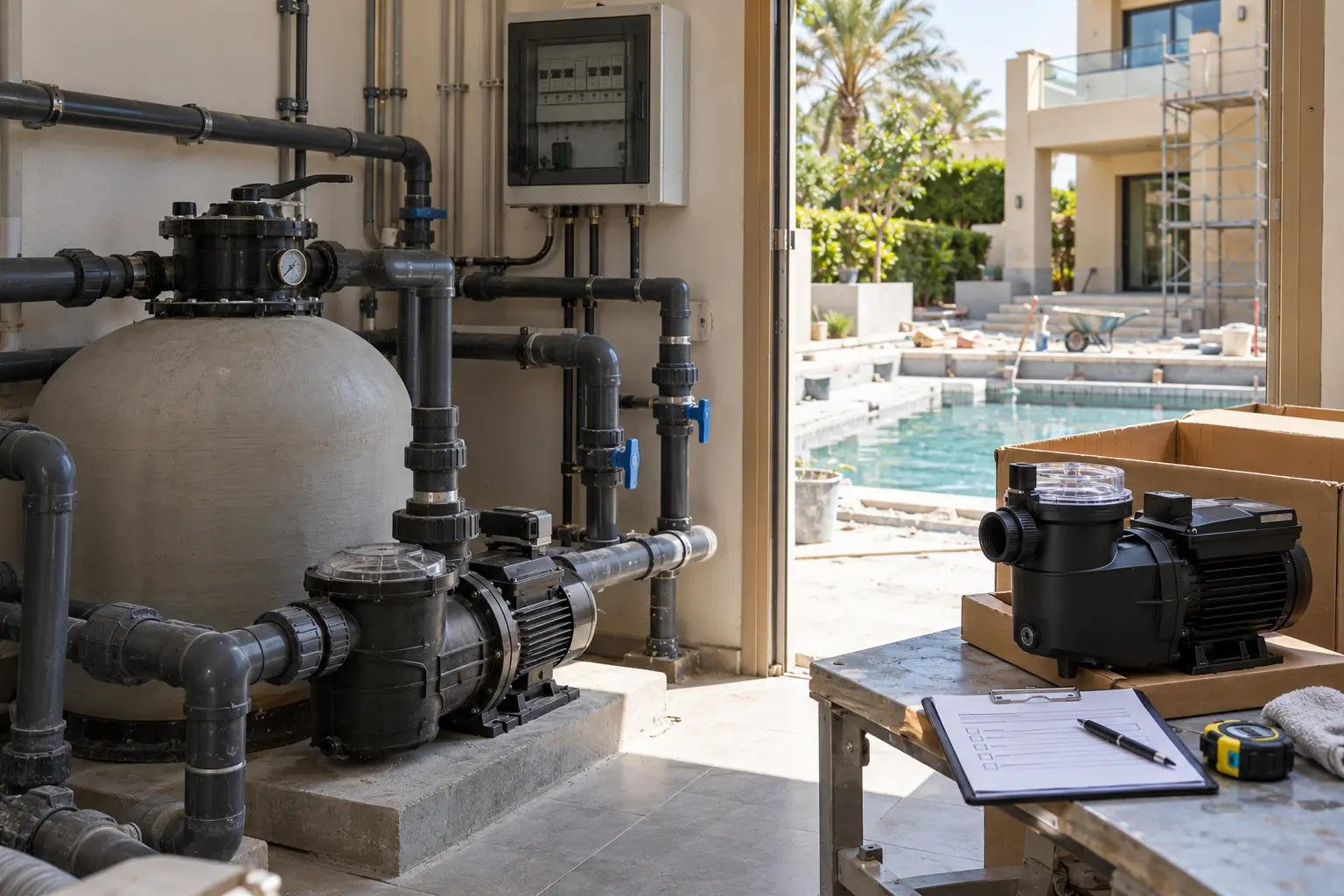
Do not decide from equipment age or appearance alone. Build an asset register, define what the renovated pool must do, then ask the appointed specialists to assess condition, measured operation, compatibility, serviceability and support for every retained item. The result should be a documented keep, service or replace decision with clear responsibility for the connections between old and new work.
Start with the renovated pool, not the old equipment
An existing pump, filter or controller may still operate, but the renovated pool may ask it to do something different. A changed waterline, integrated spa, new feature, revised lighting, temperature control or different operating schedule can alter the brief. Write down the intended functions before deciding that any item is suitable simply because it worked with the previous arrangement.
Separate essential remedial work from optional upgrades. If the project exists because of water loss, poor circulation or unreliable controls, record those symptoms and any previous repairs. If the equipment change is mainly about quieter operation, easier control or another preference, state that separately. This gives the specialist a clearer basis for testing and comparison.
Create an asset register before dismantling
Ask the responsible team to identify the circulation pumps, filters, treatment equipment, heater or chiller, controls, valves, lighting transformers and other connected components. Record the visible manufacturer and model reference, approximate installation history when genuinely known, current function, control method and physical location. Photograph identification plates for the private project file without publishing serial numbers or household details.
Link each item to a simple marked schematic or plant-room photograph. Note which pool function it serves and which other components it depends on. The register should distinguish verified information from owner recollection or an unreadable label. If a model cannot be confirmed, mark it unknown rather than guessing from appearance.
Assess five kinds of evidence
A useful review looks beyond whether an item starts. Ask what has been inspected, what has been measured and what remains unknown. The homeowner does not need to prescribe electrical or hydraulic tests; qualified specialists should define and perform appropriate checks. The decision record should make their basis understandable without turning it into a do-it-yourself instruction.
Use the same headings for every major component so one item is not retained on a casual assumption while another is replaced from a sales preference. Where evidence requires opening up or later commissioning, record the hold point and the decision that follows.
Swipe or scroll horizontally to compare all columns.
| Evidence area | Question to answer | Useful record |
|---|---|---|
| Physical condition | What visible deterioration, leakage or damage was found? | Inspection note and dated photographs |
| Operation | What relevant performance or fault evidence was checked? | Test or service report with stated conditions |
| Compatibility | Does it suit the renovated pool and connected equipment? | Coordinated equipment schedule or schematic |
| Serviceability | Can it be safely reached, isolated, maintained and removed? | Dimensioned plant layout and access route |
| Support | Are current instructions, parts and competent support identifiable? | Exact model references and supplier response |
Compare keep, service and replace as real scopes
A keep decision means more than leaving an item untouched. State any inspection, cleaning, recommissioning, settings review and connection work included. A service decision should identify the diagnosed issue, parts or work proposed and how the result will be verified. A replace decision should identify the exact new function, model-selection basis, removal, connections, controls and disposal responsibility.
Ask the quotation to show these routes side by side where a genuine choice exists. Include cost and programme effects, but do not manufacture a universal service-life rule or projected saving. The relevant comparison is the documented condition and suitability of this installation, together with the complete scope needed for the renovated pool.
Check the boundary between retained and new equipment
Many problems sit at interfaces rather than inside one box. A replacement pump may connect to retained pipework, filtration and controls; a new treatment system may depend on circulation settings; a retained heater may need to respond to a new controller. Ask the appointed specialists to show these boundaries on one schematic and name who is responsible for the completed operation.
Current manufacturer pages show why model-level checking matters. Pentair's IntelliFlo3 information describes variable speed and flow control, app connectivity and limited connections to additional equipment. Jandy's VS FloPro information describes model-specific voltage, base, plumbing-replacement and controller options. These are manufacturer examples, not recommendations for a Dubai property. They demonstrate that the word pump does not define the electrical, hydraulic or control interface.
Do not let drop-in language replace a system review
Some replacement products are designed to simplify alignment with existing pads or connections. That can reduce disruption, but physical fit is only one question. Ask whether the proposed regional model suits the required operating points, materials, power, controls, environment and service arrangement. A neat base alignment is not evidence that the whole system has been selected correctly.
Review the plant enclosure at the same time. Check ventilation or cooling needs stated for each product, drainage, irrigation exposure, working clearance and the route for a future removal. If the renovation adds equipment, redraw the plant layout rather than squeezing another cabinet into leftover space.
Make testing and responsibility part of the quotation
For every retained item, identify who disconnects it, protects it during construction, reconnects it and accepts responsibility for the final interface. State whether any pre-existing defect is excluded and how a newly discovered issue will be recorded. This avoids a vague handover where one party warrants new pipework while another assumes an old component caused any problem.
Agree appropriate pre-work observations, post-installation checks and operating demonstrations with the appointed specialists. The record should identify the tested configuration and settings without asking the homeowner to certify technical performance. If a retained component cannot be meaningfully checked until the pool is running, mark that dependency and the response if it fails.
Use this equipment decision checklist
Before approving the renovation equipment schedule, confirm the following items. Product selection, testing and installation must follow current manufacturer instructions and be completed by the appropriate appointed specialists.
- The intended functions and operating preferences of the renovated pool are written down
- Every major existing component has a traceable asset-register entry or is clearly marked unknown
- Keep, service or replace decisions cite condition, operation, compatibility, access and support evidence
- Necessary remedial work is separated from optional performance or control upgrades
- Exact regional replacement models and their selection assumptions are documented
- Hydraulic, electrical, treatment, temperature and control interfaces appear on coordinated information
- Plant-room space, environment, maintenance clearances and removal routes are checked
- Construction protection, reconnection, testing, exclusions and warranty boundaries have named responsibilities
- The final asset register, manuals, settings and commissioning records are included at handover
Carry the decision record into ownership
Update the asset register at completion so it shows what was retained, serviced or replaced, along with the installed model references and current manuals. Keep commissioned settings, control explanations, service information and warranty contacts together. Remove superseded proposals so the household is not left with several conflicting equipment lists.
For a Veyrune pool-renovation discussion, share available plant-room photographs, known repair history, the problems you want addressed and the features you hope to add. The next useful step is a property-specific condition and compatibility review—not an automatic promise that everything old should go or everything operational should stay.
Frequently asked questions
01Should every old pool pump be replaced during renovation?
No universal age decides the answer. Ask the appointed specialist to identify the pump, inspect it, record relevant operating evidence and check it against the renovated pool's hydraulic functions, controls, electrical provision, service access and available product support. Retention should be an explained decision, not an assumption that it still runs.
02Can a new variable-speed pump work with an existing filter and controls?
It may be possible, but compatibility is project- and product-specific. The responsible specialists should assess required flow, existing pipework and valves, filter limits, electrical supply, control interfaces and every connected feature. Request a coordinated schedule and control narrative for the exact regional models before ordering.
03What should a pool-renovation quotation say about retained equipment?
It should identify each retained item, the evidence supporting retention, any service or repair included, its interface with new work, exclusions, commissioning checks and who carries responsibility for the completed system. Ask how retained components affect warranty boundaries and future support.
Sources and further reading
Pentair: IntelliFlo3 Variable Speed and Flow Pool Pump product information and current resources ↗Checked Thursday, 8 October 2026Jandy: VS FloPro 1.65 HP variable-speed pump product information and current manual resources ↗Checked Thursday, 8 October 2026Confirm current requirements for your property and selected equipment. Product examples do not imply a supplier relationship or local availability.
This is an editorial planning guide, not a property survey, approved design or installation specification. Project requirements are confirmed by the appointed specialists.
Let’s bring it back to your home.
Explore the complete service and share a first brief for your property.
Major pool renovations in Dubai