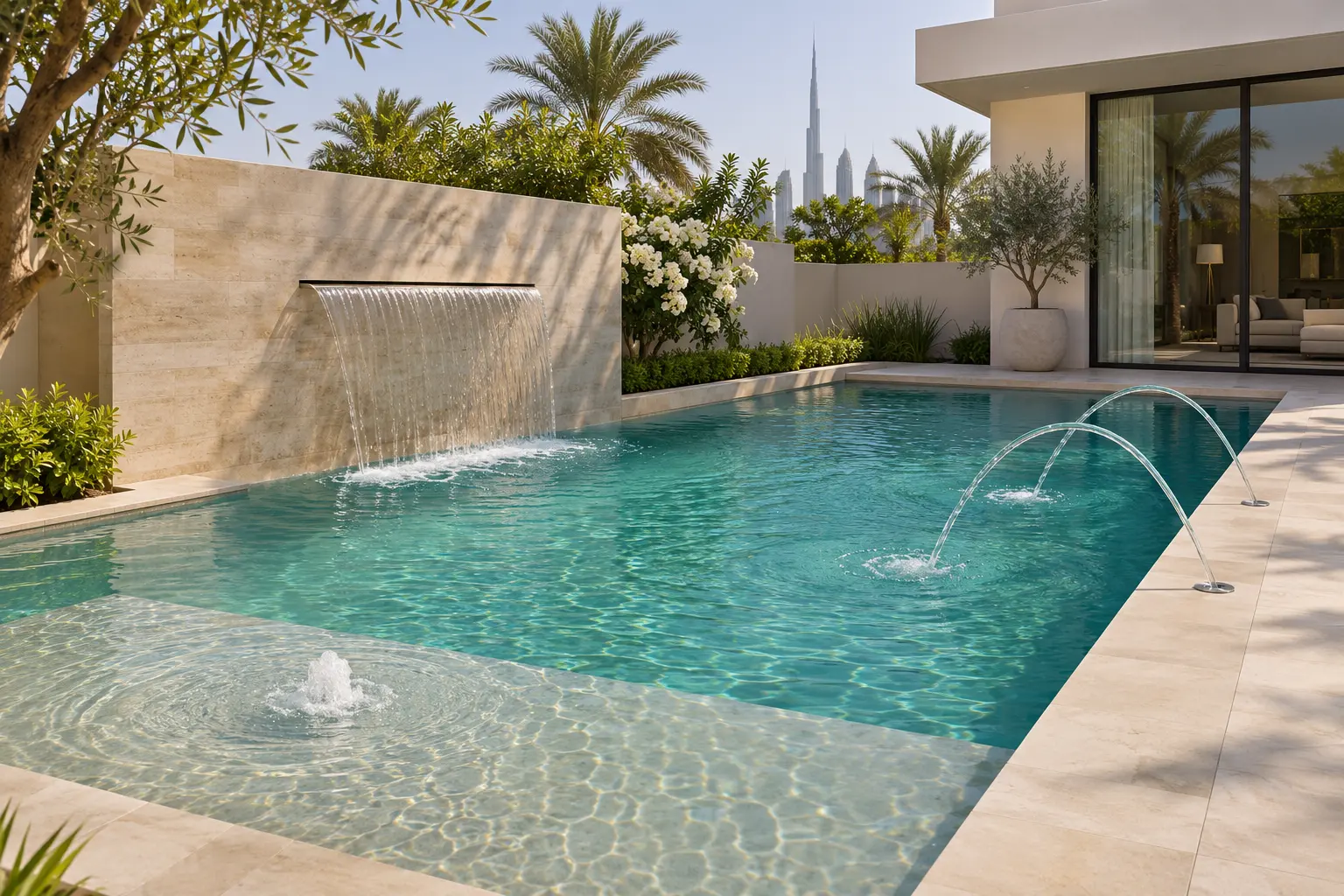
Choose a pool water feature by the experience it should create from the house and terrace, then design its water source, return, controls, structure, drainage and service access before the shell and coping are fixed. A wall spillway, deck jet and shallow-shelf bubbler create different sound, splash and maintenance conditions. The most convincing proposal shows the feature operating as part of the complete pool rather than adding a decorative outlet late in construction.
Begin with the experience, not the catalogue item
A water feature can be a quiet focal point, active sound beside seating or playful pool-edge element. Those intentions need different forms. Write where it should be seen, when it should run and whether the priority is movement, sound, night lighting or an architectural connection.
Mark the important viewing positions on the pool plan: interior rooms, terrace dining, sun loungers, the entrance to the garden and neighbouring boundaries. A wide spillway may suit a wall that is viewed frontally, while a low bubbler reads from above and deck jets create movement across a route. The design should belong to the architecture rather than compete with every other pool element.
Compare three feature families
Use one comparison brief before selecting a product. The following directions are design categories, not interchangeable technical specifications.
Swipe or scroll horizontally to compare all columns.
| Feature direction | Visual and sound character | Early coordination questions |
|---|---|---|
| Wall spillway or sheer descent | A sheet or curtain falling from a raised wall into the pool | Wall depth and finish, lip projection, receiving-water level, flow distribution, access behind the wall, splash and sound |
| Flush deck jets or laminar arcs | Individual streams crossing from the deck or landscape toward the pool | Jet boxes, aim and trajectory, trip-free covers, wind, drainage, lighting, service removal and safe swimmer zones |
| Shallow-shelf bubbler | A vertical plume emerging from a sun shelf or shallow platform | Water depth, fitting location, user movement, flow adjustment, lighting compatibility, cleaning and whether the shelf remains useful when off |
Draw the feature in every operating state
Ask for day, night and off-state views plus a simple operating schedule. If adjustment is proposed, show the normal and higher settings. The wall opening, deck fittings and shelf remain visible when no water moves.
Record whether the feature runs with filtration, only on request or as a timed scene. Identify owner controls and the state after a power interruption. The feature should not need to run simply to disguise an unresolved outlet.
Give the effect a defined hydraulic basis
The feature needs a known water source, flow path, appropriate strainers or filtration, valves, receiving point and service isolation. Jandy's Sheer Descent manual illustrates shared and separate-flow arrangements and notes a dedicated pump for particular higher-flow relationships. That is a manufacturer example, not a universal sizing rule.
Ask the pool designer for a schematic showing filtration and feature circuits in every operating mode. The schedule should identify pumps, valves, control functions and the performance basis for the selected outlet length or number of jets. Confirm that ordinary pool turnover and treatment remain defined when the feature is off. A headline pump rating does not prove the effect at the built lip or jet.
Test wind, splash and sound against the setting
Moving water is affected by height, trajectory and wind. A clean showroom sheet can break up in an exposed garden; jets may drift across a route and a tall bubbler may splash beyond its shelf. Review exposure, fall distance, receiving depth and drainage before fixing the form.
Sound is equally contextual. Falling water can mask traffic or plant noise, but it can also dominate a quiet courtyard or bedroom-facing garden. Hard walls and glazing reflect sound. Describe the desired character in plain language and request an operating reference for the proposed type. Keep independent on-off control so the household can choose quiet without switching off essential circulation.
Coordinate the structure, edge and waterproofing
A wall spillway needs a supported opening, finish build-up and feed access. Deck-jet boxes occupy the terrace; a bubbler penetrates the shelf beside other fittings. Show each component in section before the shell, wall, coping or terrace is issued for construction.
The waterproofing design should address penetrations, junctions, movement and terminations as one compatible system. Grates, covers and removable faces should sit flush and remain replaceable. Agree inspection and testing hold points before stone or tile conceals the work. The visual sample can then be reviewed at the actual lip, jet cover or shelf fitting rather than as an isolated finish board.
Protect swimmer and terrace use
Dubai Municipality's current pool-plan guideline asks for coordinated pool and deck information, pipe layouts, electrical diagrams, drainage and equipment details. It also states that the pool area should be free of obstructions or foreign objects that could hinder or injure swimmers, including additional fountains. Treat this as a prompt for property-specific design review, not permission to place decorative fittings wherever they fit.
Map swimming lines, steps, ladders, shallow areas, covers, handrails and supervision views before locating features. Deck fittings should not create a trip or maintenance hazard, and arcs should not cross an essential route. The appointed team must confirm the applicable approval path, electrical safety, suction and return arrangement, and the selected product instructions for the actual property.
Plan lighting and controls as one scene
Lighting can reveal a sheet, arc or bubbler after dark, but the source and feature need coordination. Pentair's Deck Jet and MagicStream Laminar pages show manufacturer examples of flush arcs and illuminated streams, including adjustment, removal and control integration. They do not establish the right system or a supplier relationship.
Write a control schedule for filtration, feature flow and any compatible lighting. Name the selected controller, interfaces and included programming, and keep essential pool functions understandable without a phone application. At handover, the owner should receive clear scene names, manual operation, safe shutdown and a record of the final settings.
Make cleaning and replacement possible
Outlets and jets can collect debris or lose an even effect when flow is restricted. Show how strainers, lips, boxes, nozzles, valves and lights are reached, cleaned and removed. A wall requiring demolition for access is not a service strategy.
Ask which parts remain visible, which need seasonal adjustment and which consumables or specialist visits are expected. Confirm how the feature is isolated without draining the entire pool where the selected system permits. The quotation should distinguish routine cleaning from repair access and identify the responsible warranty provider for each supplied component.
Use this pool water-feature briefing checklist
Issue the same questions to every designer or bidder so the feature is compared as an installed system rather than a decorative line item.
- State the intended view, sound and normal operating periods
- Select one primary feature direction before combining effects
- Show the feature on plan, elevation and construction section
- Provide day, night, off and normal-flow views
- Document the hydraulic schematic and every operating state
- Name pumps, valves, controls, lighting and access points
- Review wind, splash, nearby thresholds and terrace drainage
- Map swimmer routes, steps, covers, ladders and supervision views
- Coordinate structure, waterproofing, finishes and movement joints
- Confirm cleaning, isolation, removal and replacement access
- Identify property-specific approvals and responsible specialists
- Include testing, programming, operating guidance and warranty contacts
Compare proposals by the complete installed result
A useful proposal identifies design, approvals, structure, pipework, pumps, valves, controls, electrical work, drainage, waterproofing, finishes, testing and handover. It should state what the landscape or pool package provides and where responsibility changes. Unnamed allowances hide scope larger than the outlet itself.
For a Veyrune new-pool discussion, share the garden plan, important views, preferred feature character, quiet rooms, terrace use and any reference images. The next step is a restrained property-specific concept with hydraulic and construction sections, followed by selection and pricing from appointed specialists before the shell and coping details are fixed.
Frequently asked questions
01Can a pool water feature use the main filtration pump?
That depends on the feature, required flow, filtration duty and the selected hydraulic design. Some manufacturer manuals describe sharing flow with returns in certain arrangements and recommend a dedicated circuit in others. Ask the pool specialist to show the operating states, pump selection, valves and effect at each state rather than assuming one pump will do everything well.
02Are pool water features noisy?
Sound varies with fall height, sheet or jet form, flow, receiving-water depth, surrounding hard surfaces and equipment. Review a representative operating example where possible and state which nearby rooms or seating areas need quiet. The proposal should allow the feature to be switched off without compromising normal pool circulation.
03Can a water feature be added after the pool is built?
Sometimes, but late additions may require new pipe routes, electrical work, structural openings, waterproofing repairs, deck removal and revised controls. A retrofit should be assessed as a coordinated alteration, including approvals applicable to the property, rather than treated as a decorative accessory fixed onto finished coping.
Sources and further reading
Dubai Municipality: Technical Guidelines for Approval of Swimming Pool Plans, Version 4 ↗Checked Tuesday, 3 November 2026Jandy: Sheer Descent Waterfall Product and Resources ↗Checked Tuesday, 3 November 2026Jandy: Sheer Descent and FiberFall Installation and Operation Manual ↗Checked Tuesday, 3 November 2026Pentair: Deck Jet and Deck Jet II Pool Water Effects ↗Checked Tuesday, 3 November 2026Pentair: MagicStream Laminars ↗Checked Tuesday, 3 November 2026Confirm current requirements for your property and selected equipment. Product examples do not imply a supplier relationship or local availability.
This is an editorial planning guide, not a property survey, approved design or installation specification. Project requirements are confirmed by the appointed specialists.
Let’s bring it back to your home.
Explore the complete service and share a first brief for your property.
New swimming pools in Dubai