Sauna handover should prove more than that the heater becomes warm. It should identify the installed room and equipment, verify the coordinated heater, controls, sensor, ventilation, door, glazing, benches, guards and lighting, demonstrate normal and shutdown controls, and leave manuals, serial numbers, settings, care responsibilities and support contacts. Requirements vary by system. Use the exact manufacturer instructions and qualified specialists; never copy clearances, sensor positions or tests from another product.
Commission the complete room, not one appliance
A fitted sauna is a room system. The heater may be the most obvious component, but its performance and safe use depend on the enclosure, room volume, glazing, benches, guards, door, ventilation, sensor, controls, lighting and electrical provision being coordinated with the selected product. Handover should therefore test the agreed whole-room functions and confirm the final installed record.
Write the plan before the final visit. Name responsibility, required evidence, the owner demonstration and the defect route so handover does not become an informal switch-on after access equipment has left.
Freeze the exact installed schedule
Record model names, ratings, serial numbers and final locations for the heater, control, power unit, sensor, safety devices, lights and ventilation control. Include room finishes and hardware where care or replacement matters, and mark every approved substitution.
Tylö's current owner resources separate product owner manuals from installation guides, while a specific Sense UB manual asks for heater, control and contactor serial numbers and says the instructions should be left with the owner. That is product-specific evidence, not a universal Dubai form, but it demonstrates why the final package needs to match the exact installed equipment.
Verify room and heater compatibility
Ask the appointed specialist to record the measured finished room dimensions and the method used to account for glazing or other non-insulated surfaces under the selected manufacturer's guidance. Compare that basis with the installed heater and control combination. Do not accept an earlier room estimate or a heater selected only from an external footprint.
The commissioning record should confirm the applicable clearances, heater supports, guard, stone type and arrangement, sensor location and accessible electrical or control components against the current manual for that model. These are specialist checks. The homeowner should receive the result and photographs, not perform electrical measurements or dismantle the heater.
Inspect the door, glazing, benches and hot surfaces
Operate the door from both sides and confirm its closing behaviour, clear opening and hardware. Inspect glazing, benches, backrests and removable sections for stability and cleaning access. Record gaps, sharp edges, movement or cracks as defects.
Review the heater guard and intended circulation route around hot surfaces with the selected product requirements. A Tylö Sense manual, for example, specifies an outward-opening door without a mechanical lock and contains model-specific room, guard and clearance information. Apply only the instructions relevant to the installed system and current local design; do not copy the manual's dimensions into another sauna.
Confirm ventilation and drying as installed
Identify the supply, exhaust and any drying vent on the as-built drawing. Confirm that grilles are open, unobstructed and accessible and that the sensor is not unintentionally affected by the chosen air route. Demonstrate the normal post-use drying routine agreed for this room, including any door or ventilation position and the cleaning sequence.
Harvia's current ventilation guidance distinguishes mechanical and gravity arrangements and warns that air movement can interfere with a separate temperature sensor. Its examples and dimensions belong to the applicable Harvia systems, not every sauna. The handover lesson is to verify the installed ventilation and sensor together against the selected manual rather than treating two unconnected drawings as proof.
Test controls, lighting and shutdown behaviour
Demonstrate local start, set-point adjustment, timer functions, lighting, ventilation control and normal shutdown where those functions are included. Record the supported operating limits and what the display indicates during warm-up, normal operation and a documented fault. Confirm that the owner can stop the system locally without relying on an app or home network.
If remote operation is proposed, identify the safety device and pre-start conditions required by the exact manufacturer. Harvia describes door and safety switches in the context of some remote-start systems and stresses following the product manual. The specialist should demonstrate only configured functions that are supported and commissioned, with user permissions and network dependencies explained honestly.
Compare handover evidence through one table
Use the same evidence schedule when comparing proposals. It separates a documented commissioning service from a promise that the installer will explain the sauna at the end.
Swipe or scroll horizontally to compare all columns.
| Handover item | Evidence to request | Owner decision |
|---|---|---|
| Installed system | Final schedule, serial numbers and as-built locations | Does the record match what is physically present? |
| Room compatibility | Finished dimensions and selected-product basis | Has the heater been checked against the completed room? |
| Safety interfaces | Clearance, guard, door, sensor and switch record | Are all model-specific conditions visibly closed? |
| Ventilation | As-built route and functional observation | Can the room operate and dry as planned? |
| Controls | Demonstration and settings record | Can the owner start, adjust and stop it locally? |
| Care | Cleaning, stone and timber guidance | Who performs routine and specialist maintenance? |
| Support | Warranty provider, contacts and defect log | Who responds if a component or finish fails? |
Provide an owner demonstration that can be repeated
The demonstration should cover preparation, local controls, safe entry and exit, permitted water use for the selected heater, shutdown, drying, basic cleaning and the visible signs that require professional inspection. Avoid wellness or medical promises. The purpose is to help the household operate the installed room within documented product limits and know when not to use it.
Record who attended and leave a concise quick-start sheet that points back to the full manuals. Where household staff or guests may operate the sauna, agree how access and instructions will be managed. Harvia's safety guidance says manuals should remain available to users and maintenance providers and discourages using the sauna for storage or drying clothes; include relevant product guidance without turning marketing language into a local regulation.
Separate routine care from specialist service
Create an ownership schedule for cleaning benches and floors, drying the room, visually checking timber and guards, and inspecting heater stones according to the selected manual. Then list tasks reserved for qualified electrical, heater, glazing or ventilation specialists. Include safe isolation and access information for those specialists without encouraging the owner to open electrical enclosures.
Record consumables, replacement references, warranty providers, start dates, exclusions and claim routes. A generic card is insufficient if the owner cannot identify the installed model or responsibility for an interface defect.
Close defects without disguising them as future maintenance
List incomplete work, damage, unusual noise, control errors, loose trim or door issues with an owner, target date and verification method. A functioning heater does not close a material defect; repeat affected checks after correction.
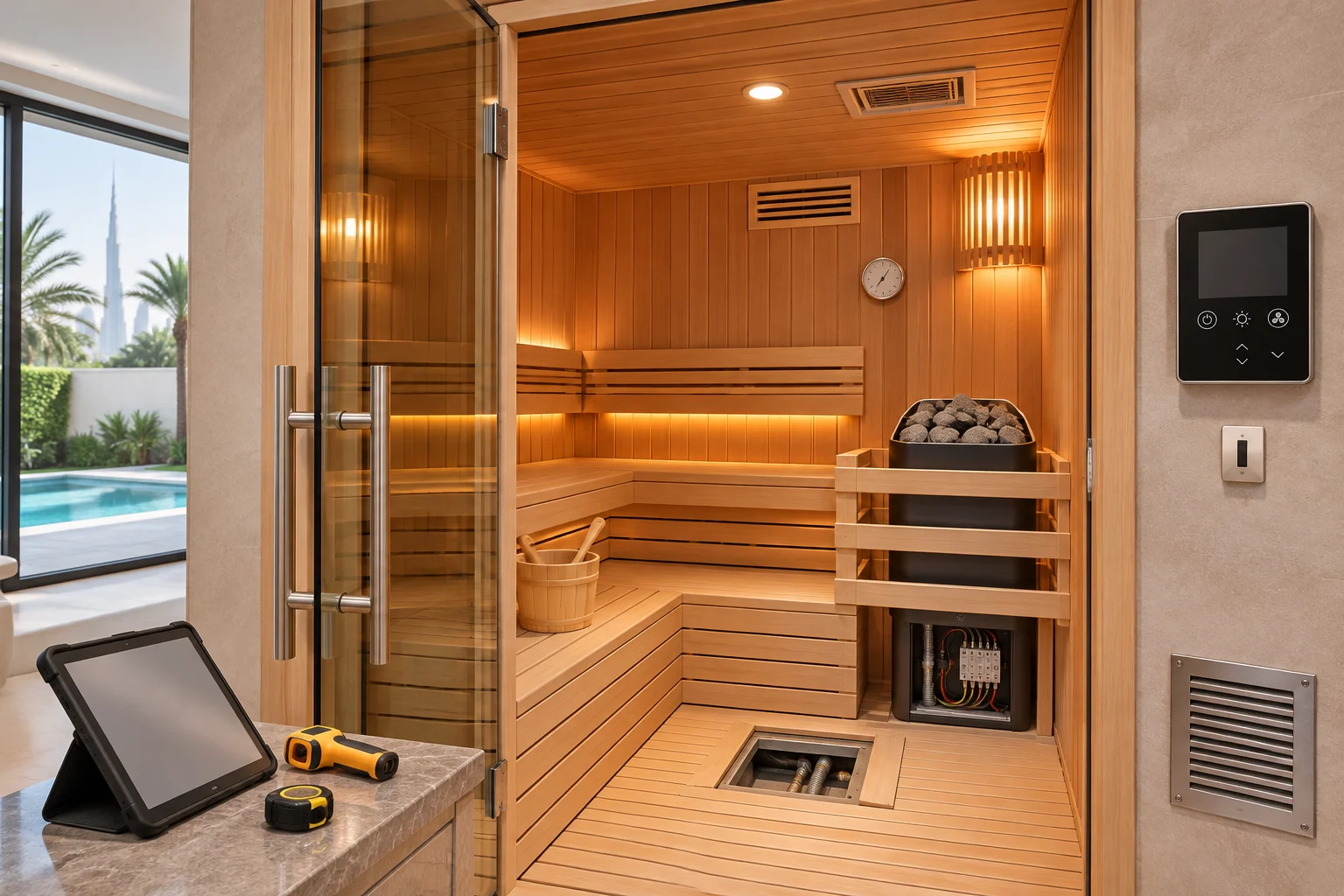
The accompanying image is a construction process illustration. It shows a dedicated dry timber sauna with a stone heater, guard, control, ventilation grilles and open inspection points during commissioning. It is not a wiring diagram, branded product reproduction or evidence of completed Veyrune work.
Use this fitted-sauna commissioning checklist
Agree the checklist before the final visit and adapt it to the selected sauna system. It is a homeowner handover framework, not a do-it-yourself test procedure.
- Record final heater, control, sensor, safety-device and lighting references
- Capture serial numbers, warranty providers and current manuals
- Verify the finished room basis against the selected heater system
- Document model-specific clearances, guard, stones and sensor location
- Inspect the door, glazing, benches, trim and cleaning access
- Confirm ventilation routes and demonstrate the agreed drying routine
- Demonstrate local controls, lighting, shutdown and supported fault information
- Enable remote features only with the required verified safety interfaces
- Separate household care from qualified specialist maintenance
- Issue as-built records, commissioning results and a tracked defects list
Frequently asked questions
01Is switching the sauna heater on enough for commissioning?
No. A useful process verifies the exact installed system and its interfaces: controls, sensor, ventilation, door, guards, lighting, access and documented settings, as applicable. It also records observations and outstanding items and provides an owner demonstration. The checks must follow the selected manufacturer's instructions and the appointed specialists' responsibilities rather than a generic online checklist.
02Which sauna documents should the owner receive?
Request the final equipment and finish schedule, serial numbers, product manuals, control and sensor information, ventilation and electrical as-built records, commissioning results, cleaning and maintenance guidance, warranty contacts and a defects list if anything remains open. The final package should describe the installed products, not earlier proposed models.
03Should remote-start controls be enabled at handover?
Only when the exact system, safety accessories, installation conditions, user permissions and manufacturer instructions support that function and the appointed specialists have verified it. Harvia describes door or safety switches for some remote-start arrangements, but that does not make them universal. Demonstrate local operation first and document what happens if the network or app is unavailable.
Sources and further reading
Harvia: Sustainable sauna experiences and sauna safety guidance ↗Checked Wednesday, 25 November 2026Harvia Support: Ventilation in the sauna ↗Checked Wednesday, 25 November 2026Tylö: Sense UB Bliss traditional sauna heater installation and operating instructions, revision B ↗Checked Wednesday, 25 November 2026Confirm current requirements for your property and selected equipment. Product examples do not imply a supplier relationship or local availability.
This is an editorial planning guide, not a property survey, approved design or installation specification. Project requirements are confirmed by the appointed specialists.
Let’s bring it back to your home.
Explore the complete service and share a first brief for your property.
Custom home saunas in Dubai