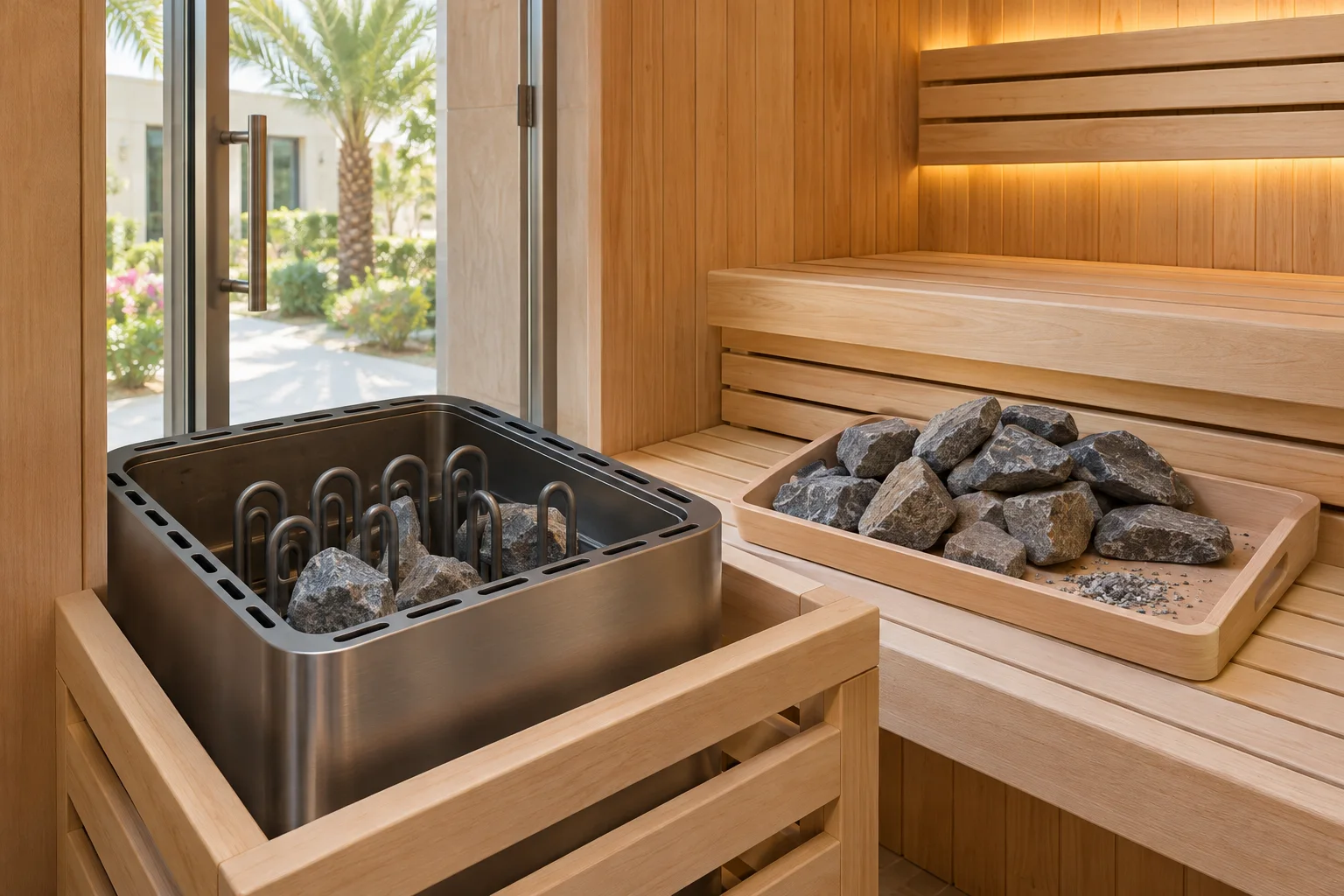
Treat heater stones as model-specific working components, not permanent decoration. Ask the supplier to record the approved stone type, size and quantity, demonstrate the correct arrangement, and define when the owner or technician should inspect, restack or replace them. Crumbling stones, debris below the heater, slow heating or a change in airflow deserve attention. Maintenance begins only when the heater is isolated and fully cool, and the selected manual controls every step. Keep spare stones, service details and a dated record with the sauna handover pack.
Give heater stones their own maintenance plan
Sauna heater stones sit through repeated heating, cooling and contact with water. Over time, some stones can fracture, crumble or settle more tightly in the basket. The room may still look immaculate while the stone compartment is gradually changing. That is why a complete home-sauna handover should identify stone inspection as a separate task rather than hiding it inside a generic cleaning paragraph.
Begin with the installed heater model. Record the approved stone specification, quantity, arrangement guidance and inspection method from its manual. Then define who may perform routine checks, when a qualified technician is required and how the owner records work. The correct plan follows the heater, not a social-media demonstration or stones chosen only for appearance.
Understand why stone condition affects the whole heater
The stone bed stores and transfers heat while allowing air to move through the heater. Harvia's current guidance explains that broken stones and debris can reduce airflow, contribute to slower heating and place greater thermal stress on electric elements. Its support information also recommends periodic restacking because stones settle and compact during use. These are manufacturer observations for its equipment, not a diagnosis for every heater.
A homeowner should notice changes without trying to diagnose electrical performance. Record loose fragments below the heater, visible crumbling, unusual settling, a new hot smell, slower warm-up or a change in the way water behaves on the stones. Share the observations with the supplier and follow the stop-use guidance in the installed manual.
Use the exact heater manual as the controlling document
Stone size, shape and permitted quantity vary with heater construction. An open-column heater, a compact wall model and a high-capacity floor heater do not necessarily use the same stones or arrangement. Harvia's stone guidance, for example, tells owners to check the selected heater manual and distinguishes common electric-heater sizes from larger stones used in some other models.
Ask the sauna supplier to include the final heater manual and stone product details in the handover pack. If the delivered heater differs from the proposal, update the plan before operation. A generic specification such as 'sauna stones included' does not identify whether the installed stones match the equipment.
Compare the maintenance plan through one evidence table
Require the same information from every sauna proposal. A concise table makes the ownership differences visible before the room is fabricated.
Swipe or scroll horizontally to compare all columns.
| Planning item | Evidence to request | Decision to close |
|---|---|---|
| Installed stones | Manufacturer, type, size, quantity and heater compatibility | What exactly should be reordered? |
| Initial arrangement | Model manual and supplier demonstration | How is airflow preserved without loading the elements? |
| Inspection | Permitted checks, warning signs and baseline interval | Who checks the stones and how is it recorded? |
| Replacement | Discard criteria and approved replacement product | Are some stones replaced or the complete charge renewed? |
| Access | Guard removal and service clearance in the final room | Can maintenance occur without damaging benches or glazing? |
| Safety | Isolation, cooling and technician-only conditions | Which observation means the heater stays off? |
| Handover | Manuals, spare stones, warranty and service contact | Can the next owner or technician identify the system? |
Choose stones by compatibility, not decoration
Natural-looking does not mean suitable for a sauna heater. The selected stones need to tolerate thermal cycling and fit the heater's geometry. Harvia advises against collecting unknown stones from nature and publishes different stone sizes and shapes for different products. Its guidance also limits some decorative stones to a top layer rather than treating them as a complete heater charge.
Ask the bidder to name the primary working stone and any decorative top stone separately. Confirm that both are permitted for the exact model. Retain a photograph of the supplied packaging or specification and keep enough matching replacement material only when the supplier recommends it. Do not mix leftover landscaping stone into the heater.
Define a safe inspection sequence without inventing DIY instructions
The plan should begin with the heater isolated, switched off and fully cool. The manual then controls whether the owner may remove stones, how guards or trims are handled and what parts must not be touched. The image in this guide shows a design concept with stones placed on a tray for inspection; it is not a universal maintenance procedure or a finished Veyrune project.
During permitted maintenance, stones and debris should not be dropped into the heater or onto timber. Electrical elements must not be bent, loaded or scraped. If an element appears displaced, discoloured or damaged, or if wiring or fixings are exposed, leave the system off and contact the qualified sauna technician.
Keep airflow central when stones are returned
Harvia's general electric-heater guidance says stones should be arranged evenly and sparsely enough for air to pass, supported by one another rather than wedged against heating elements. It also warns against a high pile above the heater frame. The exact pattern still belongs to the selected model manual because open-column and compact heaters manage their stone mass differently.
Ask the supplier to demonstrate the finished arrangement during commissioning and photograph the approved starting condition. That reference helps the owner notice later settling without encouraging guesswork. Never force extra stones into an available gap or reduce the quantity to change the heat-up character without written model-specific approval.
Connect stone care to cleaning and room ventilation
Stone debris should be removed using the method allowed by the heater manual, while the surrounding floor remains accessible for routine cleaning. Bench design and the heater guard should leave enough clearance for inspection. The ventilation and drying plan must keep the heater area free from stored towels, buckets or cleaning products.
Set the interval from use and evidence
A fixed annual date can be a useful reminder, but it is not proof that every stone charge lasts exactly one year. Harvia gives annual replacement as an example for a family sauna used around twice a week and advises more frequent attention in heavier use or when stone pieces appear below the heater. Another heater manufacturer may provide a different plan.
At handover, record the expected household use and the supplier's baseline interval. Add condition triggers that bring the inspection forward. If the sauna is used differently over time, ask the service provider whether the schedule should change rather than continuing with an interval based on the original assumption.
Use this sauna heater-stone handover checklist
Ask the supplier to complete and demonstrate this list for the selected heater. It is a planning checklist, not an instruction to service live electrical equipment.
- Record the final heater manufacturer, model and serial reference
- Name the approved stone type, size, shape and quantity
- Separate working stones from any decorative top layer
- Keep the exact heater and stone instructions
- Photograph the approved arrangement at commissioning
- Define the expected-use assumption behind the interval
- List debris, crumbling and performance changes to observe
- State the isolation and full-cooling requirements
- Identify owner-permitted and technician-only tasks
- Protect elements, fixings and timber during maintenance
- Provide safe access around the heater guard and benches
- Record each inspection, restacking and replacement date
- Keep compatible replacement stones only as advised
- Name the warranty and service contact
- Explain which condition means the sauna remains out of use
Frequently asked questions
01How often should home-sauna heater stones be changed?
There is no universal interval for every heater and pattern of use. Harvia gives once a year as an example for a family sauna used about twice weekly and recommends checking or rearranging stones at least annually, more often in heavy use. Follow the exact heater manual and supplier handover plan, and inspect sooner if debris, crumbling or changed performance is observed.
02Can any natural stones be used in a sauna heater?
No. The heater manual should specify the approved stone type, size, shape and quantity. Unknown stones can break down or behave unpredictably under repeated heating. Decorative stones may be permitted only as a limited top layer for selected systems. Ask the supplier to identify the installed product and retain the packaging or specification in the handover record.
03Can a homeowner restack electric-sauna heater stones?
Only if the selected manual permits owner maintenance and the heater is isolated, switched off and fully cool. The manual must guide removal, inspection and arrangement because stones must not overload or damage heating elements. If access, electrical condition, element position or stone suitability is uncertain, stop and use the appointed sauna technician.
Sources and further reading
Harvia: The Easy Guide to Looking After Your Sauna Stones ↗Checked Monday, 16 November 2026Harvia Support: How Often Should Heater Stones Be Changed in a Family Sauna? ↗Checked Monday, 16 November 2026Harvia: Sauna Heater Stones and Maintenance Guidance ↗Checked Monday, 16 November 2026Confirm current requirements for your property and selected equipment. Product examples do not imply a supplier relationship or local availability.
This is an editorial planning guide, not a property survey, approved design or installation specification. Project requirements are confirmed by the appointed specialists.
Let’s bring it back to your home.
Explore the complete service and share a first brief for your property.
Custom home saunas in Dubai