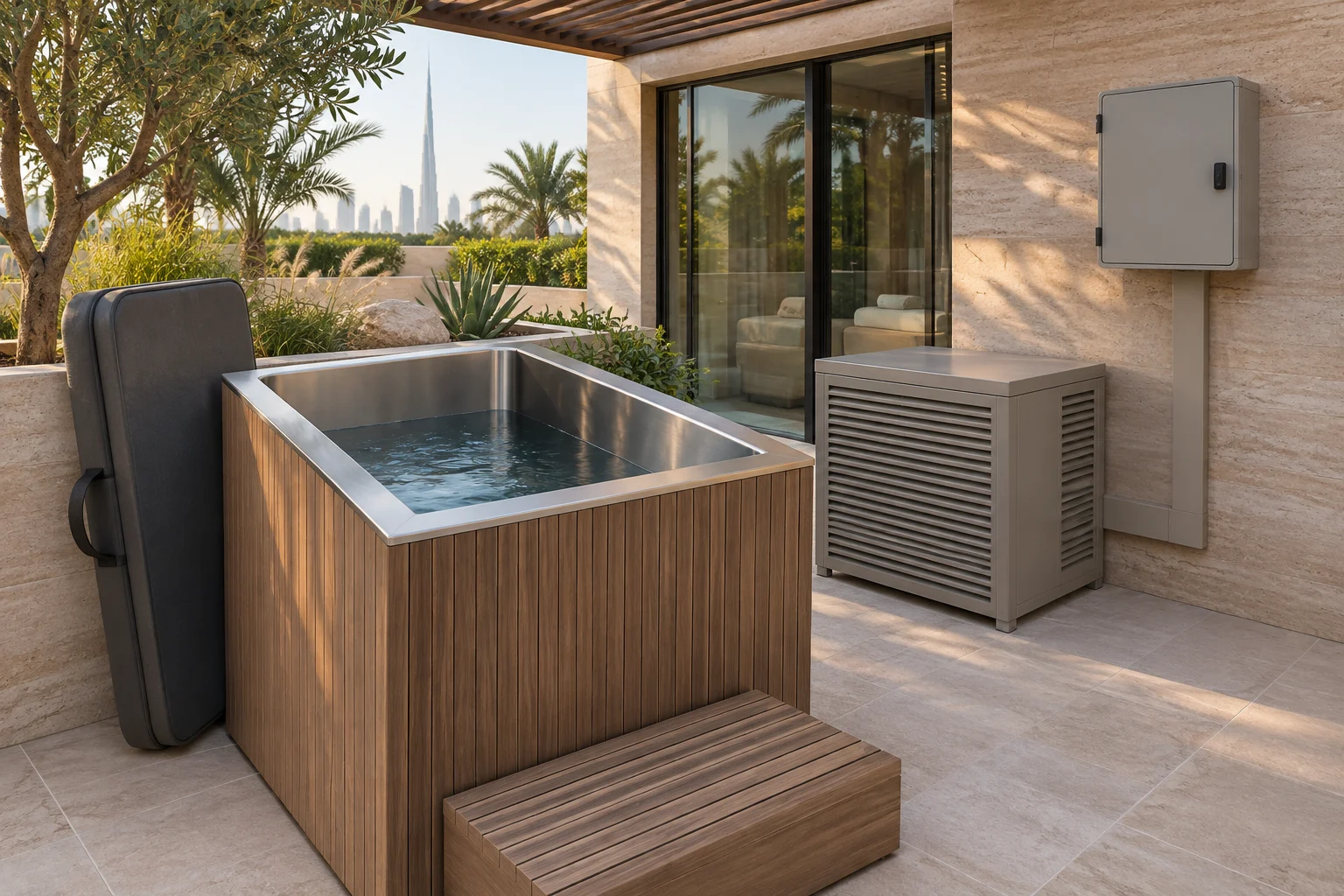
Do not approve a cold-plunge electrical allowance from the words ‘power point included’. Record the exact proposed model and nameplate data, connection method, manufacturer-required circuit and protection, cable route, outdoor enclosure strategy, isolation and equipment access. A qualified electrical specialist should coordinate those requirements with the property’s existing installation and current Dubai rules, then test and document the completed work. Different plunge models have materially different requirements, so a circuit copied from another product is not a specification.
Start with the exact model, not a generic power allowance
A cold plunge combines water, refrigeration or heat-pump equipment, circulation components and controls. Its electrical brief therefore starts with a selected model or a clearly defined design basis. Ask for the manufacturer, model, market version, nameplate voltage, frequency, rated current, connection type, cord length and current installation manual. If the product is still undecided, the proposal should label the electrical work as provisional and state the assumptions that must be rechecked before procurement.
Manufacturer requirements are not interchangeable. Plunge’s current electrical guide lists dedicated circuits with different ratings for different models, while Renu Therapy’s current specification page describes its own US-market products and connections. These are not Dubai installation specifications. The appointed electrical specialist must reconcile the selected equipment with the property supply and local requirements.
Compare proposals through one electrical responsibility table
Use the same headings for every proposal. A supplier may provide the plunge and cord while an electrical contractor provides the circuit, enclosure and testing; the scope must show where one responsibility ends and the next begins.
Swipe or scroll horizontally to compare all columns.
| Proposal item | Evidence to request | Decision to close |
|---|---|---|
| Product load | Exact model, nameplate and current manual | Is the allowance based on the equipment that will actually be delivered? |
| Supply and circuit | Voltage, frequency, current and manufacturer circuit requirement | Can the existing installation support it, or is coordinated work required? |
| Connection | Plug and receptacle or hardwired method, cord length and location | Can it be connected without extensions, strain or a wet crossing? |
| Protection | Specified protective devices and local electrical design | Who selects, installs, tests and records the protection? |
| Outdoor installation | Enclosure, fitting, conduit and water-ingress strategy | Are connections dry, weather-resistant, accessible and protected from irrigation or runoff? |
| Handover | Test records, circuit identification, manual and demonstration | What proves that the complete installed system was checked? |
Confirm the property supply before equipment is ordered
The existing distribution board, spare capacity, circuit route and any shared loads need review by the appointed qualified party. A nearby socket does not establish capacity, suitability or protection. Record whether the plunge is expected to share any services with a sauna, steam generator, pool equipment, outdoor kitchen or landscape system, then separate the requirements rather than assuming they can use one convenient feed.
If upgrades or long routes may be required, show them as a defined option or investigation item. The proposal should identify who checks the existing installation, who develops the electrical design, which approvals or property permissions are relevant, and what remains excluded. This keeps a late discovery from being disguised as an unexplained variation.
Keep connections dry, protected and maintainable
Outdoor electrical planning must account for more than rain. Irrigation, washdown, splash, condensation, groundwater and poorly sealed conduit can introduce moisture. DEWA’s 2024 circular on preventing water entry into distribution boards, conduits, junction boxes and accessories calls for IP65 weatherproof boxes, fittings and accessories for outdoor installations and proper sealing of external conduits. The electrical specialist determines the complete compliant arrangement for the actual location.
Place the connection and isolation where they remain dry and accessible. Do not hide a receptacle behind a full plunge if the protective device or plug must be inspected. Keep it clear of routine drainage and filter-rinsing routes. A neat design coordinates the tub, equipment ventilation, service doors and electrical enclosure as one maintainable zone.
Coordinate the cable route with the wellness layout
Draw the route from the distribution point to the plunge before finishes are approved. Note walls, floors, waterproofed surfaces, doors, landscape beds and movement joints. The route should not create a trip hazard, cross a drain path or depend on a loose lead across the terrace. Penetrations, sleeves and sealing responsibilities must be agreed before stonework and wall finishes close the route.
The selected product’s usable cord length matters. It may be shorter than the overall cord length because part remains inside the equipment. Do not stretch, coil, splice or extend it unless the current manufacturer instructions and electrical design expressly allow the proposed arrangement. If the final model changes, recheck the connection position before delivery.
Allow ventilation and service access around powered equipment
A plunge chiller or integrated equipment bay rejects heat and needs manufacturer-defined clearances. Renu Therapy’s current FAQ, for example, gives different clearance needs at its vents and links those spaces to maintenance access. That information is product-specific, but it illustrates the coordination issue: screening a unit tightly for appearance can undermine ventilation or make filters and controls unreachable.
Show the service envelope on the plan and confirm which panels open, where a technician stands, how components are removed and whether isolation remains visible. Keep storage, towels and planting out of required ventilation zones. Electrical enclosures and cable routes must not block the same access that the refrigeration or water-care equipment needs.
Define commissioning and stop-use conditions
The handover should join two sets of evidence: electrical installation records from the qualified specialist and product start-up records from the responsible equipment party. Agree who verifies the selected protective devices, circuit identification, enclosure condition, isolation, controls, circulation and normal operating sequence. Record serial numbers and the exact manuals supplied.
Homeowners also need a clear stop-use response. Plunge’s current guidance lists warning signs such as a hot or melted plug, arcing, buzzing, repeated immediate trips or water in an electrical compartment and says not to bypass the protective device or repeatedly reset the breaker. Use the selected manufacturer’s own instructions at handover, isolate the equipment as directed, and obtain qualified help rather than experimenting with a fault.
Use this cold-plunge electrical briefing checklist
Complete the checklist before procurement, revisit it after any model change, and close it again during commissioning. It is a scope-control tool, not a wiring guide.
- Record the exact manufacturer, model, market version and nameplate information
- Attach the current installation, electrical and warranty documents
- State the supply, circuit and connection assumptions used in the proposal
- Have the existing distribution board, capacity and route reviewed by the appointed specialist
- Identify who designs, supplies, installs, tests and approves each electrical element
- Confirm the permanent connection location without relying on an extension cord
- Show outdoor enclosure, fitting, conduit and water-ingress protection strategy
- Keep the connection and isolation dry, visible and safely accessible
- Coordinate cable routing with drainage, irrigation, waterproofing and finishes
- Preserve manufacturer ventilation and service-access clearances
- Recheck the electrical brief if the product model or location changes
- Define commissioning tests, records, circuit labels and responsible parties
- Provide manuals, serial records, normal shutdown and stop-use guidance
- Record exclusions, provisional allowances and property-specific approval responsibilities
Turn the checklist into a comparable proposal
A complete proposal should name the equipment basis, installation parties and deliverables instead of hiding them in an electrical allowance. It should distinguish the plunge supplier’s product warranty from the electrical contractor’s installation responsibility, identify any enabling work, and state what happens if the final model has a different load or connection. Ask bidders to price the same documented outcome so differences are visible.
For a Veyrune cold-plunge planning conversation, bring the preferred location, property electrical records if available, proposed plunge model and any linked sauna or wellness layout. The next useful step is a coordinated site and product review with the appointed specialists. That creates a model-specific, testable scope while keeping electrical design and installation with qualified parties.
Frequently asked questions
01Does every fitted cold plunge need the same electrical circuit?
No. Voltage, frequency, current, plug or hardwired connection, protective device and dedicated-circuit requirements vary by product and market. Current manufacturer information shows different circuit ratings even within one product family. Use the exact model nameplate and current installation manual, then have the appointed electrical specialist confirm compatibility with the Dubai property and applicable requirements.
02Can an extension cord be used temporarily for a cold plunge?
Do not assume it is acceptable. Plunge’s current support information prohibits extension cords for its listed models and warns about trips, overheating and unreliable operation. Other manufacturers may set their own conditions. Plan the permanent connection before delivery, follow the selected product documentation and never bypass a protective device or improvise a connection near water.
03What should be tested before the cold plunge is handed over?
The agreed commissioning plan should cover the electrical installation, protective devices, isolation, polarity and earthing or bonding arrangements as applicable, dry and accessible enclosures, equipment start-up, controls, alarms and normal operation. The exact tests and records are determined by the appointed qualified parties and selected product documents. The homeowner should also receive the model manual, circuit identification and stop-use procedure.
Sources and further reading
DEWA: Circulars and Regulations ↗Checked Tuesday, 10 November 2026DEWA: Requirements for Preventing Water Entry into Distribution Boards, Conduits, Junction Boxes and Electrical Accessories ↗Checked Tuesday, 10 November 2026Plunge Support: Electrical Requirements for Cold-Plunge Models ↗Checked Tuesday, 10 November 2026Renu Therapy: Specifications and Dimensions ↗Checked Tuesday, 10 November 2026Renu Therapy: Cold Plunge FAQ ↗Checked Tuesday, 10 November 2026Confirm current requirements for your property and selected equipment. Product examples do not imply a supplier relationship or local availability.
This is an editorial planning guide, not a property survey, approved design or installation specification. Project requirements are confirmed by the appointed specialists.
Let’s bring it back to your home.
Explore the complete service and share a first brief for your property.
Fitted cold plunges in Dubai