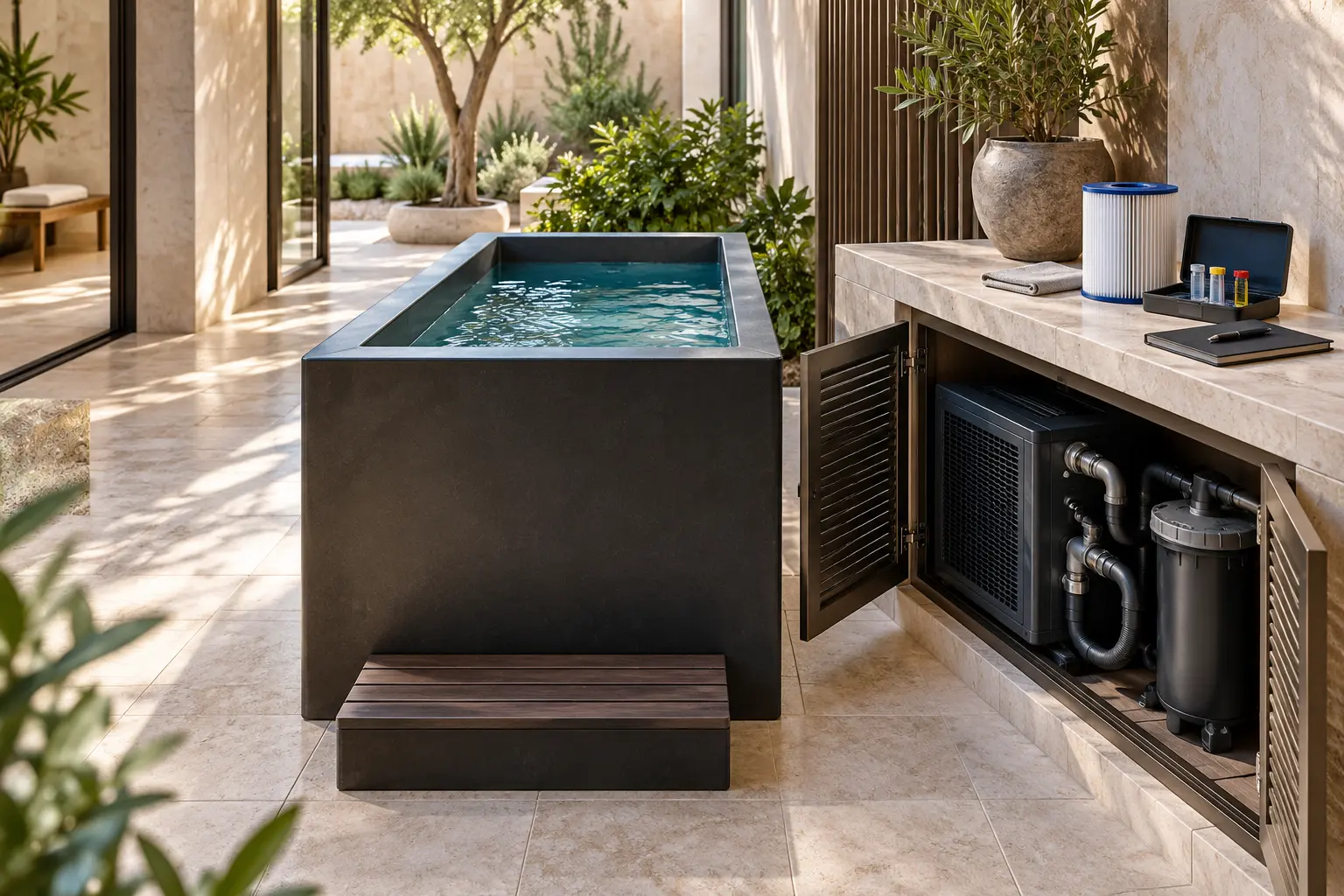
A chiller and a filter do not make a cold plunge maintenance-free. Before purchase, obtain the exact residential water-care protocol for the selected model, assign testing and cleaning responsibilities, provide practical filter and drain access, and keep records that help the owner recognise when to pause use and call the supplier.
Treat water care as part of the installation brief
A residential cold plunge contains a small shared body of recirculating water, often paired with cooling, a pump, filtration and one or more treatment features. Debris, body oils, refill-water characteristics, exposure and frequency of use all affect the routine, while restricted flow can affect equipment performance.
This guide organises the project and handover questions. It does not prescribe chemicals, exposure temperature or medical use. The selected manufacturer's current residential manual and qualified supplier determine the supported water-care method; a generic online recipe cannot safely replace that model-specific information.
Obtain one protocol for the exact model
Ask the supplier to identify the vessel, chiller, pump, filter, treatment features and regional manual by exact model. Request the residential water-maintenance document that applies to that combination and the actual refill water. Plunge's current support page says water chemistry can vary with local water quality and publishes separate residential chlorine and non-chlorine manuals. That alone shows why a brand name is not a complete care plan.
Sun Home's current support page likewise tells owners to use the manual for the exact model and publishes different tasks and intervals across its Horizontal, Vertical, Pro and Apex families. Do not combine the easiest instruction from several products. Record which document controls, its date or revision, and who answers questions after installation.
Separate the jobs that work together
Mechanical filtration captures material carried through the filter; it does not replace surface cleaning, water testing or the supported treatment method. CDC's current healthy-swimming guidance explains in a broader pool context that filters and disinfectants perform different jobs and work together. That public-health explanation is useful background, not a chemical specification for a private plunge.
Create a care plan with distinct lines for debris removal, water-line cleaning, filter or screen cleaning, replacement elements, testing, supported treatment products, water replacement, deep cleaning and inspection of hoses or connections. Assign each line to the owner, maintenance provider or equipment supplier. If one party assumes another is doing the work, the plan is incomplete.
Swipe or scroll horizontally to compare all columns.
| Care layer | Evidence to keep | Question for handover |
|---|---|---|
| Refill water | Supplier's accepted source-water assumptions and any required preparation | Does local water need testing or treatment before filling this model? |
| Filtration and flow | Filter part reference, screen locations and model-specific change or cleaning criteria | What observation or alert means circulation should be checked? |
| Water testing | Supported test method, target information from the exact protocol and record sheet | Who tests, records and responds to results? |
| Cleaning | Approved surface products and method for the vessel and equipment | Which cleaners or tools could damage the finish or warranty? |
| Drain and refill | Confirmed emptying route, reset steps and restart checks | Where does water go and who confirms the system is ready to restart? |
| Support | Warranty provider, service contact and pause-use triggers | When should the owner stop and call the supplier? |
Design access around the maintenance routine
The care plan should influence the room or garden layout. Show the filter housing, screens, drain, fill point, water-sampling position, valves and service panels on the equipment drawing. Preserve the manufacturer's ventilation and access requirements, plus a clean route to remove a wet filter or carry care supplies without crossing dry clothing storage.
Plunge's current Evolve Pro-care article warns that failure to change the filter can reduce flow and damage the system. Sun Home's current guidance similarly links regular filter care with strong flow and asks owners to keep the chiller area clean and ventilated. Those are product-specific examples of a general project lesson: decorative screening and built-in joinery must not obstruct the tasks named in the actual manual.
Plan refill water and first-fill evidence
Ask what information the supplier needs about the property's water source and whether any pre-fill testing or preparation is required. Plunge's support material notes that local water quality can change the appropriate protocol and highlights calcium concerns for some source water. The correct response is not to guess a treatment from that note; it is to obtain the selected model's instructions and a supplier decision for the property.
At first fill, record the water source, date, installed filter, supplier-confirmed protocol and any initial test results the qualified commissioning party takes. Keep that record with the equipment serials and manual revision. It gives the owner a reliable starting point and prevents later carers from inventing the original setup.
Define a routine that can change with use and exposure
A useful schedule has a baseline and escalation rules. Plunge labels its published Evolve Pro residential intervals as minimum requirements and says outdoor dirt or water changes may require more frequent service. Sun Home varies filter replacement guidance by model and frequency of use. The lesson is not that one brand's interval should become a universal Dubai rule; it is that the owner needs both a starting schedule and clear signs for earlier action.
Ask the supplier to list those signs in plain language: visible debris or film, reduced flow, a product alert, readings outside the supported protocol, unusual odour or appearance, a contamination event, leakage or an extended period out of use. The plan should say when routine owner work is enough and when use should pause for specialist advice.
Give drain, clean and refill tasks a property route
Show how the vessel and connected equipment are emptied for scheduled water changes, cleaning, servicing or a prolonged shutdown. Identify the hose or drain connection, isolation points, route through the room or garden and the proposed discharge destination. The appointed property specialists must confirm that destination against the actual water-care products, drainage system and applicable requirements.
Also plan how the vessel is physically cleaned and refilled without wetting equipment or trapping water inside cabinetry. The exact restart sequence belongs to the manufacturer and commissioning specialist. At handover, the owner should know who performs it and where the model-specific procedure is stored.
Use this cold-plunge water-care checklist
Before approving the installation and handover, confirm that each item has a model-specific answer. This checklist is a briefing tool, not a substitute for the selected manual.
- The exact vessel, chiller, pump, filter and treatment features are named
- The current regional residential manual and water-maintenance protocol are supplied
- Refill-water assumptions and any required testing or preparation are confirmed
- Filter, screen and consumable part references are recorded
- The baseline schedule and signs requiring earlier action are written down
- Testing method, responsible person and response route are assigned
- Only product-approved care and cleaning materials are listed
- No ozone, UV or filtration feature is presented as maintenance-free
- Filter housings, screens, drains and panels remain accessible after fit-out
- Chiller airflow and service access remain clear of storage and towels
- Drain, cleaning-water and refill routes are confirmed for the property
- Commissioning records the starting condition, manual revision and open actions
- The owner knows which observations mean pause use and contact support
- Warranty provider, local service route and replacement-parts source are documented
Make the handover usable on an ordinary week
Ask the commissioning party to demonstrate the normal checks, identify the components the owner may access, and state which work remains for trained service personnel. The handover pack should include manuals, model and serial details, first-fill record, care schedule, log template, filter references, approved products, warranty contact and any unresolved item. Store a copy where future maintenance providers can find it.
For a Veyrune cold-plunge discussion, share the selected or preferred product, location, equipment access, refill-water source and proposed drain route. The next step is a property-specific installation and ownership brief that the actual equipment supplier and appointed specialists can verify together.
Frequently asked questions
01Does a cold plunge with ozone or UV need no other water care?
Do not infer that from one feature label. Filtration, circulation, cleaning, testing and any product-approved sanitizer or treatment must be considered together. Ask the supplier for the current residential protocol for the exact model and installation conditions. A manufacturer may support different methods across product families, and public or commercial guidance should not be copied into a private unit without model-specific review.
02How often should cold-plunge water and filters be changed?
There is no responsible universal interval. Current Plunge and Sun Home guidance publishes different schedules for different residential models, use levels and conditions. Follow the exact manual, record the starting schedule at handover and ask what observations require earlier cleaning, replacement, draining or supplier support. Do not transfer an interval from another brand or a commercial installation.
03Can cold-plunge drain water go into the garden in Dubai?
Do not assume so. The route depends on the water-care products used, the volume, the property drainage arrangement and applicable authority or community requirements. Ask the appointed property specialists to confirm a suitable filling, emptying and cleaning-water route before the vessel is installed, and keep it accessible after cabinetry and landscaping are complete.
Sources and further reading
Plunge Support: residential water-maintenance manuals and model-specific protocols ↗Checked Wednesday, 21 October 2026Plunge Support: caring for an Evolve tub and Pro chiller ↗Checked Wednesday, 21 October 2026Sun Home Support: model-specific cold-plunge maintenance and manual links ↗Checked Wednesday, 21 October 2026CDC Healthy Swimming: filtration and disinfection perform different functions ↗Checked Wednesday, 21 October 2026Confirm current requirements for your property and selected equipment. Product examples do not imply a supplier relationship or local availability.
This is an editorial planning guide, not a property survey, approved design or installation specification. Project requirements are confirmed by the appointed specialists.
Let’s bring it back to your home.
Explore the complete service and share a first brief for your property.
Fitted cold plunges in Dubai