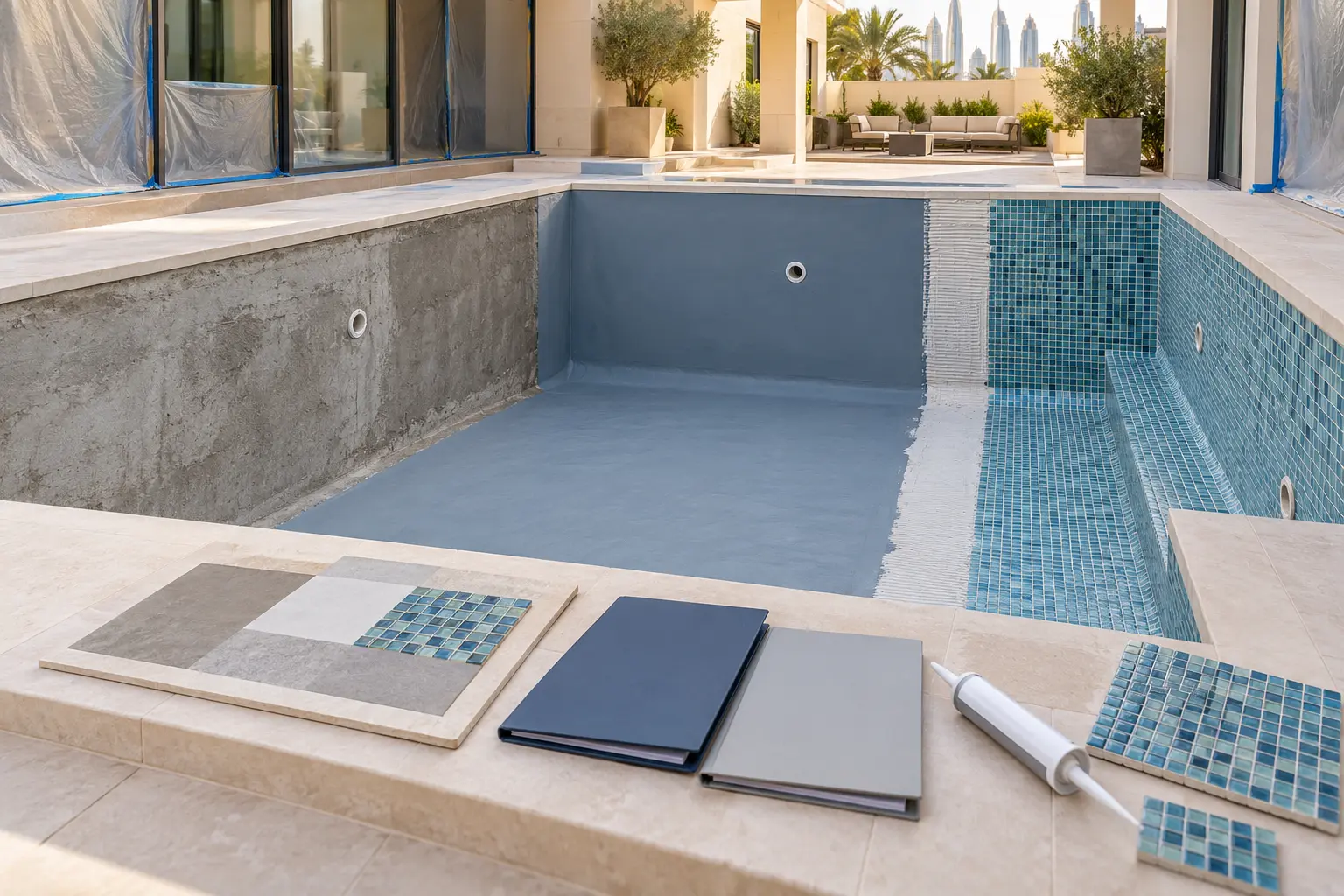
Do not compare a pool retiling proposal by mosaic rate or a generic waterproofing line item. First define what will be removed and investigated, then compare the complete named system from substrate repair through waterproofing, joint details, adhesive, grout and sealant, with inspection hold points, tests, protection and responsibility recorded.
Compare a diagnosed renovation scope, not a tile quotation
A leaking, hollow, stained or dated pool can have several overlapping conditions. The visible mosaic may be one issue, while the shell, old render, penetrations, movement joints, pipework or pool-to-terrace interfaces create others. A quotation that begins with square metres of tile can hide different assumptions about what remains below it.
Start with an existing-condition record and a common investigation brief. Identify known symptoms, previous repairs, operating history, water-loss observations, finish condition, structural concerns and accessible service information. State which areas can be opened before final pricing and how unforeseen findings will be documented. This turns a vague refurbishment allowance into a comparable renovation scope.
Require a layer-by-layer system schedule
Every proposal should name the work from retained structure to finished surface: removal, substrate assessment, repair or levelling, junction treatment, waterproofing, adhesive, tile, grout and movement-joint sealant. Add primers, tapes, trims and proprietary accessories where the selected system requires them. Record exact regional product references and current technical documents rather than accepting or equivalent without an approval process.
Sika GCC's current swimming-pool tiling guidance presents a complete sequence including surface preparation, waterproofing tape, waterproofing mortar, tile adhesive, grout and sealant. Its broader tiling-system page also says the correct system includes preparation, waterproofing where required, adhesive, grout and sealant. These are useful comparison principles, not a Veyrune specification: the actual proposal must be selected and accepted for the existing pool by the responsible specialists.
Swipe or scroll horizontally to compare all columns.
| Scope layer | Evidence to compare | Common ambiguity to remove |
|---|---|---|
| Removal and investigation | Limits, protection, disposal and opening-up record | Remove loose tiles only |
| Substrate and repairs | Acceptance criteria, repair categories and levelling responsibility | Make good as needed |
| Waterproofing and details | Named system, accessories, junction drawings and inspection plan | Two coats waterproofing |
| Tiling and joints | Exact adhesive, tile, grout, joint layout and sealant scope | Premium mosaic installed |
| Testing and handover | Purpose, timing, acceptance, records and responsible signatories | Test and guarantee included |
Define what happens after strip-out reveals the substrate
A major renovation needs a controlled decision point after removal. Ask each bidder to distinguish included repair quantities or categories from provisional items, and define how additional findings will be measured, photographed, priced and approved. Record who decides whether the exposed substrate is suitable to receive the proposed system and whether the shell or any cracks need separate engineering review.
Do not force certainty where concealed conditions are genuinely unknown. A strong proposal can acknowledge uncertainty while creating a fair process: agreed opening-up zones, an attributable inspection, priced repair options where practical, a change record and a release before new layers hide the evidence. This is more useful than a low fixed figure built on silent exclusions.
Give penetrations, joints and edges their own details
Pool failures and disputes often concentrate at transitions rather than open wall areas. List lights, inlets, outlets, drains, skimmers, channels, pipe sleeves, steps, benches, construction or movement joints, wall-to-floor corners and the pool-to-coping interface. Match each location to an accepted detail and number it on drawings or photographs before concealment.
Manufacturer system literature separates joint tapes or sealing systems from the field-applied waterproofing and separates movement-joint sealant from tile grout. That is a reminder to ask how each junction is designed, not an instruction to mix products from an example system. Confirm compatibility, substrate preparation and sequencing with the selected supplier and responsible designer for the actual pool.
Compare compatibility and responsibility across the whole system
A list of familiar product names is not automatically a compatible system. Ask whether the repair material, waterproofing, accessories, adhesive, finish, grout and sealant are documented to work together under permanent immersion and the property's treatment conditions. If more than one manufacturer is proposed, identify who accepts each interface and who supports a warranty claim involving the boundary.
Record the applicator, technical-review contact, inspection responsibility and warranty provider separately. A product warranty, an applicator warranty and a contractor's workmanship obligation may cover different things. Require written terms and exclusions rather than converting a warranty duration into a promise that every cause of leakage or finish failure is covered.
Plan samples, sequencing and hold points before installation
Approve the visible finish with a representative sample that combines tile, joint width, grout colour, sealant colour and relevant edge or corner treatment. Review it in the property's daylight and evening lighting. A loose sheet of mosaic does not show the installed joint pattern, transition or overall tone, and a digital image is not a colour acceptance record.
The programme should include hold points after substrate exposure and repair, after critical junction detailing, before tiling, after the approved sample and before refilling. Product data governs preparation, environmental limits, curing and protection for the selected materials; do not copy durations from another system. Define who can release each stage and how damage by later trades returns to inspection.
Make tests specific about purpose and boundary
The inspection and test plan should distinguish shell observations, service-pipe pressure tests, waterproofing checks and final operating observations. Passing one does not prove the others. Ask what is being tested, when, under whose procedure, against which acceptance criterion and how the result is recorded. If a water-retention stage applies, the responsible parties should define it for the selected system and site conditions.
Dubai Municipality publishes a current technical-guidelines index that includes guidance for approval of swimming-pool plans. Authority and community requirements can change and the exact project path depends on scope and property. Ask the appointed designer or contractor to identify applicable approvals and inspection records; a renovation quotation should not imply that generic product literature replaces local project obligations.
Use this waterproofing and retiling proposal checklist
Put all bids into the same comparison schedule and resolve exclusions before appointment. This is a homeowner project-control checklist, not an application method.
- Known symptoms, previous repairs and existing records are issued to every proposer
- Removal limits, access protection, debris handling and disposal are included
- Opening-up and post-strip-out review have named participants and a written outcome
- Retained shell, render, pipework and fittings are identified rather than assumed
- The complete build-up names regional repair, waterproofing, tiling and joint products
- Product compatibility and responsibility for mixed-manufacturer interfaces are explicit
- Every penetration, corner, joint, channel and coping interface has an accepted detail
- Repair allowances, provisional items and the variation method can be compared
- A representative finish, grout and joint sample is approved before full installation
- Hold points, tests, acceptance criteria, curing and protection responsibilities are scheduled
- Authority or community approval responsibilities are identified for the actual scope
- Cleaning, filling, commissioning, reinstatement and landscape interfaces are priced visibly
- Handover records, care information, warranty parties and exclusions are listed
Close the concealed evidence before refilling
At completion, assemble the accepted system schedule, batch or delivery traceability, substrate and repair records, detail photographs, inspection releases, test results, approved sample, finish references and closed-item list. Add commissioning information and the final location of concealed fittings or joints. Hundreds of unlabelled site photographs are less useful than a compact record tied to drawings and dates.
For a Veyrune pool-renovation discussion, share the current pool photographs, known symptoms, finish preference and any existing drawings or repair history. The practical next step is a comparable investigation and system brief that the appointed designer, contractor and selected manufacturers can verify before the visible retiling work begins.
Frequently asked questions
01Can a pool be retiled without removing the existing tiles?
That cannot be decided from appearance alone. The responsible designer and specialist should assess the existing finish, substrate, geometry, interfaces, moisture condition and compatibility of the proposed system. If an overlay is proposed, request the exact manufacturer's accepted build-up, preparation and limitations in writing. Do not treat reduced demolition as proof of a lower-risk solution.
02Is epoxy grout a substitute for pool waterproofing?
No. Grout is one component of a tiled finish and should not be presented as the pool's complete waterproofing strategy. Current manufacturer system guidance separates substrate preparation, waterproofing, joint detailing, adhesive, grout and movement-joint sealant. The appointed specialists should specify a compatible build-up for the actual shell and intended finish.
03What should be included in a pool waterproofing and retiling handover?
Request the accepted system schedule, product and batch traceability, drawings and detail references, substrate and repair records, inspection and test results, photographs before concealment, approved sample, installed finish and grout references, movement-joint record, commissioning information, care guidance, warranty parties and a closed defects list. Keep responsibilities and exclusions attributable.
Sources and further reading
Sika GCC: tiling in and around swimming pools as a complete system ↗Checked Thursday, 22 October 2026Sika GCC: tiling-system selection includes preparation, waterproofing, adhesive, grout and sealant ↗Checked Thursday, 22 October 2026Sika: Tiling System Solutions brochure with swimming-pool system layers ↗Checked Thursday, 22 October 2026Dubai Municipality: Health and Safety Department technical guidelines index ↗Checked Thursday, 22 October 2026Confirm current requirements for your property and selected equipment. Product examples do not imply a supplier relationship or local availability.
This is an editorial planning guide, not a property survey, approved design or installation specification. Project requirements are confirmed by the appointed specialists.
Let’s bring it back to your home.
Explore the complete service and share a first brief for your property.
Major pool renovations in Dubai