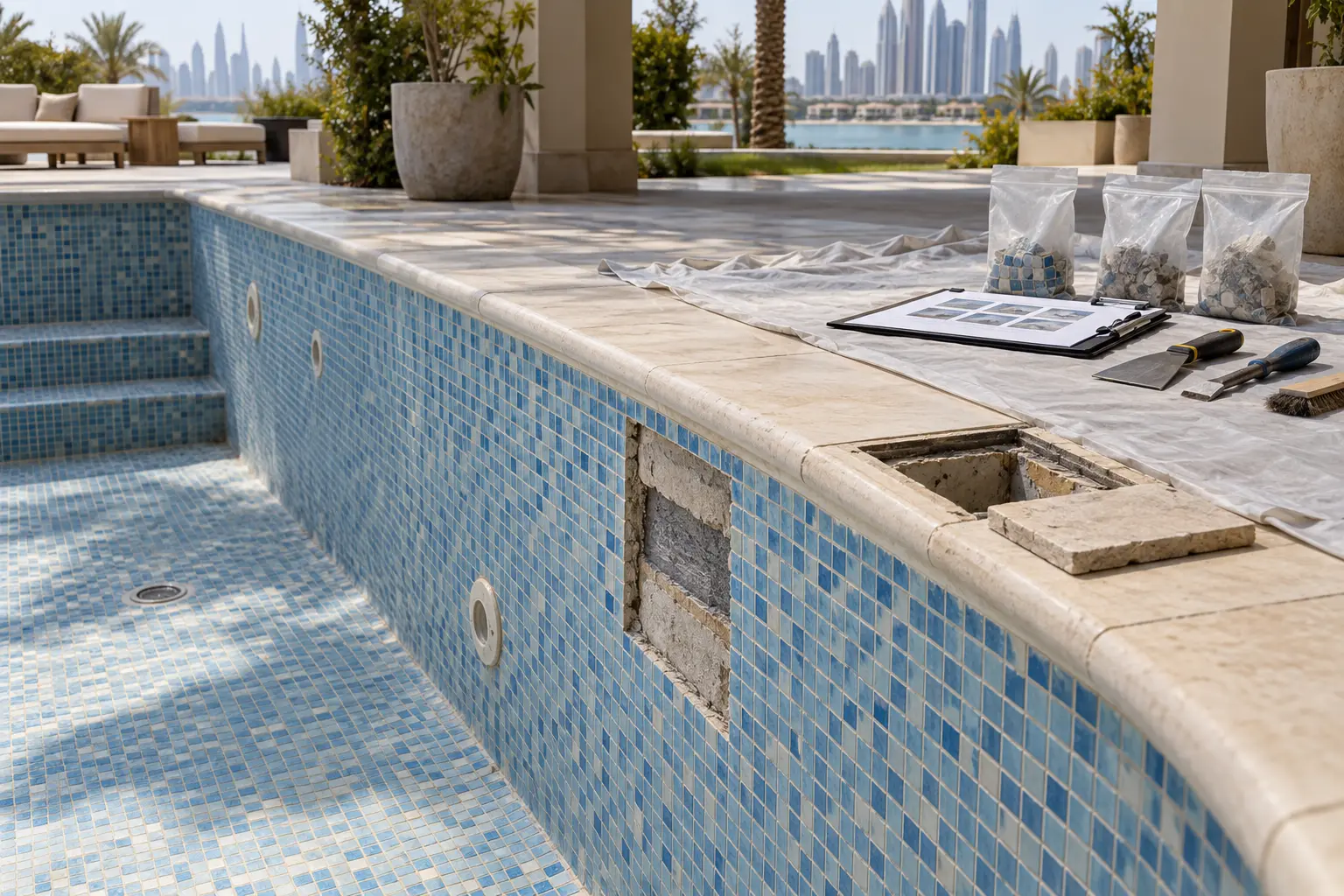
Do not strip an entire pool simply to discover what condition it is in. Begin with a written investigation plan: state the decisions the team needs to make, select the smallest representative openings that can answer them, record the existing layers and concealed interfaces, and define who interprets the findings. Use each finding to confirm, revise or stop the proposed renovation scope before wider removal or material orders begin.
Investigate to answer decisions, not simply to expose more work
Opening-up is useful when it changes a real decision: retain or remove a finish, repair or rebuild an interface, reuse or replace a concealed route, or proceed with a proposed edge and terrace detail. Begin with those decisions in writing. For each one, state what is known, what remains an assumption, what evidence could resolve it and who is qualified to interpret the result.
This turns investigation into a bounded stage rather than uncontrolled demolition. The initial scope can include a condition survey, drain-down, selected test areas, cleaning, access and temporary protection. It should also identify what is excluded, such as structural conclusions, underground pipe locations or waterproofing performance that the chosen methods cannot establish.
Create a condition map before removing anything
Photograph the pool as found and divide it into named zones: steps, shallow floor, deep floor, waterline, walls, outlets, lights, skimmers or channel, coping, terrace interface and plant area. Mark visible symptoms and earlier repairs on a simple plan. Include dates and water level or operating status so later reviewers understand the observation context.
Do not diagnose from appearance alone. Discolouration, hollow-sounding finish, a cracked joint or recurring water loss can have more than one cause. The condition map helps the specialists select useful test locations and prevents the most visibly damaged patch from being treated as representative of every surface. It also preserves evidence before cleaning or removal changes the scene.
Choose representative openings and define their limits
A useful opening has a location, purpose, size, method, responsible party and planned record. The team might compare a visibly affected area with an apparently sound area, inspect a repaired junction, expose the build-up at a coping edge or confirm how a fitting meets the surrounding finish. The appointed specialist determines where opening is safe and what must remain untouched.
Record each revealed layer in sequence, with overview and close photographs, approximate dimensions and any product information that can be verified. Do not assign a material name from colour or texture alone. If a laboratory test or specialist assessment is needed, identify the sample chain, question and decision it supports rather than ordering an unfocused bundle of tests.
Swipe or scroll horizontally to compare all columns.
| Question | Possible evidence stage | Limit to record |
|---|---|---|
| Can the visible finish be retained? | Mapped condition review and selected comparison openings | A few locations do not prove the whole surface |
| What build-up is present? | Layer-by-layer record at an agreed test area | One edge may differ from floors, walls or repairs |
| Can an interface support the new design? | Opening at the exact coping, penetration or terrace junction | The responsible designer must interpret compatibility |
| Is a concealed route serviceable? | Defined test, access review or trace by the appointed specialist | A result applies only to the tested boundary |
| What should be priced next? | Findings schedule linked to retain, repair, replace or investigate | Unknowns remain explicit, not silently included |
Keep finishes, structure and services as separate evidence questions
Removing mosaic can reveal a substrate, but it does not by itself establish structural condition, pipe integrity or the performance of an existing waterproofing system. Likewise, a pressure observation on a defined line does not explain a crack or prove every concealed fitting. Ask each specialist to state the boundary of the check and avoid combining unrelated conclusions into one passed inspection.
Coordinate investigations so one trade does not destroy evidence needed by another. Before removal, identify embedded lights, fittings, pipes, joints and earlier repair locations. Where a new edge, overflow detail or equipment route is proposed, include that interface in the investigation plan rather than discovering the conflict after the design has been ordered.
Check the property-specific permit route before destructive work
The approval route depends on the property, community, authority and extent of work. Dubai Development Authority's current maintenance-permit service, for example, requests a photograph of the building's current status and a method of repair for a new permit. Its maintenance-completion service links completion to the approval and may require an owner NOC and consultant compliance certificate. These are DDA examples, not universal requirements for every Dubai pool.
Ask the appointed team to identify whether the proposed investigation, repair, modification or pool drawing needs community or authority review before work starts. Dubai Municipality lists approval of public and private swimming-pool drawings as a service and maintains a technical guideline for that submission route. A previous pool approval should not be assumed to authorise a changed layout or system.
Use findings to pass through clear decision gates
After each investigation stage, update a findings schedule with four possible outcomes: confirmed for the proposed scope, scope revision required, more evidence required or stop and obtain specialist advice. Link every finding to its location, photograph, reviewer and affected quotation item. Do not leave the interpretation in a messaging thread or rely on a verbal site comment.
Release wider removal only when the evidence supports it and the next scope is understood. Release finish orders only when the relevant substrate, geometry and junction decisions are sufficiently defined. If findings change cost or programme, follow the project's written variation process before affected work proceeds. This makes investigation a decision tool instead of an open-ended cost centre.
Use this pre-renovation investigation checklist
Before the first tile or coping unit is removed, confirm the following with the appointed team. This is a planning checklist, not a technical investigation method.
- Existing condition is mapped with dated overview and close photographs before cleaning or removal
- Each opening answers a named decision and has an agreed location, size, method and responsible specialist
- Property-specific community and authority requirements are identified before destructive work
- The team distinguishes finish, substrate, structure, waterproofing, pipework and equipment questions
- Nearby fittings, services and interfaces are identified and protected before work starts
- Evidence requirements include layer records, location references, samples and the limits of each conclusion
- Temporary protection, safety, water control, waste route and reinstatement are included in the investigation scope
- Findings are classified as retain, repair, replace or investigate further, with an attributable reviewer
- Quotation assumptions and provisional allowances are updated from evidence rather than hidden in a revised total
- Wider removal and material orders wait for the relevant written decision gate
Turn the investigation into a buildable renovation scope
The output should be a concise pack: existing-condition plan, opening register, photographs, verified layer descriptions, test records, specialist comments, approval notes, updated drawings and a decision schedule. The revised quotation should show confirmed work, optional upgrades, remaining provisional items, exclusions, protection, waste handling and reinstatement. Keep unresolved risks visible rather than forcing premature certainty.
For a Veyrune pool-renovation discussion, share the pool layout, visible symptoms, earlier repair information and the changes you want. The practical next step is to separate the investigation stage from the final renovation order, then let the appointed specialists define safe methods and interpret the evidence for your property.
Frequently asked questions
01Can a pool-renovation contractor give a fixed price before any opening-up?
A contractor can price visible and defined work, but concealed conditions may need assumptions or provisional allowances. Ask the proposal to separate confirmed scope from assumptions, state which small investigations would reduce uncertainty and explain how later discoveries are valued. A headline fixed price is not useful if the exclusions transfer every concealed risk back to the homeowner.
02Does opening a few pool tiles prove the condition of the whole pool?
No. A test area shows only the location examined. Choose areas from different conditions or interfaces, record why each was selected and state the limits of the conclusion. The responsible specialists decide whether the sample is representative or whether additional investigation is required before extending the finding across the pool.
03Should investigation openings be repaired immediately?
Agree this before work starts. Some openings may be temporarily protected while findings are reviewed; others may need prompt reinstatement under the selected system. Record who protects the area, the permitted exposure period, the repair method and whether the repaired area must be inspected again. Do not improvise a patch that hides the evidence or conflicts with the future renovation build-up.
Sources and further reading
Dubai Development Authority: Maintenance Permit ↗Checked Tuesday, 13 October 2026Dubai Development Authority: Maintenance Completion Certificate ↗Checked Tuesday, 13 October 2026Dubai Municipality: Technical Guidelines List, including approval of swimming-pool plans ↗Checked Tuesday, 13 October 2026Confirm current requirements for your property and selected equipment. Product examples do not imply a supplier relationship or local availability.
This is an editorial planning guide, not a property survey, approved design or installation specification. Project requirements are confirmed by the appointed specialists.
Let’s bring it back to your home.
Explore the complete service and share a first brief for your property.
Major pool renovations in Dubai