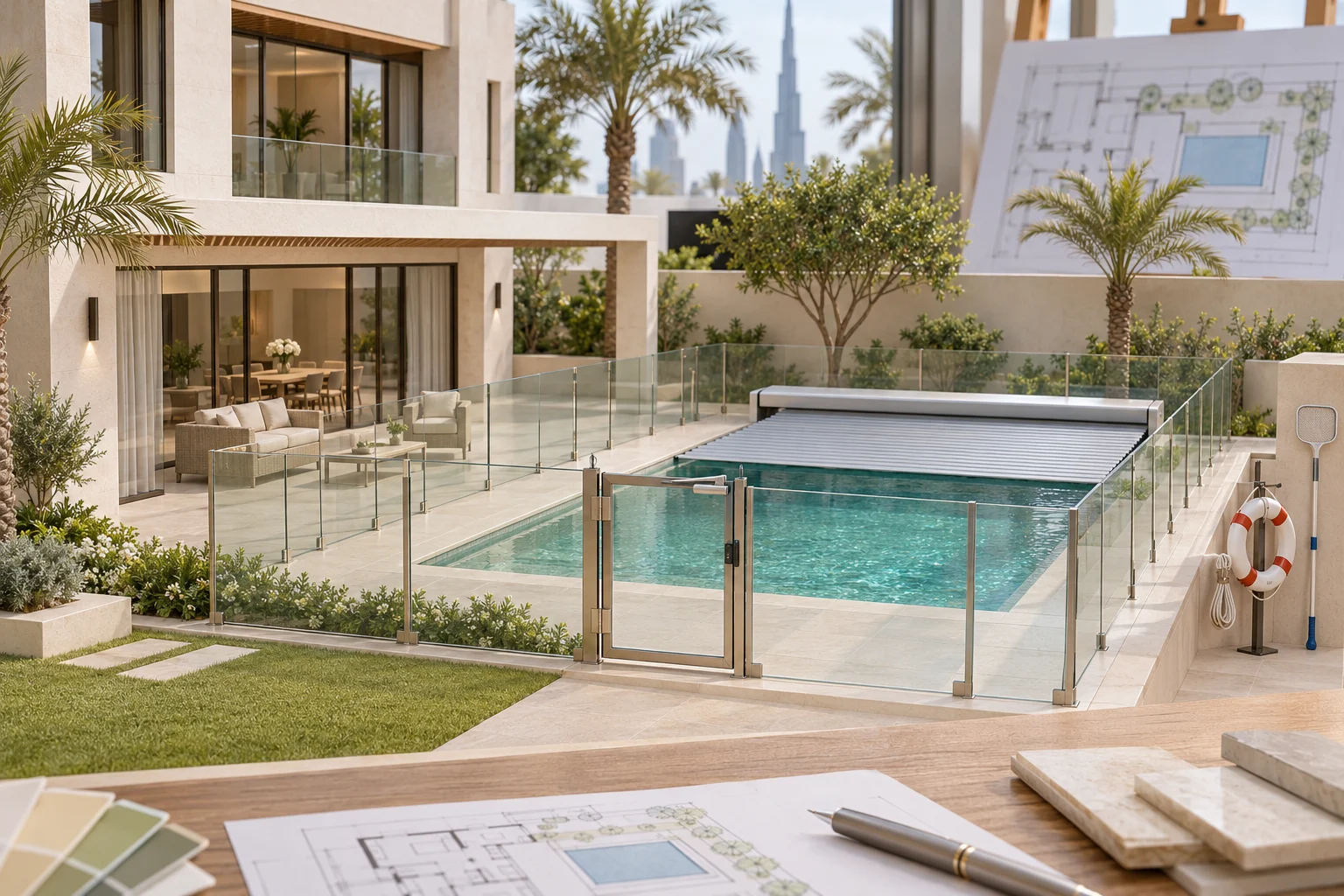
No single device makes a villa pool child-safe. Begin with constant capable adult supervision, then plan independent layers: controlled access from the home and garden, a compliant barrier and gate, clear sightlines, an appropriate cover or alarm strategy, safer suction-outlet design, rescue equipment and a rehearsed response plan. Confirm the exact Dubai authority, community and property requirements for the project; supplemental international guidance is useful for briefing but is not a substitute for local approval or specialist review.
Start with layers, because every single layer can fail
A pool barrier can be left open, an alarm can be switched off, and a cover can be open while the pool is in use. That is why child-safety planning should not be reduced to one product. The US Consumer Product Safety Commission and the Pool Safely programme both frame drowning prevention around multiple layers, including supervision, barriers, alarms, safe drains and emergency readiness. Use those principles to structure the brief while the Dubai project team confirms the rules that actually apply to the property.
The first layer is active, capable adult supervision whenever children can reach or use the pool. Design cannot replace that responsibility. It can slow unsupervised access, improve visibility, reduce foreseeable hazards and put rescue tools within reach. Record each layer, who maintains it and how failure is noticed.
Map every route from the villa and garden to the water
Draw an access plan before choosing the fence style. Mark doors, gates, service paths, outdoor kitchens, guest suites, play lawns and boundaries. Include level changes and objects a child could move or climb.
Decide which doors and gates form part of the controlled perimeter. Where the house forms a boundary, ask how door hardware, alarms and adult routines support that role. Keep plant-room and chemical-storage access separate from children's circulation.
Compare the access-control layers as one system
A useful concept comparison shows what each layer does and what it cannot do. The numbers and construction details must come from the applicable requirement and selected manufacturer's documents; do not copy a foreign dimension into a Dubai drawing without review.
Swipe or scroll horizontally to compare all columns.
| Layer | Useful role | Questions the brief must close |
|---|---|---|
| Perimeter barrier | Delays direct access and defines the controlled pool zone | What height, openings, non-climbable zones, ground interfaces and structural specification apply? |
| Self-closing, self-latching gate | Restores the barrier after normal entry | Does it close and latch from every permitted open position, and is the latch protected from child operation? |
| Door controls or alarms | Warn when a route through the villa is opened | Which doors are covered, who can disable the alert, and how is status checked? |
| Safety cover | Adds a physical layer across the water when fully deployed | Is the exact system documented for the purpose, load, pool geometry, drainage and emergency operation? |
| Pool alarm | May alert to access or water disturbance | What triggers it, what are the false-alarm risks, where is it heard, and who tests it? |
| Supervision and response | Provides the active human layer when the pool is accessible | Who supervises, where are rescue tools, and is the emergency plan understood and practised? |
Design the barrier and gate around finished conditions
Review the barrier after terrace build-ups, drainage, planters and landscape furniture are added. A technically sound panel can be undermined by a raised planter, bench, outdoor sofa or low wall placed next to it. Confirm gaps at steps, sloping ground and junctions with the villa. Where transparent panels are proposed, specify the complete engineered assembly rather than treating glass as a generic finish.
The gate deserves a separate detail and a physical test. Its closing action can change with hinges, wind, settlement and user adjustment. CPSC guidance describes self-closing and self-latching gates as part of a home-pool barrier strategy, but the project's required height, hardware and test method must be confirmed locally. Put the gate where an adult can approach safely without standing in a vehicle route or stepping backwards toward the pool.
Preserve sightlines without creating a false sense of security
From the main family rooms and usual seating areas, check whether the water surface, steps and gate can be seen during the day and after dark. Model mature planting, screens, umbrellas and reflections, not only the bare concept plan. Lighting should help adults see edges and activity without producing glare on glazing that hides the pool from inside.
A clear view is valuable, but it is not supervision. Treat sightlines as support for active supervision and routine checks. Keep landscape features and equipment from creating hidden corners or improvised climbing aids.
Coordinate water features, depths and suction safeguards
A family-pool brief should show water depths, transitions, steps, benches, ledges and any abrupt changes. A shallow shelf can look like a children's zone but still connects directly to deeper water. Mark it accurately, provide slip-conscious finishes and do not let the visual design imply that a shelf removes the need for close supervision.
Suction outlets, drain covers and circulation arrangements require specialist hydraulic design. Pool Safely advises compliant drain covers and encourages additional safeguards such as a safety vacuum release system where appropriate. For a new Dubai pool, ask the designer to identify every suction point, the relevant standards and product documentation, the hydraulic assumptions, how missing or damaged covers are detected, and the shutdown or response procedure. Never allow children to play on or near suction outlets.
Make rescue equipment and emergency action practical
Provide reachable rescue equipment appropriate to the pool, keep it visible, and avoid locking it behind the same barrier needed during an emergency. Pool Safely recommends learning CPR and keeping a phone close when supervising. The household plan should state the local emergency number, the property access instructions and who meets responders at the gate. Training must come from a qualified provider rather than from a website checklist alone.
During handover, walk the route from noticing a problem to reaching rescue equipment, calling for help and opening the property for responders. The aim is to remove delays and ambiguity.
Use this child-safety planning and commissioning checklist
Complete the checklist at concept design, before construction details are released, and again at handover. Record exceptions and the person responsible for closing them.
- Confirm the applicable Dubai authority, developer, community and property requirements
- Map every house, garden, service and boundary route to the pool
- Identify the controlled perimeter and every gate or door within it
- Detail barrier height, gaps, non-climbability, finished levels and structural fixing
- Test self-closing and self-latching gate operation from all permitted positions
- Remove furniture, planters and equipment that create climbing opportunities
- Check water, step and gate sightlines with mature landscape and night lighting
- Verify the exact cover or alarm purpose, compatibility, controls and maintenance
- Document depths, ledges, slip-conscious surfaces and visible transition cues
- Record suction outlets, covers, hydraulics, safeguards and shutdown response
- Place rescue equipment and emergency information where adults can reach them
- Demonstrate, test and record each safety layer during commissioning
- Give the household manuals, maintenance intervals and a recurring inspection routine
- Reassess the strategy after landscape, furniture, occupancy or pool-use changes
Write a safety brief that can be priced and verified
A comparable proposal should identify every safety layer, the exact product or performance basis, responsible specialist, interfaces, approvals, tests, exclusions and handover evidence. Phrases such as ‘child-safe fence included’ or ‘safety cover ready’ are not complete scopes. Require drawings that show gates, finished levels, cover pits or tracks, door controls, plant isolation, rescue equipment and inspection access.
For a Veyrune swimming-pool construction discussion, bring the villa plan, landscape design, household access patterns and community guidance. The next useful step is a property-specific safety workshop with the relevant pool, architectural, landscape and specialist teams. The outcome should be a layered plan that can be reviewed and maintained, while making clear that supervision remains essential and no design can promise to prevent every incident.
Frequently asked questions
01Does a pool cover replace a child-safety barrier?
Do not assume it does. A suitable safety cover can add a valuable layer when it is fully closed, secured, maintained and used exactly as specified, but access controls, supervision and a response plan remain necessary. Confirm whether the proposed cover is documented for the intended safety purpose, how it behaves during a power failure, and what local or community rules still require around the pool.
02Is a glass pool fence suitable for a Dubai villa?
A glass barrier may preserve sightlines, but appearance alone does not establish safety. The complete design must address height, non-climbability, gaps, glass and fixing specification, gate location, self-closing and self-latching behaviour, finished ground levels, nearby furniture and maintenance. The appointed specialists must verify the property-specific design against applicable requirements.
03When should child-safety measures be decided for a new pool?
Set the safety strategy during concept design, before pool position, doors, landscape levels, plant access and deck finishes are fixed. Confirm exact products and interfaces before construction, then test gates, covers, alarms, circulation safeguards and rescue access during commissioning. Leaving the decisions until handover can create gaps that are difficult to correct.
Sources and further reading
Dubai Municipality: Technical Guidelines for Approval of Swimming Pool Plans, Version 4.0 ↗Checked Monday, 9 November 2026US Consumer Product Safety Commission: Safety Barrier Guidelines for Residential Pools ↗Checked Monday, 9 November 2026US Consumer Product Safety Commission: Drowning Prevention ↗Checked Monday, 9 November 2026Pool Safely: Safety Tips ↗Checked Monday, 9 November 2026Confirm current requirements for your property and selected equipment. Product examples do not imply a supplier relationship or local availability.
This is an editorial planning guide, not a property survey, approved design or installation specification. Project requirements are confirmed by the appointed specialists.
Let’s bring it back to your home.
Explore the complete service and share a first brief for your property.
New swimming pools in Dubai