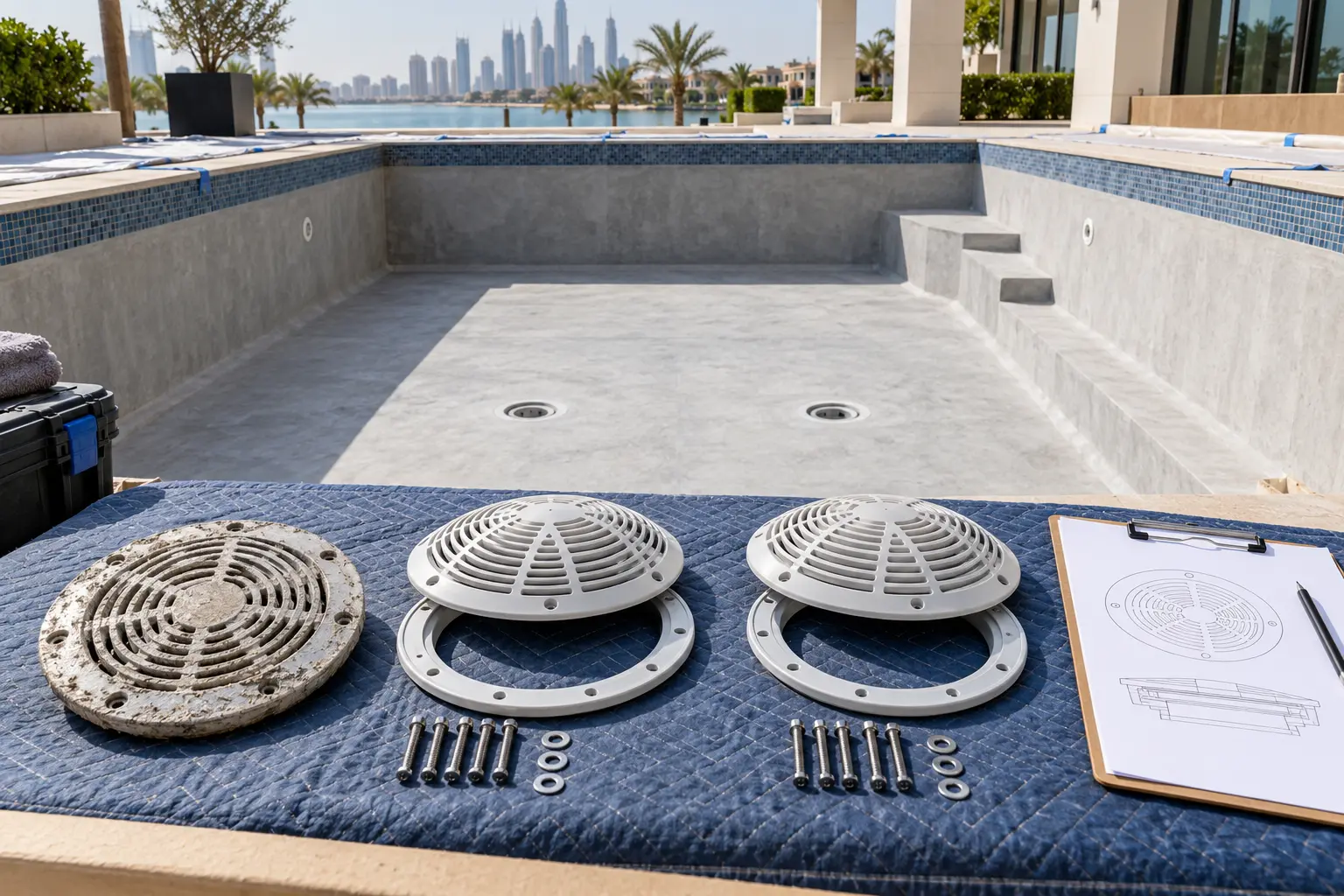
A suction-outlet safety review is a system review, not a cosmetic cover swap. Identify every outlet and connected pump, verify compatible certified components and current local requirements, inspect concealed interfaces before retiling, and keep installation and commissioning records from the appointed specialist.
Treat every suction outlet as part of a hydraulic safety system
The fitting commonly called a main drain is normally a suction outlet connected to the circulation or feature system; it is not simply a hole that empties the pool. Water can be pulled through it by a pump, so the visible cover, the outlet body or sump beneath it, the pipe arrangement, valves and pump operating condition all matter. A renovation that changes finishes, pumps or plumbing is the right moment to document that complete path.
This is a specialist safety task. Owners should not remove covers, test suction by hand, substitute fasteners or operate a pool with a loose, broken or missing cover. The US Consumer Product Safety Commission's Pool Safely guidance warns swimmers to stay away from drains and suction outlets and not to enter a pool with a damaged or missing cover. Use that as a risk prompt while following the requirements that apply to the Dubai property.
Map the existing installation before deciding what to retain
Start with an as-found plan. Mark every floor and wall suction outlet, skimmer equalizer where present, spa suction point, cleaner line and feature suction. Trace which pump and valves each one serves and whether any operating mode can isolate outlets. Record the existing pump model, proposed replacement, pipe sizes where verified, valve positions and evidence of alterations. Do not infer buried connections from symmetry alone.
Photograph each cover before removal, then inspect the frame, sump or outlet body and fastener points when safely exposed by the appointed specialist. Record manufacturer markings, dimensions, condition, missing hardware and any field modification. If an item cannot be positively identified, label it unknown rather than matching it by appearance.
Check the current Dubai approval context
Dubai Municipality's current Technical Guidelines for Approval of Swimming Pool Plans, document DM-HSD-GU34-ASPP2 version 4.0, ask for drain-outlet details in the submitted pool information and include outlet drains within the technical requirements for water filtration. Dubai Municipality also lists approval of public and private swimming-pool drawings as a service intended to confirm technical, engineering and safety compliance before construction.
A villa renovation may involve other authorities, community rules or existing approvals depending on location and scope. Ask the appointed consultant or contractor to state which approvals and current local requirements apply to the actual works. The proposal should name the responsible designer and installer rather than saying only that the covers are compliant.
Use overseas guidance carefully, not as Dubai law
The Virginia Graeme Baker Pool and Spa Safety Act is a United States federal law for US public pools and spas. It does not become Dubai law because a product brochure mentions it. Pool Safely's educational material remains useful because it explains the entrapment hazard and the importance of anti-entrapment drain covers, but the project still needs local compliance and a suitable product for the exact installation.
Pentair's current StarGuard product page states compliance with a named US standard and the US Act, while its installation guide gives model-specific warnings about compatible frames, sumps, screws and flow conditions. That evidence illustrates a broader procurement lesson: request the actual certification, current instructions and complete compatible assembly for the offered model. Do not mix parts or transfer a rating from a similar-looking cover.
Swipe or scroll horizontally to compare all columns.
| Review item | Evidence to request | Weak response |
|---|---|---|
| Existing outlet identity | Photographs, markings, dimensions and as-found drawing | It looks standard |
| Proposed assembly | Cover, frame or sump, fasteners and compatibility statement | New cover only |
| Hydraulic basis | Connected pump, operating modes and specialist design check | Same horsepower as before |
| Compliance basis | Applicable Dubai requirements plus product certification | VGB style |
| Handover | As-built record, inspection, commissioning and replacement information | Installed and tested |
Compare the cover, sump, frame and fasteners as one assembly
A cover is only the visible part of the system. The quotation should identify the compatible frame or sump, specified fasteners and the installation method. Ask whether the existing component is retained, adapted or replaced and on what evidence. A proposal that gives a cover model but not the receiving interface leaves a critical question unresolved.
Manufacturer instructions can include limits on flow, life, mounting and replacement parts. These are product specific. The pool designer should verify the proposed assembly against the system's duties and current certification, while the installer follows the approved detail. Homeowners should receive the result and supporting records.
Reassess the system when pumps or operating modes change
A renovation may add a larger pump, variable-speed control, spa jets, a water feature or a new automation sequence. Even if the outlet covers appear unchanged, those changes can alter which lines are open and how much water is drawn through them. Give the specialist the final pump schedule and every operating mode, including combinations that automation can create.
Ask for a coordinated hydraulic schematic showing outlets, valves, pumps and returns. The design review should consider the most demanding credible mode, not only normal filtration. If an old line is to be abandoned, document how it is isolated and finished. If valves could create an unintended condition, address the control and labeling strategy before the plant room is handed over.
Inspect before waterproofing and finishes conceal the work
Include a hold point after opening-up and before the pool is waterproofed or retiled. At that stage the responsible specialist can inspect the outlet bodies, connections, concrete or screed interface and any repaired pipework. Record dated photographs with a location reference and place unresolved defects on a close-out list. A final photograph of a neat cover cannot prove the concealed connection was suitable.
Coordinate the finished cover level with the waterproofing and tile build-up without altering the certified assembly. Keep adhesives, grout and debris out of the openings and fastener points. Any proposed site modification should be referred back to the manufacturer and designer; it should not be improvised to solve a finishing tolerance.
Use this suction-outlet renovation checklist
Require written answers before accepting the suction-outlet scope. This checklist supports a proposal review; it does not replace design, installation or inspection by qualified specialists.
- Every floor and wall suction point is mapped to its pump, valves and operating modes
- As-found covers, frames, sumps, fasteners and visible defects are photographed and identified
- Unknown or modified components are not assumed suitable by appearance
- The exact replacement cover, compatible frame or sump and specified fasteners are scheduled
- Current manufacturer instructions and product certification are included
- The designer states the applicable Dubai requirements and any approval responsibility
- US VGB references are identified as US requirements, not presented as Dubai law
- Pump changes, variable-speed settings and feature modes are included in the hydraulic review
- A pre-waterproofing or pre-tiling inspection hold point is in the programme
- No site alteration or mixed component assembly proceeds without documented approval
- Commissioning includes the agreed system modes, controls, valve positions and observations
- Handover records include model details, as-builts, manuals, inspection evidence and replacement information
Make commissioning and future inspection traceable
Before the pool returns to service, the appointed specialists should inspect every installed cover and its fixings, confirm the valve and control arrangement, commission the agreed operating modes and close all safety-related defects. Record observations and relevant readings in the format set by the designer and manufacturer. If a cover is loose, damaged, missing or cannot be verified, keep the pool out of use until the responsible professional resolves it.
For a Veyrune pool-renovation discussion, share the as-found photographs, pump and valve schedule, previous drawings and proposed finish build-up. The productive next step is a documented review scope that lets qualified local specialists resolve the visible components, concealed interfaces and hydraulic system together.
Frequently asked questions
01Can a pool-renovation contractor replace only the visible drain cover?
Sometimes the existing interface may be suitable, but this must not be assumed. The appointed pool specialist should identify the outlet body, sump, frame, cover, fasteners, connected pipework and pump duty, then verify that the proposed components are compatible under the current manufacturer's instructions and applicable local requirements. Damaged or unidentified interfaces may require a wider repair.
02Does the US Virginia Graeme Baker Pool and Spa Safety Act apply to a private Dubai villa pool?
No. It is a United States federal law with requirements for US public pools and spas. Its consumer guidance is useful for understanding entrapment hazards and the importance of compliant covers, but it is not a substitute for Dubai Municipality guidance, project approvals, the selected product standard or advice from the appointed local specialists.
03What records should be handed over after suction-outlet work?
Keep an as-built drawing linking each outlet to its pump and valves, clear photographs before concealment, exact cover and frame model details, product certification or listing evidence, current installation instructions, installation and inspection sign-off, commissioning readings, isolation information, maintenance instructions and any stated service-life or replacement date.
Sources and further reading
Dubai Municipality: Technical Guidelines for Approval of Swimming Pool Plans, version 4.0 ↗Checked Friday, 23 October 2026Dubai Municipality: Approval of public and private swimming-pool drawings ↗Checked Friday, 23 October 2026US CPSC Pool Safely: Drain and suction-outlet safety tips ↗Checked Friday, 23 October 2026Pentair: StarGuard main-drain product and standards information ↗Checked Friday, 23 October 2026Pentair: StarGuard 8-inch round main-drain installation guide ↗Checked Friday, 23 October 2026Confirm current requirements for your property and selected equipment. Product examples do not imply a supplier relationship or local availability.
This is an editorial planning guide, not a property survey, approved design or installation specification. Project requirements are confirmed by the appointed specialists.
Let’s bring it back to your home.
Explore the complete service and share a first brief for your property.
Major pool renovations in Dubai