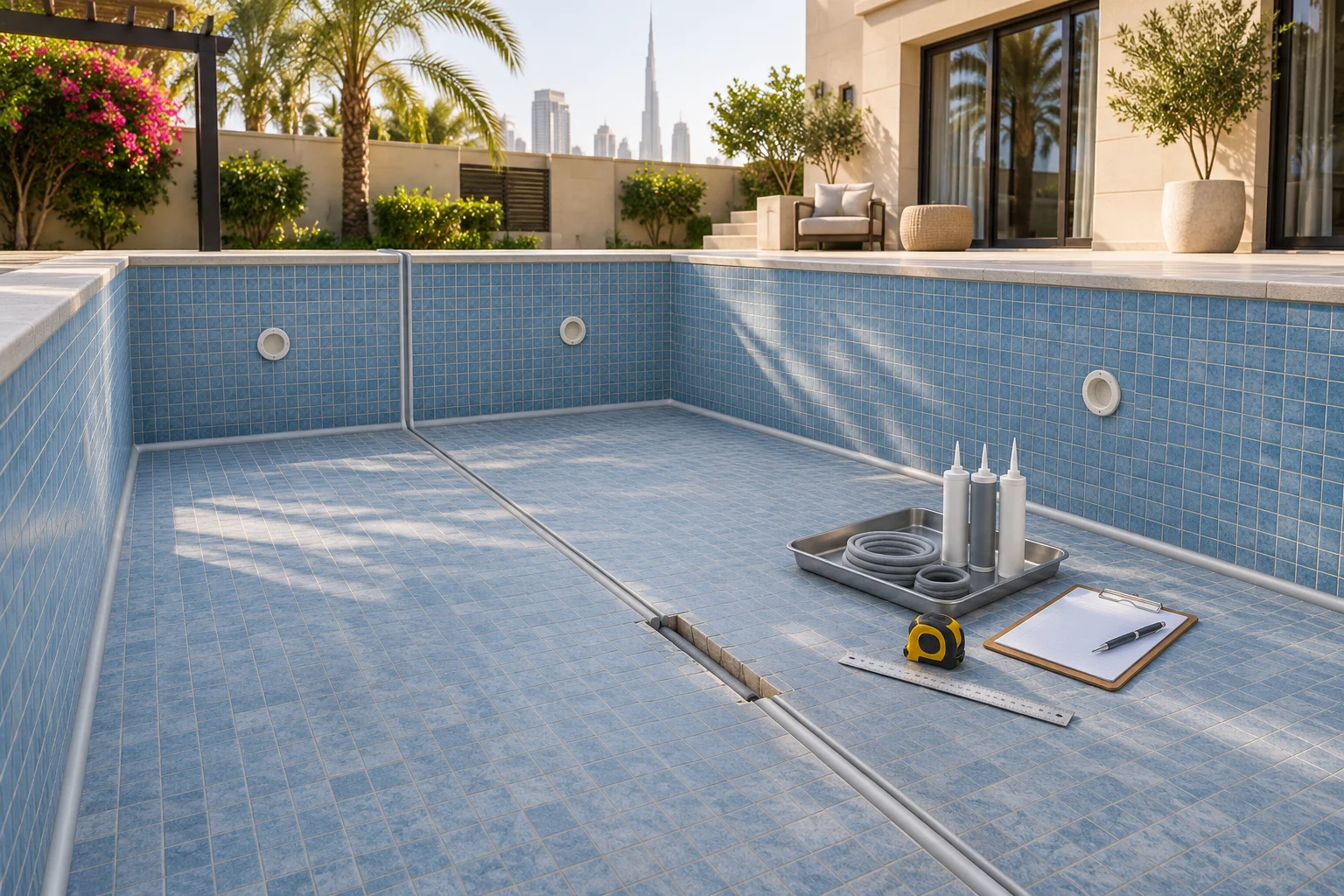
A movement-joint proposal is not complete when it says only 'replace silicone'. It should map the existing structural, construction, perimeter and tile-field joints; identify what each joint is expected to accommodate; record the condition of the edges, waterproofing and adjacent tiles; and define a compatible system, preparation, sequencing, cure protection and acceptance evidence. The appointed pool-renovation specialist must decide which joints are retained, rebuilt, added or referred for structural assessment. Product literature can inform the questions, but it cannot diagnose the pool or replace a property-specific joint design.
Start with a joint map, not a cartridge count
A tiled pool can contain several kinds of intentional discontinuity. There may be structural or construction joints in the shell, movement joints carried through the waterproofing and finish, perimeter joints where planes or materials meet, and field joints that divide large tiled areas. They do not automatically share the same purpose or treatment. A quotation based only on metres of visible sealant does not show whether the underlying movement path has been understood.
Ask for a marked plan and photographs that identify every visible joint in the pool shell, steps, benches, overflow channel, coping and adjoining terrace. Each should have a reference, condition and proposed action. Where original drawings exist, compare them with what is visible on site. Where the construction is concealed or contradictory, record the uncertainty instead of turning an assumption into a fixed repair detail.
Investigate the failure before selecting the repair
Discoloured, detached or split sealant is an observation, not a diagnosis. The joint may have lost adhesion at one edge, torn within the sealant, been compressed beyond its shape, collected contamination, or been installed over weak or wet material. Adjacent tile detachment, cracking that crosses the joint, water loss or a changing gap can point to a wider issue that should be assessed before cosmetic renewal.
The proposal should describe controlled opening-up: which short sections will be exposed, how the pool finish and waterproofing are protected, what edge condition is recorded and who decides whether the scope expands. Structural movement, unexplained cracking or continuing water loss should be referred to the appropriate qualified specialist. A homeowner should not be asked to choose an injection, sealant or waterproofing repair from photographs alone.
Carry movement through the complete finish system
The visible bead is only the outer part of a joint. The renovation team needs to coordinate the shell or screed discontinuity, waterproofing transition, adhesive and tile edges, backing material and exposed sealant. If one layer bridges a joint that another layer is intended to accommodate, movement can be transferred into the finish or create a path for water.
MAPEI's swimming-pool technical notebook illustrates elastic seals at expansion joints, corners and wall-to-floor interfaces as part of a complete waterproofing and tiling system. Its ceramic-installation guide also treats joint layout as a design decision rather than a finishing afterthought. These are manufacturer system examples, not a detail to copy across brands. Require one written system proposal whose components, layer order and interfaces are confirmed by the appointed specialist.
Compare proposals through one evidence table
Give each bidder the same drawings, photographs and investigation assumptions. The comparison should reveal whether the bidder has designed a repair or merely priced removal and resealing.
Swipe or scroll horizontally to compare all columns.
| Proposal item | Evidence to request | Decision to close |
|---|---|---|
| Joint inventory | Numbered plan, photographs and joint classifications | Which joints are retained, rebuilt, added or investigated further? |
| Failure review | Edge, backing, waterproofing and adjacent-finish observations | Is this a sealant failure or evidence of a wider defect? |
| Movement basis | Expected joint role and responsible designer | What movement must the selected system accommodate? |
| System compatibility | Current data sheets and written component schedule | Are sealant, primer, backing, waterproofing and finishes compatible? |
| Preparation | Removal limits, cleaning, drying and edge-repair method | How is a sound, uncontaminated joint face achieved? |
| Sequence | Hold points, environmental checks and cure protection | When can later work and refilling proceed? |
| Handover | As-built joint map, batch records, photos and maintenance advice | What evidence remains for future inspection or renewal? |
Select a system from the joint duty
The words 'pool sealant' do not establish suitability for every joint. Consider whether the location is continuously immersed, frequently wet, exposed to sunlight, at a material transition, or connected to a larger structural joint. The designer should also account for expected movement, joint geometry, substrate condition, water-treatment environment and compatibility with natural stone, metals or coatings where present.
Sika's May 2026 Sikasil Pool data sheet, for example, identifies use in and around pools and gives product-specific movement capability, joint-design limits, backing and preparation information. It also notes that local product descriptions can vary. Use that document as an example of the evidence a proposal should contain, not as proof that the product suits this pool or that its stated dimensions transfer to a different sealant.
Do not let preparation disappear behind a lump sum
A durable repair depends on the condition of the joint faces. The scope should explain how old sealant, incompatible residues and weak material are removed without widening the joint casually or damaging adjacent waterproofing. It should define how edges are repaired, how dust and moisture are checked, and which primer or pretreatment is required by the selected system.
Ask for a small approved sample joint before repeating the work across the pool. Review colour, finish, adhesion preparation and the way the sealant sits between the tile edges. The sample is not a substitute for design or testing; it gives the owner and contractor one agreed visual and workmanship reference before dozens of metres are completed.
Coordinate the pool edge and surrounding terrace
Movement does not stop at the waterline. Coping, overflow channels, terrace paving, drainage grates and wall junctions can meet the pool joint network. A pool-only drawing may repair the interior while leaving an uncoordinated rigid bridge at the coping or terrace. Conversely, cutting a new visible joint without understanding the structure can create unnecessary disruption.
Ask the pool and landscape teams to mark responsibility at every transition. The plan should show which finish is removed, what is protected, where waterproofing continues and how the repaired line meets adjacent materials. The accompanying image is a construction process illustration; its joint route and sample materials communicate the review process and are not an approved detail for another property.
Define inspection and release-to-fill evidence
Before concealment or refilling, inspect continuity, edge contact, surface finish and any recorded voids or damage. Confirm that required primers, backing materials and sealants match the approved submittal, and retain product batch information where the contractor's quality plan calls for it. Photograph representative joints and every important transition while they remain visible.
The selected product instructions should define cure and exposure conditions. Site temperature and humidity, joint depth and the surrounding work can affect sequencing. Record who authorises filling and what evidence supports that decision. Filling too soon should not become the default way of testing a joint, and a visually neat bead should not be represented as proof that the complete waterproofing system is sound.
Use this movement-joint renovation checklist
Close these items before approving a full pool-joint renewal. This is a briefing and comparison checklist, not a do-it-yourself repair method.
- Obtain existing drawings and create a numbered as-found joint map
- Separate structural, construction, perimeter and tile-field joint questions
- Record sealant, edge, tile, waterproofing and water-loss observations
- Define controlled opening-up and the decision point for wider assessment
- Identify the responsible designer for joint role and expected movement
- Submit current data sheets for every proposed system component
- Confirm compatibility at tile, concrete, metal, glass and stone interfaces
- Approve preparation, sample joint, sequence and cure-protection hold points
- Coordinate the pool interior with coping, channel and terrace joints
- Handover the as-built map, photos, batches, release record and inspection plan
Frequently asked questions
01Can failed pool movement-joint sealant simply be cut out and replaced?
Sometimes renewal is appropriate, but first establish why the joint failed and whether its edges, dimensions, backing, adjacent waterproofing and tiles remain suitable. Replacing only the visible sealant can conceal movement, contamination, weak edges or a joint that was never coordinated through the finish system. Ask the appointed specialist to record the investigation and proposed repair boundaries before ordering the work.
02Is flexible tile grout the same as a swimming-pool movement joint?
No. A movement joint is a deliberately designed discontinuity that uses a compatible elastic joint system to accommodate expected movement. Grout fills ordinary tile joints and should not be assumed to perform the same role. The renovation drawings should distinguish movement joints from grout lines and identify the selected system for each location.
03How long should a renovated pool remain empty after joint sealing?
Use the selected system's current product data, the actual joint dimensions and recorded site conditions. Cure time can depend on product, thickness, temperature, humidity and exposure. One 2026 Sika data sheet gives a product-specific minimum before filling, but that figure is not a universal rule. Require the contractor to state and record the applicable release-to-fill condition for the installed system.
Sources and further reading
MAPEI: Waterproofing Baths and Swimming Pools Technical Notebook ↗Checked Wednesday, 18 November 2026MAPEI: Guide to Installing Ceramic Materials ↗Checked Wednesday, 18 November 2026Sika: Sikasil Pool Product Data Sheet, May 2026 ↗Checked Wednesday, 18 November 2026Confirm current requirements for your property and selected equipment. Product examples do not imply a supplier relationship or local availability.
This is an editorial planning guide, not a property survey, approved design or installation specification. Project requirements are confirmed by the appointed specialists.
Let’s bring it back to your home.
Explore the complete service and share a first brief for your property.
Major pool renovations in Dubai