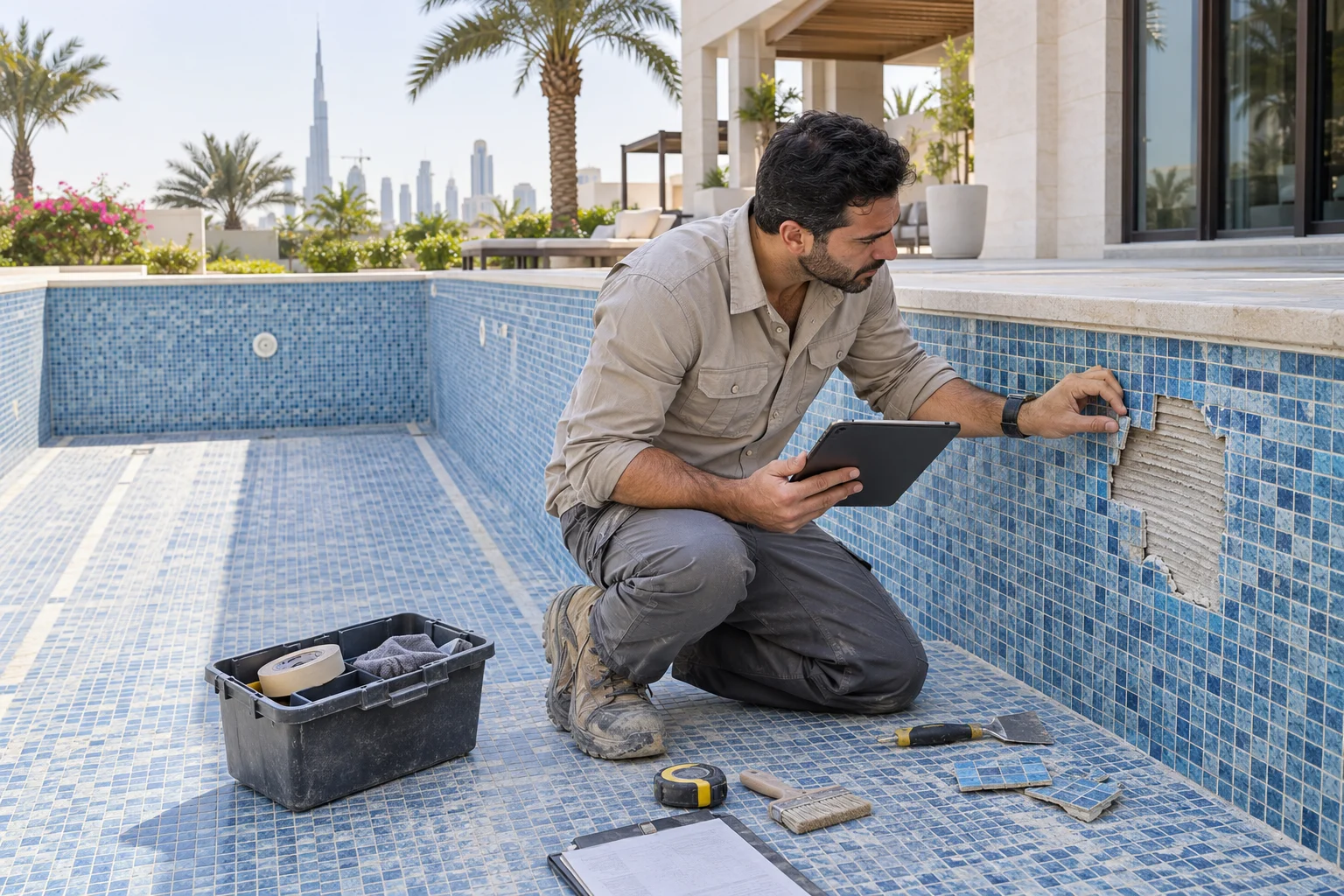
Repeatedly loose pool tiles are a symptom, not a diagnosis. Before choosing a patch repair or complete retiling, map where the failure occurs, review water and repair history, open representative areas and ask the appointed specialists to identify which layer has failed. The useful renovation scope corrects the evidenced cause and defines the complete replacement system; it does not assume that stronger adhesive alone will solve every recurrence.
Start with the failure pattern, not a tile catalogue
Loose tiles can result from more than one condition: incomplete bonding, a contaminated or weak surface, movement, unsuitable materials, water reaching a vulnerable layer, premature filling, or deterioration linked to operation and maintenance. The visible tile cannot reveal which explanation applies. A responsible first step is therefore a condition map, not an immediate material order.
Mark every known hollow, loose, cracked, stained or previously repaired area on a pool plan. Note whether symptoms gather at the waterline, steps, corners, fittings, floor, wall junctions or a former repair boundary. Photograph the same reference points before draining. A pattern that follows a joint or transition asks a different question from a few impact-damaged mosaics.
Separate four observations that are often confused
A homeowner may describe all surface trouble as ‘the tiles falling off’, but the investigation should record what has actually failed. These observations can overlap without sharing one remedy.
Swipe or scroll horizontally to compare all columns.
| Observed condition | Question to investigate | Evidence worth recording |
|---|---|---|
| Loose or hollow tile | At which interface has the bond been lost? | Back of removed tile, adhesive contact, substrate surface and extent of surrounding hollow areas |
| Cracked tile or repeated line | Is movement being expressed through the finish? | Crack path, joint layout, adjacent construction and whether the line continues behind the finish |
| Eroded or discoloured grout | Is this material deterioration, movement, maintenance history or a combination? | Distribution, depth, water records, repair dates and manufacturer information |
| Water loss or dampness | Is the finish involved, or is another pool component responsible? | Specialist test results, penetrations, joints, pipework and waterproofing observations |
Build a record before the pool is drained
Collect the original drawings, material submissions, product names, invoices, repair photographs and service logs if available. Record when the symptoms first appeared, how quickly they spread and whether they followed an emptying, refill, structural alteration or previous patch. Missing records are common; state the gaps instead of converting memory into certainty.
LATICRETE's current guidance on submerged grout deterioration lists several possible influences, including water chemistry, early filling, lack of movement allowance, unsuitable grout, poor preparation and incorrect installation. It also advises identifying why a repair is needed before making the repair. This is a useful diagnostic principle, not proof that any one item caused the problem at your pool.
Use controlled opening-up to identify the failed layer
Choose representative test locations with the renovation specialist: an obvious failed area, a nearby apparently sound area and any important transition or previous repair. The purpose is to see the back of the tile, the adhesive layer, substrate, joints and waterproofing condition without stripping the whole pool before the decision is made.
Record each opening with a location reference and scale. Ask whether the adhesive remained mainly on the tile, mainly on the substrate or fractured within itself; whether coverage was continuous; and whether dust, coatings, mesh glue or other material appears to have interrupted the bond. LATICRETE's pool technical manual treats full, solid contact as important in submerged work and warns that some mosaic backing systems can obstruct bonding. The appointed tile-system specialist must interpret the actual sample.
Review the pool as one layered system
Tile is the visible layer of a system that may include the structural shell, repairs or render, waterproofing, adhesive, tile, grout, movement joints and sealants. Sika's pool guidance similarly describes preparation, waterproofing, setting mortar, grout and flexible joint sealant as a coordinated sequence. Replacing only the visible finish may leave the failed interface untouched.
Ask for the proposed replacement build-up as a named, compatible system. Identify who accepts the existing substrate, which preparation and repairs precede waterproofing, how penetrations and changes of plane are handled, and which movement joints continue through the finish. Product names alone are insufficient unless the proposal also follows their current instructions and the property-specific design.
Compare three repair directions only after investigation
Do not force every pool into the same remedy. Compare the least intervention that addresses the evidenced cause with the risk and boundaries it leaves behind.
Swipe or scroll horizontally to compare all columns.
| Possible direction | When it may merit assessment | Scope questions |
|---|---|---|
| Localized repair | A bounded defect with sound surrounding work and a traceable cause | How is the repair edge prepared, which layers are renewed and how will matching materials be sourced? |
| Partial-area renewal | A failed zone or construction phase can be defined, while other areas have supporting evidence | Where is the boundary, how is retained waterproofing treated and how will visual differences be handled? |
| Complete finish-system renewal | Failure is widespread, evidence is poor, interfaces are unreliable or the design is changing | What is removed, what substrate is accepted, which waterproofing and tile system is proposed, and what inspections precede filling? |
Do not diagnose leaks from tile appearance alone
Loose tile does not by itself prove that the pool shell or waterproofing leaks, and a visually intact finish does not prove that every concealed layer is sound. If water loss, dampness or cracking is reported, create a separate specialist investigation with a defined test sequence. Record the pool condition and operating status during each check.
Keep structural, waterproofing, hydraulic and finish responsibilities visible in the scope. A tile contractor can provide valuable evidence from the finish layers, but conclusions about the shell, pipework or property structure may require other appointed specialists. The homeowner's decision record should show which conclusion is observed, tested or still provisional.
Use this pre-retiling investigation checklist
Issue the checklist before quotations are finalized so each bidder responds to the same evidence rather than assuming a different failure.
- Map loose, hollow, cracked, stained and previously repaired areas
- Gather drawings, product records, repair history and water-service logs
- Photograph reference locations before draining or removal
- Agree representative opening-up locations and who will attend
- Record the tile back, adhesive contact, substrate and waterproofing at each opening
- Identify movement joints, changes of plane, fittings and repair boundaries
- Separate finish defects from any leak or structural investigation
- State what remains unknown and which conclusions are provisional
- Compare localized, partial and full-renewal options against the same findings
- Require a complete compatible replacement build-up, not isolated product names
- Define pre-tiling inspections, curing assumptions and the refill hold point
- Record retained-work warranties, repair boundaries and future maintenance guidance
Turn the diagnosis into a comparable renovation brief
A useful brief attaches the condition map, opening-up record, test reports and agreed design changes. It distinguishes confirmed remedial work from allowances for concealed conditions. Each proposal should describe removal, preparation, substrate repairs, waterproofing, tile fixing, grout, movement joints, fittings, waste, protection, inspection records and the conditions for refilling.
For a Veyrune pool-renovation discussion, begin with the symptoms and available evidence rather than a request for a price per square metre of tile. The next useful step is a property review and an investigation plan proportionate to the failure. That creates a defensible basis for comparing repair or renewal options without claiming a diagnosis from photographs alone.
Frequently asked questions
01Can loose pool tiles simply be stuck back on?
A localized repair may be reasonable when investigation shows a genuinely isolated defect and the surrounding system is sound. Repeated, widespread or patterned failure needs a broader review first. Ask what remains bonded, what condition the substrate and waterproofing are in, why the original bond failed and how the repair interfaces with retained work. A cosmetic patch should not be presented as correction of an unknown underlying cause.
02Does damaged grout mean the pool must be completely retiled?
Not automatically. Grout deterioration, tile debonding, movement-joint failure and water loss are different observations, even when they appear together. A specialist should map the symptoms, inspect representative areas and assess the wider installation. The resulting evidence may support targeted regrouting, localized tile repair, partial renewal or a full system replacement.
03Should water chemistry be reviewed during a tile-failure investigation?
Yes, because operating history can help explain grout or finish deterioration, but it is only one part of the diagnosis. Gather dated service records and unusual events, then review them alongside the tile, adhesive, substrate, joints, waterproofing and structural condition. Do not assume that one current water test proves or excludes the cause of a failure that developed over years.
Sources and further reading
LATICRETE: Tiled Swimming Pools, Fountains and Spas Technical Design Manual ↗Checked Thursday, 5 November 2026LATICRETE: TDS 186 Re-Grouting Swimming Pools, Fountains and Water Features ↗Checked Thursday, 5 November 2026Sika: Tile and Stone Installation — swimming-pool system guidance ↗Checked Thursday, 5 November 2026Confirm current requirements for your property and selected equipment. Product examples do not imply a supplier relationship or local availability.
This is an editorial planning guide, not a property survey, approved design or installation specification. Project requirements are confirmed by the appointed specialists.
Let’s bring it back to your home.
Explore the complete service and share a first brief for your property.
Major pool renovations in Dubai