A chemical-dosing proposal should identify the complete treatment method, not only a controller or feeder. Ask which water values are measured, which products are fed, how dosing stops when circulation is unavailable, where injection occurs, how incompatible products remain separated, and who calibrates and services the system. Compare a simple feeder, salt-chlorine system and monitored dosing package against the same pool-use brief. Require commissioning results, owner instructions and a clear manual-testing plan because automation does not remove the need to verify water quality.
Start with the treatment outcome, not the control panel
A controller display is only one component. A complete proposal connects circulation, filtration, sampling, sensors, the selected disinfectant and pH method, feed equipment, injection points, chemical storage, alarms and owner testing. Missing links can leave the operating basis unclear.
Write the required outcome first: the pool volume and use assumptions, treatment method, values to be monitored, intended operating schedule and the person responsible for routine care. Then ask each bidder to show how its proposed equipment supports that outcome. This keeps the comparison focused on the installed system rather than the most impressive screen or app.
Understand the main proposal types
A tablet or erosion feeder, a salt-chlorine generator and a sensor-led liquid-dosing package perform different jobs. A feeder provides a controlled route for a specified disinfectant product. A salt system generates chlorine from dissolved salt but still needs a complete water-balance and testing plan. A monitored controller may read pH and oxidation-reduction potential and operate compatible dosing equipment, yet its performance depends on sensor condition, flow, settings and the chemicals connected to it.
Do not compare these as three prices for the same object. Ask what each proposal measures, produces or feeds, what it does not control and which tasks remain.
Use Dubai guidance as the local starting point
Dubai Municipality's Technical Guidelines for Approval of Swimming Pool Plans request pool and pump-room drawings, equipment details, a schematic and the proposed treatment arrangement. The guidance states that private pools require a chlorine feeder, a free-chlorine or bromine injection device, an automated dosing system, or another automatic system for feeding disinfectants and sterilizers. The appointed team should confirm the current approval route for the actual property and selected system.
Document the treatment method clearly instead of copying a generic detail. Community requirements and equipment manuals may add constraints. The proposal should identify who supplies approval information and remains responsible for the commissioned treatment system.
Compare each option through the same evidence table
Give bidders the same operating brief and require the same evidence. The table exposes gaps that a product name alone can hide.
Swipe or scroll horizontally to compare all columns.
| Planning item | Evidence to request | Decision to close |
|---|---|---|
| Treatment method | Named feeder, generator, dosing pumps and compatible chemicals | What is produced or fed, and what remains manual? |
| Measurement | Sensors, sample point, test kit and calibration method | Which reading controls dosing and which verifies it independently? |
| Circulation protection | Flow switch, pump interlock, delay and alarm logic | How is dosing stopped when safe flow is unavailable? |
| Injection arrangement | Schematic showing sequence, valves and injection points | How are concentrated products prevented from meeting improperly? |
| Storage | Container sizes, separation, containment, ventilation and security | Can each product be received, stored and replaced safely? |
| Service | Consumables, sensor life, calibration and replacement access | Who performs each task and records it? |
| Handover | Commissioning readings, settings, manuals and owner demonstration | What proves the system is ready for routine use? |
Make no-flow protection a visible part of the design
Chemical feed must not continue into stagnant pipework when circulation is unavailable. Pentair's IntelliChem manual provides a model-specific example: it uses a flow switch, requires the controller to operate with the filter pump, and warns against running feed pumps without appropriate water flow. The manual also describes dose-priority logic where acid and chlorine equipment share a nearby hydraulic area. These are prompts to ask better questions, not universal wiring instructions.
Request a simple sequence showing normal start-up, the flow-proving step, any stabilization delay, permitted dosing, low-flow shutdown, alarm and manual recovery. The selected supplier and qualified installers must define the actual interlocks. A homeowner should never bypass a flow device or alter chemical-feed settings to silence an alarm.
Plan chemical storage as a separate safety decision
A dosing system creates a storage and delivery task. Containers need a secure, serviceable position that follows the product label and safety data sheet. The design should prevent incompatible chemicals from mixing, protect containers from water and heat, and keep them away from casual household access. Secondary containment should be sized and arranged by the appointed specialists for the selected products.
The US CDC's pool-chemical guidance is not a Dubai private-villa code, but it supplies useful general review prompts: separate incompatible products, retain original labelled containers, provide ventilation, control access, keep safety information available and prevent spills from mixing. Use those prompts alongside local requirements and the selected manufacturers' instructions.
Keep testing, calibration and consumables in the ownership plan
Automatic dosing does not prove that a sensor is clean, calibrated or reading representative water. Ask where the sample is taken, how the sampling line remains clear, how readings are checked independently and which parts are wear items. The handover should list reagents, tubing, pump heads, probes or cells that require service, with model-specific intervals rather than an invented universal schedule.
The owner also needs an escalation route. Define which result prompts a retest, which alarm calls for routine service and which condition means the pool should remain out of use until a qualified person has checked it. Keep records of readings, calibration and component changes so later faults are assessed against evidence rather than memory.
Coordinate the equipment room before construction closes
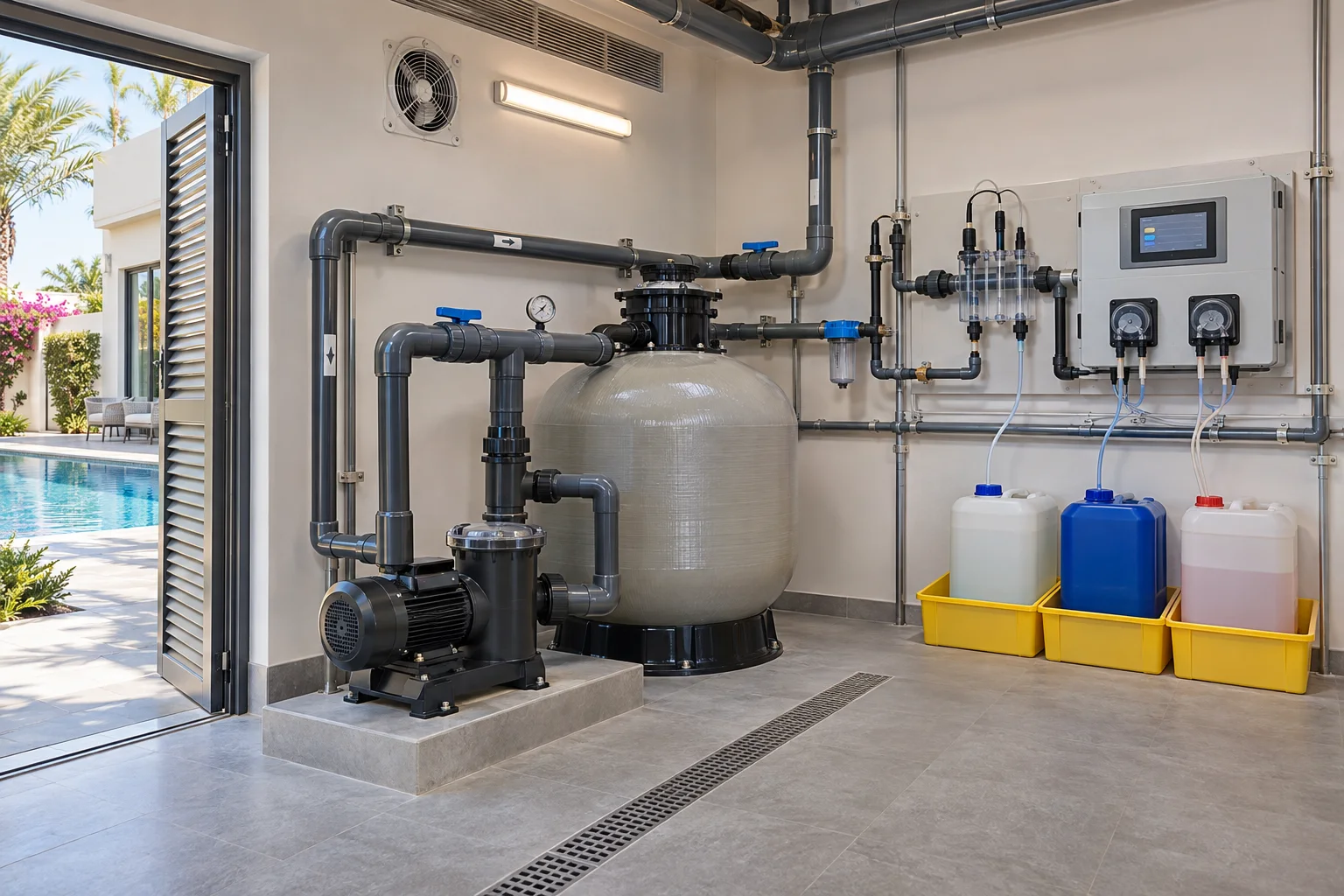
Show the controller, flow cell, feed pumps, storage containers, containment trays, electrical enclosures, ventilation and floor drainage on one plant-room layout. Service personnel need to remove containers and components without climbing over pumps or opening finished walls. Pipework and tubing should be supported and protected from accidental damage, while labels and displays remain readable.
The room image in this guide is a design concept, not a construction specification. The actual layout must be developed for the selected pool equipment, property services and specialist safety requirements. Record a construction hold point before the plant-room doors, plinths, drainage and service routes are fixed.
Commission the water and the safeguards together
Commissioning should verify more than a green status light. Record circulation conditions, sensor readings, independent test results, feed response, no-flow shutdown, alarms and the recovery sequence. Confirm that containers, tubing and injection points are correctly identified and that the owner can reach manuals and service contacts without entering a hazardous area.
Ask for an operating demonstration using the installed system. The person responsible for routine pool care should be able to explain the normal display, expected testing, consumable checks and the action for each common alarm. Settings and water results should be documented at handover rather than left as temporary installer knowledge.
Use this pool chemical-dosing briefing checklist
Complete this checklist before comparing quotations. It supports a specialist conversation; it is not a do-it-yourself dosing procedure.
- State the pool volume, use assumptions and circulation schedule
- Name the proposed disinfection and pH-control method
- List every controller, feeder, generator, pump and sensor
- Explain what is measured automatically and what is tested independently
- Show the sample route, flow cell and injection sequence
- Define flow proving, delays, pump interlocks and alarms
- Identify compatible products and required consumables
- Show secure separated storage and secondary containment
- Coordinate ventilation, drainage, lighting and service clearance
- Keep chemicals away from heat, water and unauthorized access
- Provide current labels, safety data sheets and manuals
- Set calibration, cleaning and wear-part responsibilities
- Record commissioning readings and safeguard tests
- Demonstrate normal operation and alarm response
- Name the warranty and service contact for each supplied component
Frequently asked questions
01Does every private villa pool need automatic chemical dosing?
Dubai Municipality's current pool-plan guidance states that a private pool should have a chlorine feeder, free-chlorine or bromine injection device, automated dosing system, or another automatic disinfectant-feeding system. That does not make every option equivalent. The appointed pool specialist should confirm the route for the property, select a system for the pool and document how water quality will be checked and maintained.
02Does an automatic controller replace manual water testing?
No. Sensors, dosing pumps, tubing and reagents require inspection, calibration or replacement according to the selected manuals. Independent water checks remain part of verifying that the displayed reading and actual pool condition agree. Ask the supplier to define the testing method, frequency, acceptable results and response to an alarm or unexpected reading.
03Can pool chemicals simply be stored in the plant room?
Storage has to follow the selected product labels, safety data sheets, equipment instructions and applicable local requirements. The proposal should show secure access, ventilation, secondary containment, separation of incompatible products, protection from heat and water, and a safe service route. A tidy shelf beside electrical or mechanical equipment is not a complete storage plan.
Sources and further reading
Dubai Municipality: Technical Guidelines for Approval of Swimming Pool Plans, Version 4 ↗Checked Monday, 16 November 2026CDC: Pool Chemical Safety ↗Checked Monday, 16 November 2026Pentair: IntelliChem Water Chemistry Controller Installation and User's Guide ↗Checked Monday, 16 November 2026Confirm current requirements for your property and selected equipment. Product examples do not imply a supplier relationship or local availability.
This is an editorial planning guide, not a property survey, approved design or installation specification. Project requirements are confirmed by the appointed specialists.
Let’s bring it back to your home.
Explore the complete service and share a first brief for your property.
New swimming pools in Dubai