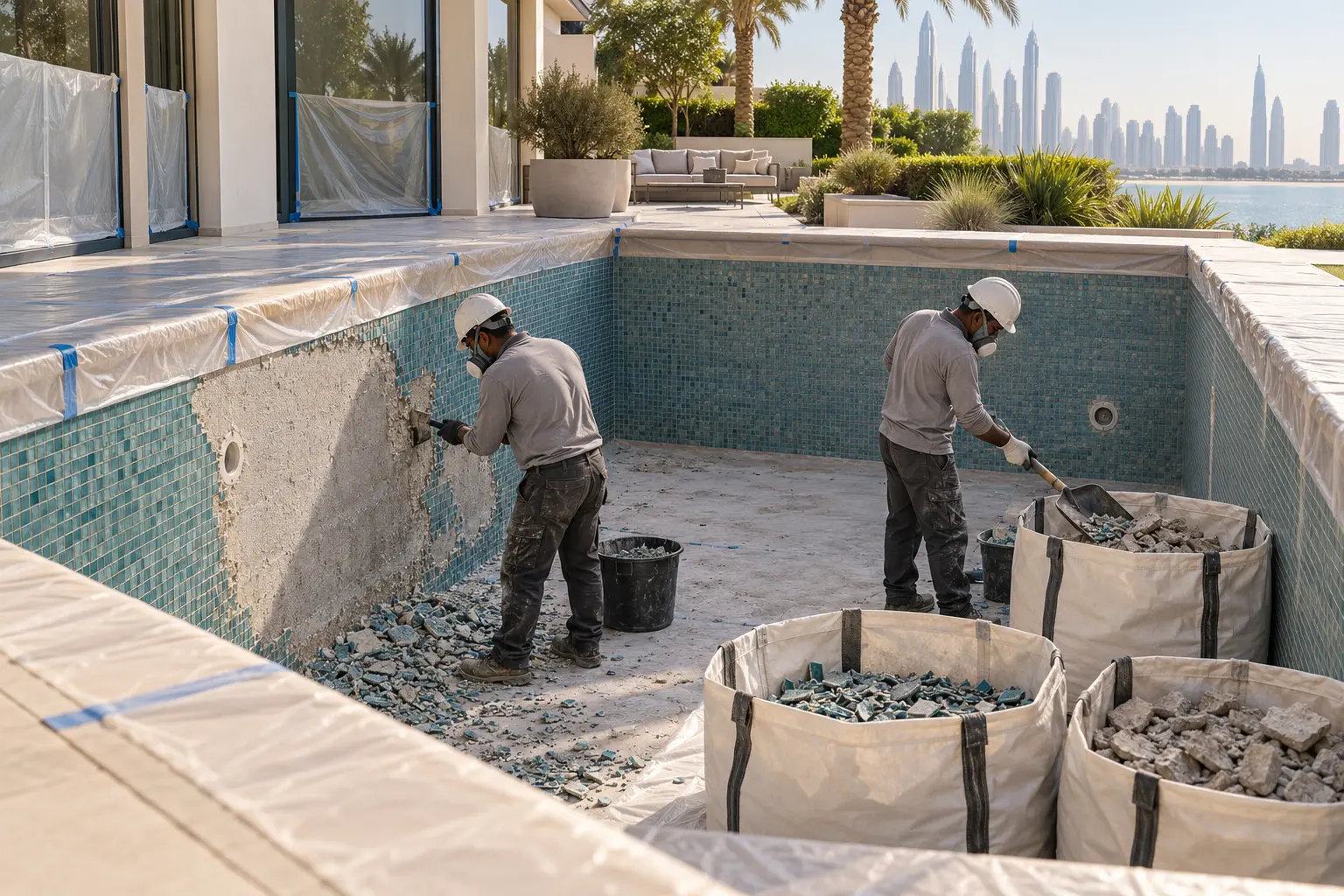
Treat strip-out as a defined investigation and logistics package, not an unlimited instruction to remove everything. Mark what stays, protect the villa and garden, separate waste streams, pause at planned inspection points and agree how hidden findings will change the scope before further demolition proceeds.
Define strip-out as its own work package
Pool renovation often begins with removal, but removal is not one vague activity. It may include finishes, adhesive or bedding, coping, fittings, damaged repairs, pipe sections, electrical accessories or surrounding terrace work. Write a strip-out drawing and schedule that identifies each area as retain, protect, remove, investigate or decide after opening up. This keeps an exploratory opening from becoming uncontrolled demolition.
The brief should also state why each element is being removed. A finish replacement, a water-loss investigation and a shell alteration create different boundaries. If the final repair method is not yet known, describe the first limited opening and the decision it is intended to support. The next stage should wait for an attributable inspection record.
Map the route before tools arrive
Draw the complete route from pool to vehicle. Mark the work entrance, internal gates, narrow turns, changes in level, doors, glazing, planted areas, irrigation, terrace finishes and any neighbour-facing edge. Record where workers enter, where materials are stored, where debris is sorted and how a covered container can be reached without blocking household access or emergency routes.
For an occupied villa, separate the household route from the work route wherever practical. Confirm working hours, gate control, temporary barriers, daily cleaning and the way pets and children are kept outside the site area. These arrangements need to fit the actual community and property; a generic site photograph does not prove that a proposed route will work.
Protect what the renovation is meant to keep
Protection should be itemised rather than hidden inside general preliminaries. Identify coping, terrace stone, doors, glazing, façades, external furniture, planting, irrigation, drainage points and retained pool fittings. Record the starting condition with dated, location-labelled photographs before coverings are installed. Agree which protection stays for the whole project and which is removed for inspections or deliveries.
Dubai Municipality Circular 12-4-1 addresses organisation, protection and cleanliness on construction sites. Some provisions apply to project types larger than a villa pool, so it should not be copied as a universal method statement. Its emphasis on protected waste handling, preventing dust and falling material, regular cleaning and protecting property is nevertheless a useful prompt for the appointed team to develop a property-specific plan and confirm the applicable requirements.
Separate the waste plan from the skip size
A skip or truck allowance answers only the container question. The useful plan identifies likely materials, how they will be kept separate, the location and capacity of each container, who removes them and which records demonstrate the approved route. Pool strip-out can generate tiles or mosaic, mortar, concrete, metal fittings, plastics, cables, timber packaging, garden waste and potentially materials requiring separate assessment.
Dubai Municipality's waste-classification guideline includes refurbishment waste within construction and demolition waste and notes that this is a family of material streams rather than one uniform load. Circular 12-10-1 asks construction and demolition contractors to sort materials at site before transport and to keep quantity and transport records. The contractor and responsible consultant should determine how those requirements apply to the actual renovation, rather than the homeowner improvising a disposal method.
Swipe or scroll horizontally to compare all columns.
| Planning layer | Evidence to request | Question to resolve |
|---|---|---|
| Removal boundary | Marked drawing and itemised schedule | Exactly what stops at each edge, fitting and junction? |
| Protection | Condition record and protection layout | Which retained surfaces are covered, isolated or temporarily removed? |
| Waste sorting | Named material streams and container positions | How are tile, concrete, metal, plastic and other materials kept separate? |
| Transport | Responsible company, collection plan and applicable records | Who controls the route from the villa to the accepted destination? |
| Unknowns | Hold points, inspection roles and change process | Who decides whether removal extends after a concealed condition is exposed? |
| Reinstatement | End-state drawing and acceptance record | What is restored, replaced or intentionally changed after access is complete? |
Use small investigation zones for genuine unknowns
If the substrate, old waterproofing, reinforcement, penetrations or concealed pipe routes are uncertain, plan representative openings rather than assuming the whole pool must be stripped immediately. Give each opening an identifier and purpose. Record the layers found, visible condition and limitations, then ask the responsible structural, pool or material-system specialist to interpret the finding.
One opening may not represent every elevation or repair era. The inspection record should say where the conclusion applies and whether another area needs review. That distinction prevents a limited observation from being presented as proof of the complete shell. It also gives quotations a better basis than an unlimited provisional note for whatever is found.
Control dust, fragments and water deliberately
The method statement should address the chosen tools, local extraction or suppression approach, covered movement of fragments and daily housekeeping. It should also explain how drains, soil and the pool's remaining pipework are protected from debris or slurry. The appointed contractor decides the safe technical method; the owner's role is to make the expected outcome and property constraints explicit.
Do not allow wash water or slurry to become an unplanned disposal route. Ask where it is collected, how it is classified and who confirms the permitted handling method. Keep the work area weather-aware as well: exposed materials, an empty shell and temporary protection may require a response to wind, rain or standing water before the next trade begins.
Put inspection hold points into the programme
Useful hold points include completion of initial protection, the first representative opening, completion of finish removal, exposure of each penetration or repair zone, and final substrate review before remedial work. For every hold point, name the reviewer, the evidence expected and the instruction that releases the next stage. Allow time for decisions instead of assuming the removal crew can proceed continuously.
When an unexpected crack, void, corrosion sign, undocumented pipe or incompatible layer appears, the record should separate observation from diagnosis. Photograph and locate it, protect the area and ask the relevant specialist for the next step. Pricing and programme effects belong in the variation process before the removal boundary changes.
Use this strip-out and waste checklist
Before authorising pool-renovation removal, check that the proposal answers these practical questions. The list is a homeowner control framework, not a demolition method statement.
- The drawing distinguishes retain, protect, remove, investigate and later-decision areas
- The pool-to-vehicle route is measured and checked against gates, levels and household access
- Retained coping, terrace, glazing, façades, planting, irrigation and fittings have protection owners
- Starting-condition photographs are dated and tied to locations
- Work-area separation, gate control, daily cleaning and community constraints are recorded
- Likely waste streams and separate container positions are identified
- The responsible contractor confirms transport, accepted disposal routes and required records
- Dust, fragments, slurry and accidental water are controlled within the agreed method
- Investigation openings have identifiers, purposes and responsible reviewers
- Hold points prevent concealed findings from triggering uncontrolled extra removal
- Variations show the finding, proposed response, price and programme effect before approval
- Final cleaning, temporary-protection removal and reinstatement have clear acceptance criteria
Compare the controlled plan, not only the removal price
A low strip-out allowance can move cost and risk into vague exclusions for access, protection, sorting, disposal, hidden findings and reinstatement. Compare each proposal against the same marked scope and logistics matrix. Ask bidders to price confirmed removal separately from investigation allowances and possible extensions.
For a Veyrune pool-renovation discussion, share the existing pool dimensions, condition concerns, desired design changes, access photographs and the parts of the garden that must remain. The practical next step is a coordinated property review that turns removal into a bounded, documented first stage of the renovation.
Frequently asked questions
01Should every old pool tile be removed during renovation?
That decision should follow a condition review and the accepted finish-system proposal. Some projects require complete removal; others may have a different engineered scope. Ask the appointed specialists to define the removal boundary, the evidence behind it and the substrate condition that must be achieved. Do not assume that removing more is automatically safer or that leaving material in place is automatically economical.
02Can pool-renovation debris go into the villa's normal waste bins?
Do not plan it that way. Dubai Municipality classifies waste from refurbishment, including materials such as concrete, ceramics, metals and plastics, within construction and demolition waste. The contractor should confirm the property-specific storage, sorting, transport and disposal route, along with any community access conditions and the records that will be retained.
03What happens if strip-out reveals damage that was not in the quotation?
Stop at the agreed inspection boundary, record the location and condition, and obtain a written assessment from the responsible specialist. The change record should show the proposed response, price and programme effect before the affected work continues. A photograph in a messaging thread is useful evidence, but it is not a complete instruction or approval.
Sources and further reading
Dubai Municipality: Technical Guidelines No. 5, Waste Classification ↗Checked Tuesday, 20 October 2026Dubai Municipality: Circular 12-4-1 on construction-site organisation, protection and cleanliness ↗Checked Tuesday, 20 October 2026Dubai Municipality: Circular 12-10-1 on sorting construction and demolition waste ↗Checked Tuesday, 20 October 2026Confirm current requirements for your property and selected equipment. Product examples do not imply a supplier relationship or local availability.
This is an editorial planning guide, not a property survey, approved design or installation specification. Project requirements are confirmed by the appointed specialists.
Let’s bring it back to your home.
Explore the complete service and share a first brief for your property.
Major pool renovations in Dubai