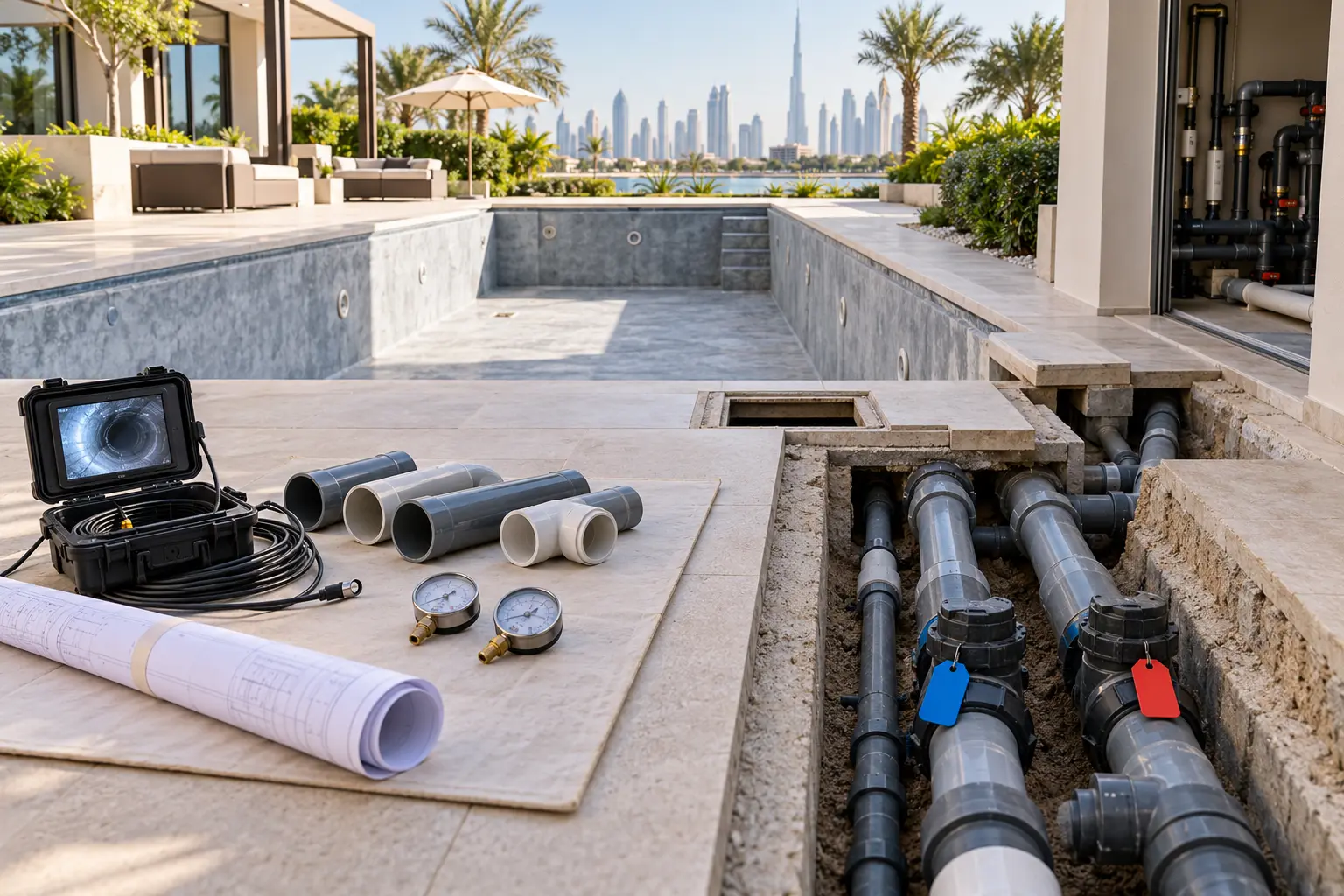
Do not retain concealed pipework because it looks acceptable at one opening, and do not replace every line without evidence. Map each circuit, verify its condition and suitability for the new pool duties, then record a retain, repair or replace decision before finishes close the work.
Begin with the new pool brief, not the old pipe routes
Existing pipework can sometimes be retained, but only if it remains suitable for the renovated pool as well as physically sound. Start by defining the future edge system, filtration duty, heating or cooling, treatment, cleaning connection, water features and any integrated spa. A line that served the old layout may not suit a new ledge, revised return pattern, different pump duty or added feature.
Ask the pool designer to issue a proposed hydraulic schematic before deciding what stays. Mark every suction, return, overflow, balance, vacuum, feature, make-up and waste-related route that forms part of the actual design. Retention is then a circuit-by-circuit design decision instead of a broad promise that the existing plumbing is usable.
Build a line register from records and site evidence
Collect original drawings, previous repair invoices, equipment schedules and photographs, but verify them against the site. Trace accessible pipes from the pool fittings to the plant room and record material, apparent diameter, valves, unions, fittings, direction and condition. Where a route is uncertain, label it unknown rather than drawing a confident line from assumption.
Give each circuit a stable identifier that appears on the survey, photographs, valve labels and test records. Note where pipework changes material, passes through the shell, disappears beneath new or retained hardscape, or shares a trench with other services. This register becomes the control document for investigation and prevents results from being separated from the line that was actually tested.
Use controlled opening-up to inspect critical interfaces
A complete excavation is rarely the first useful step, but one convenient opening is not representative of every concealed route. Agree targeted inspection points at recurring-risk interfaces: shell penetrations, skimmers, return fittings, changes in direction, earlier repairs, settlement zones, plant-room entries and places affected by the new construction. Protect the villa and terrace, record each opening and reinstate it within the defined renovation package.
Look for incompatible transitions, stressed fittings, unsupported sections, brittle or damaged material, evidence of movement and unrecorded branches. An inspection camera may help with certain accessible routes, but it cannot establish every external joint or buried condition. Record both what the investigation confirms and what remains outside its view.
Require a specialist test plan with clear boundaries
Testing should be designed and carried out by a competent pool specialist using a method appropriate to the pipe material, circuit, fittings and condition. The written plan should identify which lines are isolated, what equipment or components are excluded, the medium and method used, the test limits, observation period, environmental conditions and acceptance criteria. Homeowners should not improvise pressure or plug arrangements from generic internet instructions.
A pass applies to the stated test, not to every future duty or concealed interface. A failed result should trigger a structured isolation process that narrows the affected section before demolition expands. Keep calibrated instrument details, start and finish readings, photographs and the specialist's conclusion with the line register.
Swipe or scroll horizontally to compare all columns.
| Decision | Evidence expected | Scope consequence |
|---|---|---|
| Retain | Known route, suitable duty, acceptable accessible condition and recorded test evidence | Protect during works and include in as-built records |
| Repair | Localised defect with a defined, accessible repair and compatible detail | Open, repair, retest and photograph before closure |
| Reroute | Existing route conflicts with the new layout, access or serviceability | Design a new coordinated path and abandon the old line safely |
| Replace | Failed evidence, unsuitable duty, widespread uncertainty or incompatible interfaces | Include removal or abandonment, new line, tests and reinstatement |
| Investigate further | Important uncertainty remains after the first survey | Hold the finish order and price the next controlled investigation |
Check compatibility with the proposed pump and equipment
Pipe diameter alone does not establish hydraulic suitability. The appointed designer should review length, elevation, fittings, valve arrangement, suction configuration, return distribution and the operating modes required by the selected equipment. Pentair's current IntelliFlo3 guide, for example, links pump plumbing to maintenance isolation and specific installation requirements; those model instructions must be applied by the project specialist rather than copied as universal dimensions.
Current Jandy filter troubleshooting material also treats suction-side air leaks and restrictions in suction or return lines as possible causes of low flow. That is a useful reminder that a visually tidy plant room cannot compensate for an unsuitable or obstructed circuit. Ask for a commissioning method that demonstrates each agreed mode after the renovated system is complete.
Treat suction lines and pool fittings as a safety review
Suction outlets, covers, sumps, equalisation arrangements and their connections should be reviewed as a complete safety system by the appointed competent specialist. Do not preserve a line merely because it holds water. Confirm the proposed pump duties, outlet configuration, component compatibility, current applicable requirements and who accepts responsibility for the final design and commissioning.
Dubai Municipality's private-pool guidance defines a competent person in relation to pool design, construction, installation and maintenance, while its pool-plan guidance calls for coordinated pool and pump-room pipe information. The authority or community route remains property- and scope-specific, so the appointed consultant should confirm whether revised drawings or approvals are required for the renovation.
Coordinate shell penetrations, waterproofing and finishes
Where retained pipes meet new fittings, waterproofing or pool finishes, define the interface before the shell is repaired and tiled. A pipe test does not approve the surrounding penetration detail, and a new decorative fitting does not prove compatibility with an older buried connection. Draw the junctions that will be renewed and identify who supplies, installs, seals and inspects each component.
Hold an inspection before screeds, waterproofing, tile adhesive or terrace build-ups conceal the work. Photograph dimensions and routes against fixed reference points. If a line is abandoned, record where it was disconnected and how its openings were treated so it cannot later be mistaken for a live circuit.
Use this pool-pipework retention checklist
Resolve these questions before ordering final finishes or closing trenches. The checklist is a homeowner's evidence brief, not a testing or installation method.
- The renovated pool's circulation, treatment, conditioning and feature duties are defined
- Every known suction, return, overflow, balance, vacuum and feature line has an identifier
- Available drawings are verified against accessible site conditions
- Unknown routes and concealed branches are recorded as uncertainties
- Critical penetrations, fittings and earlier repair zones have an inspection plan
- The appointed specialist has issued circuit-specific test boundaries and acceptance criteria
- Test results are linked to the exact line and retained with instrument and photograph records
- Pipework suitability is reviewed against the proposed pump, filter and operating modes
- Suction outlets and related components receive a complete competent-person safety review
- Retain, repair, reroute or replace decisions are shown on one controlled drawing
- Waterproofing, shell, plant-room and terrace interfaces have assigned responsibility
- As-built routes, closure photographs, commissioning results and valve labels form part of handover
Compare renovation proposals by evidence and residual risk
Give each proposer the same line register, new pool brief and known investigation results. Ask them to distinguish confirmed retention, included repairs, provisional investigation, new pipework, abandoned routes, testing, commissioning and reinstatement. A quotation that says existing pipes to remain should state what supports that decision and what happens if later evidence changes it.
For a Veyrune pool-renovation discussion, share the current plant-room photographs, available drawings, observed water loss or flow problems, proposed layout changes and access constraints. The useful next step is a documented investigation and scope plan that the appointed pool designer and contractor can verify before new finishes hide the network again.
Frequently asked questions
01Does a successful pressure test prove old pool pipes can be retained?
Not by itself. A specialist test can provide useful evidence for the circuits and conditions tested, but the retention decision should also consider pipe identity, accessible condition, fittings, penetrations, suction safety, compatibility with the proposed pump and operating modes, and any sections that could not be isolated. The test method, limits, duration and acceptance criteria should be set and recorded by the appointed competent specialist.
02Should all concealed pool pipework be replaced during retiling?
Not automatically. Retiling creates an opportunity to investigate critical interfaces, but replacement should follow a defined condition and design review. Some verified lines may remain suitable; others may be inaccessible, leaking, undersized for a changed duty or connected through unverified fittings. Compare the disruption and risk of selective repair, rerouting and full replacement before agreeing the renovation scope.
03What pipework records should be included at pool-renovation handover?
Request the final hydraulic schematic, line and valve schedule, as-built routes and sizes, photographs before trenches or walls were closed, test records, retained-versus-new schedule, equipment settings, commissioning readings and relevant product information. Labels at the plant room should match the documents so future maintenance does not depend on memory.
Sources and further reading
Dubai Municipality: Technical Guidelines for Approval of Swimming Pool Plans, version 4.0 ↗Checked Tuesday, 27 October 2026Dubai Municipality: Private Swimming Pools Safety Guidelines ↗Checked Tuesday, 27 October 2026Pentair: IntelliFlo3 VSF and IntelliPro3 VSF installation guide ↗Checked Tuesday, 27 October 2026Jandy: CL and CV cartridge pool-filter installation and operation manual ↗Checked Tuesday, 27 October 2026Confirm current requirements for your property and selected equipment. Product examples do not imply a supplier relationship or local availability.
This is an editorial planning guide, not a property survey, approved design or installation specification. Project requirements are confirmed by the appointed specialists.
Let’s bring it back to your home.
Explore the complete service and share a first brief for your property.
Major pool renovations in Dubai